• HOME
  • NEWS
  • EXPLORE
    • CAREER
      • Companies
      • Jobs
    • EVENTS
    • iGEM
      • News
      • Team
    • PHOTOS
    • VIDEO
    • WIKI
  • BLOG
  • COMMUNITY
    • FACEBOOK
    • INSTAGRAM
    • TWITTER
Wednesday, May 13, 2026
BIOENGINEER.ORG
No Result
View All Result
  • Login
  • HOME
  • NEWS
  • EXPLORE
    • CAREER
      • Companies
      • Jobs
        • Lecturer
        • PhD Studentship
        • Postdoc
        • Research Assistant
    • EVENTS
    • iGEM
      • News
      • Team
    • PHOTOS
    • VIDEO
    • WIKI
  • BLOG
  • COMMUNITY
    • FACEBOOK
    • INSTAGRAM
    • TWITTER
  • HOME
  • NEWS
  • EXPLORE
    • CAREER
      • Companies
      • Jobs
        • Lecturer
        • PhD Studentship
        • Postdoc
        • Research Assistant
    • EVENTS
    • iGEM
      • News
      • Team
    • PHOTOS
    • VIDEO
    • WIKI
  • BLOG
  • COMMUNITY
    • FACEBOOK
    • INSTAGRAM
    • TWITTER
No Result
View All Result
Bioengineer.org
No Result
View All Result
Home NEWS Science News Chemistry

Researchers discover new information on interstellar magnetic field in solar neighborhood

Bioengineer by Bioengineer
April 8, 2020
in Chemistry
Reading Time: 3 mins read
0
IMAGE
Share on FacebookShare on TwitterShare on LinkedinShare on RedditShare on Telegram

IMAGE

Credit: Vilppu Piirola

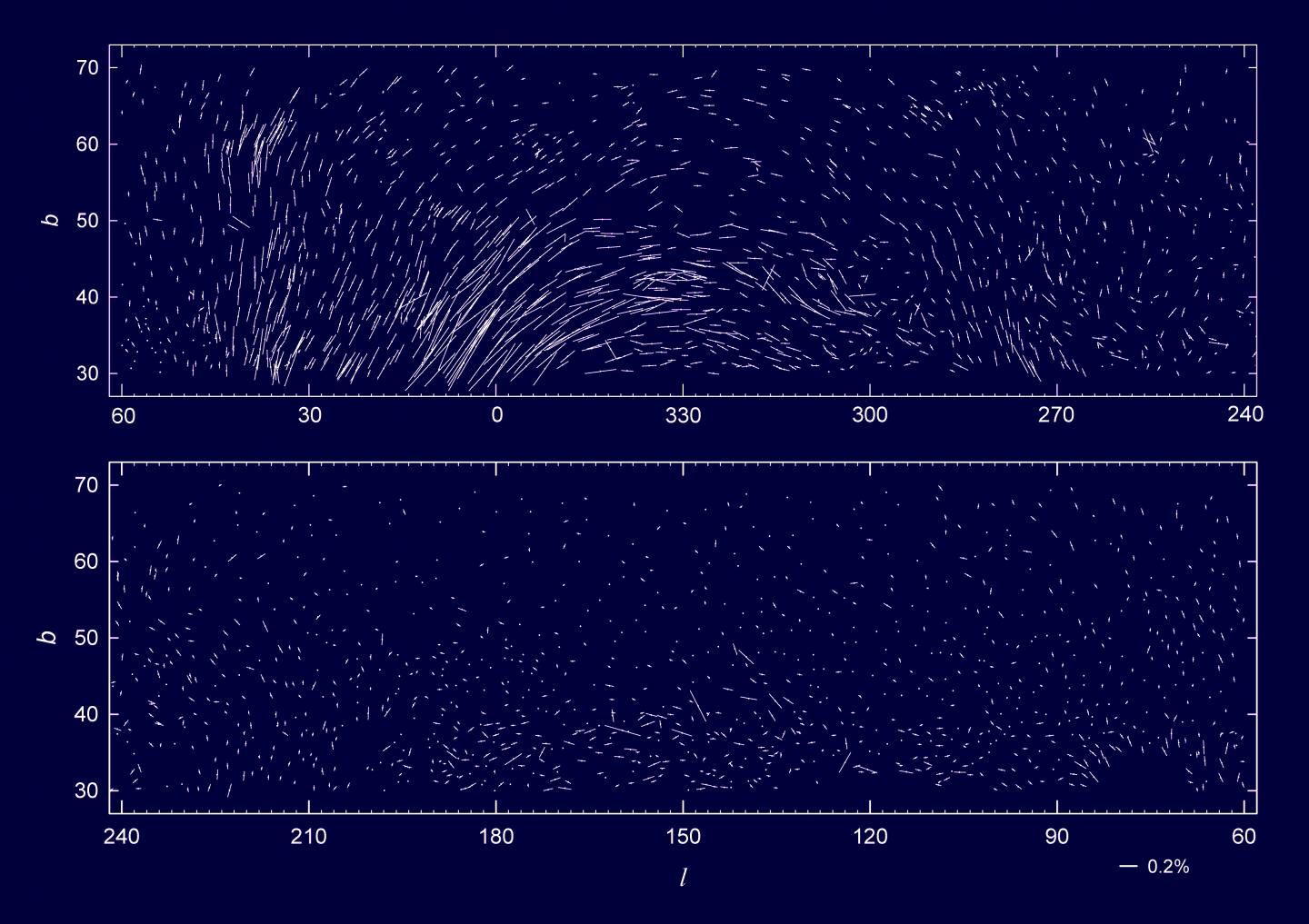
An international research team led by the Department of Physics and Astronomy at the University of Turku, Finland, mapped the interstellar magnetic field structure and interstellar matter distribution in the solar neighbourhood. The results of the study have been published in the esteemed European journal Astronomy & Astrophysics (A&A) in March.

Magnetic field has an important role in the processes of stellar and planetary system formation. The study led by Docent Vilppu Piirola and Docent Andrei Berdyugin is based on high-precision polarisation measurements. Starlight passing through interstellar clouds is polarised by scattering from dust particles aligned by the magnetic field.

— Polarisation means that electromagnetic oscillation is stronger in a specific direction that is perpendicular to the direction of motion of the light. The alignment of small, less than one micrometer in size, elongated dust particles is based on the same phenomenon as a compass needle aligning with the Earth’s magnetic field, although it is a more complicated process, explains Vilppu Piirola.

What makes the study particularly significant, is its connection with the results obtained from the Interstellar Boundary EXplorer (IBEX) orbiter sent to explore the interaction between the Sun and the magnetic field in the solar neighbourhood. The Sun and its magnetic field interact with the surrounding interstellar matter, and the solar wind creates a so-called local bubble where the matter density is low and only little dust exists. The task of the IBEX is to observe the interface between the Sun’s heliosphere and interstellar space and matter where the solar wind practically stops.

High-precision Equipment Reveal Magnetic Field Direction

The IBEX receives information of the interstellar magnetic field (ISMF) by observing energetic neutral atoms (e.g. neutral hydrogen) that pass through the heliospheric boundary. The ISMF direction, however, can be accurately determined only by polarisation measurements. High-precision equipment with polarisation detection sensitivity at the level of or better than 0.001 % (one part in hundred thousand) has been developed for these type of measurements at the Tuorla Observatory of the University of Turku.

Four telescopes have been used for the observations of this recently published study: two in Hawaii (Mauna Kea and Haleakala observatories), one in La Palma (Nordic Optical Telescope), and one in the southern hemisphere at the Greenhill Observatory of the University of Tasmania.

— The observations have revealed interesting magnetic filament structures both in the direction where our solar system is moving in relation to the surrounding interstellar space (heliosphere ‘nose’) and in the opposite direction (heliosphere ‘tail’). The filaments form ribbon-like arcs where dust particles and starlight polarisation have aligned with the direction of the magnetic field, says Piirola.

###

The results of the study have been published in the March issue of the esteemed European Astronomy & Astrophysics (A&A) journal. The article has also been selected as an A&A Highlight. The A&A Editors select particularly interesting papers as Highlights.

Media Contact
Docent Vilppu Piirola
[email protected]

Original Source

https://www.utu.fi/en/news/press-release/researchers-discover-new-information-on-interstellar-magnetic-field-in-solar-neighbourhood

Related Journal Article

http://dx.doi.org/10.1051/0004-6361/201937324

Tags: AstronomyAstrophysicsSpace/Planetary ScienceStars/The Sun
Share12Tweet8Share2ShareShareShare2

Related Posts

Researchers Develop High-Efficiency Hydrogen Separation Membranes Using Innovative ‘Mortar-and-Brick’ Design — Chemistry

Researchers Develop High-Efficiency Hydrogen Separation Membranes Using Innovative ‘Mortar-and-Brick’ Design

May 13, 2026
Green Electrosynthesis Paves the Way for Direct Amines Production from Atmospheric Nitrogen — Chemistry

Green Electrosynthesis Paves the Way for Direct Amines Production from Atmospheric Nitrogen

May 13, 2026

Decoding Life’s Chemistry: A Revolutionary Search Engine from Molecules to Meaning

May 13, 2026

How Olympic Weightlifting Harnesses the Barbell’s ‘Whip’ for Peak Performance #ASA190

May 13, 2026
Please login to join discussion

POPULAR NEWS

  • Research Indicates Potential Connection Between Prenatal Medication Exposure and Elevated Autism Risk

    842 shares
    Share 337 Tweet 211
  • New Study Reveals Plants Can Detect the Sound of Rain

    729 shares
    Share 291 Tweet 182
  • Salmonella Haem Blocks Macrophages, Boosts Infection

    62 shares
    Share 25 Tweet 16
  • Breastmilk Balances E. coli and Beneficial Bacteria in Infant Gut Microbiomes

    57 shares
    Share 23 Tweet 14

About

BIOENGINEER.ORG

We bring you the latest biotechnology news from best research centers and universities around the world. Check our website.

Follow us

Recent News

Wireless Wearable Sweat Sensor Enables Continuous Biomarker Monitoring

Unlocking Pancreatic Development and Cellular Plasticity

Unraveling Raf-MEK-ERK Pathway in Prostate Cancer

Subscribe to Blog via Email

Enter your email address to subscribe to this blog and receive notifications of new posts by email.

Join 82 other subscribers
  • Contact Us

Bioengineer.org © Copyright 2023 All Rights Reserved.

Welcome Back!

Login to your account below

Forgotten Password?

Retrieve your password

Please enter your username or email address to reset your password.

Log In
No Result
View All Result
  • Homepages
    • Home Page 1
    • Home Page 2
  • News
  • National
  • Business
  • Health
  • Lifestyle
  • Science

Bioengineer.org © Copyright 2023 All Rights Reserved.