• HOME
  • NEWS
  • EXPLORE
    • CAREER
      • Companies
      • Jobs
    • EVENTS
    • iGEM
      • News
      • Team
    • PHOTOS
    • VIDEO
    • WIKI
  • BLOG
  • COMMUNITY
    • FACEBOOK
    • INSTAGRAM
    • TWITTER
Sunday, October 4, 2026
BIOENGINEER.ORG
No Result
View All Result
  • Login
  • HOME
  • NEWS
  • EXPLORE
    • CAREER
      • Companies
      • Jobs
        • Lecturer
        • PhD Studentship
        • Postdoc
        • Research Assistant
    • EVENTS
    • iGEM
      • News
      • Team
    • PHOTOS
    • VIDEO
    • WIKI
  • BLOG
  • COMMUNITY
    • FACEBOOK
    • INSTAGRAM
    • TWITTER
  • HOME
  • NEWS
  • EXPLORE
    • CAREER
      • Companies
      • Jobs
        • Lecturer
        • PhD Studentship
        • Postdoc
        • Research Assistant
    • EVENTS
    • iGEM
      • News
      • Team
    • PHOTOS
    • VIDEO
    • WIKI
  • BLOG
  • COMMUNITY
    • FACEBOOK
    • INSTAGRAM
    • TWITTER
No Result
View All Result
Bioengineer.org
No Result
View All Result
Home NEWS Science News Biology

Researchers discover how protein can inhibit cancer development in mice

Bioengineer by Bioengineer
May 26, 2020
in Biology
Reading Time: 3 mins read
0
IMAGE
Share on FacebookShare on TwitterShare on LinkedinShare on RedditShare on Telegram

IMAGE

Credit: The University of Copenhagen

Proteins are found throughout our cells and regulate a lot of biological processes that are important forour survival. But some of them also regulate processes that can make us sick. Now, an international research team, with researchers from the University of Copenhagen at the forefront, has achieved a much better understanding of one such protein.

In a new study, the researchers discovered how the protein PP2A works at the molecular level, and how it inhibits the development of tumours in mice. The new results have been published in the scientific journal, the EMBO Journal.

‘We call PP2A a household protein because it is found almost everywhere. In everything living – from simple yeast cells to complex cells in humans. PP2A removes phosphate groups on other proteins, and now we have found these proteins and how PP2A, via one of these proteins, inhibits cancer development’, says Jakob Nilsson, Professor at the Novo Nordisk Foundation Center for Protein Research.

Turned-Off Enzyme

According to the researchers, there is a great deal of interest from both the academic research community and from the pharmaceutical industry for the protein PP2A because it is well-known that PP2A is a so-called tumour suppressor that suppresses tumours. But precisely which proteins PP2A regulates in order to inhibit cancer have so far not been known. Now, the researchers have gained detailed insight into this.

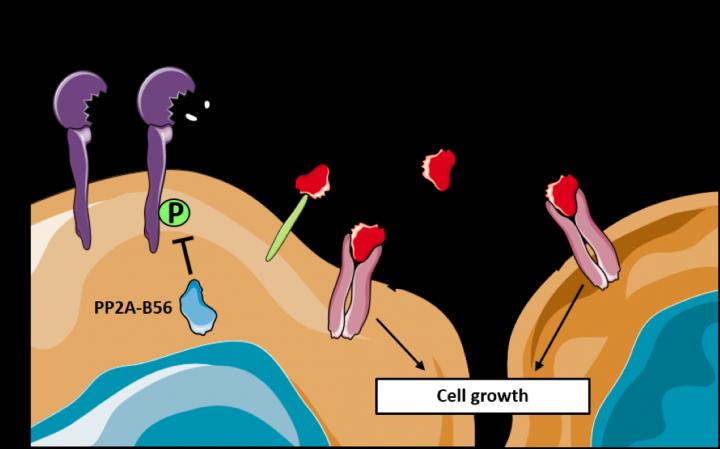
‘The new thing about our study is that we show how PP2A selects the phosphate groups that shall be removed from other proteins. And then at the same time, we show that PP2A turns off an enzyme named ADAM17. This shutdown of ADAM17 results in inhibition of tumour growth in mice’, explains Associate Professor Marie Kveiborg from the Biotech Research and Innovation Centre.

The researchers have used advanced methods to show that PP2A can turn off the activity of ADAM17 on the outside of the cell by removing phosphate groups from the part of ADAM17 that is located inside the cell.

The Function is Inhibited

Normally, ADAM17 sits as a pair of molecular scissors in the cell’s outer membrane and cleaves other proteins from the cell surface – for example, growth factors that will then stimulate cell growth. But that function ceases when PP2A removes the phosphate groups from ADAM17.

The researchers already knew from previous studies that ADAM17 stimulates a variety of cancers, including breast and bowel cancer. But this is the first time that PP2A has been shown to actively turn off ADAM17 activity.

Going forward, the researchers hope that their new cancer discovery will also apply to human tumoursFor now, the next step for the researchers is to clarify whether substances that activate PP2A can be used to regulate ADAM17 activity. In addition, the researchers also want to look at how PP2A regulates other proteins that may be important for the understanding of its tumour suppressor function.

###

Media Contact
Mathias Traczyk
[email protected]

Original Source

https://healthsciences.ku.dk/newsfaculty-news/2020/05/researchers-discover-how-protein-can-inhibit-cancer-development-in-mice/

Related Journal Article

http://dx.doi.org/10.15252/embj.2019103695

Tags: BiologyBreast CancercancerCell BiologyGenesGeneticsMedicine/Health
Share12Tweet8Share2ShareShareShare2

Related Posts

Simple Sugar Dextrose Emerges as Best Carbon Source for Zero-Exchange Shrimp Hatcheries

Simple Sugar Dextrose Emerges as Best Carbon Source for Zero-Exchange Shrimp Hatcheries

October 4, 2026
New Algorithm Simulates Gene Frequency Histories Exactly, Even as Populations Change Size

New Algorithm Simulates Gene Frequency Histories Exactly, Even as Populations Change Size

October 4, 2026

Touch-Sensing Piezo Channels Found to Steer the Cells That Build Our Teeth

October 4, 2026

Rumen Fluke Parasite Reveals Its Molecular Playbook Across Life Stages

October 4, 2026
Please login to join discussion

POPULAR NEWS

  • Alloys That Shrink Their Own Grains: New PIX Mechanism Refines Metals With Heat Alone

    Alloys That Shrink Their Own Grains: New PIX Mechanism Refines Metals With Heat Alone

    29 shares
    Share 12 Tweet 7
  • Endurance Exercise Reshapes the Liver in Males and Females Through Distinct Molecular Routes

    29 shares
    Share 12 Tweet 7
  • Single Transcription Factor PU.1 Rapidly Converts Fibroblasts into Macrophage-Lineage Cells

    29 shares
    Share 12 Tweet 7
  • New Scale Measures How Ready Nurse Educators Really Are for the AI Era

    29 shares
    Share 12 Tweet 7

About

We bring you the latest biotechnology news from best research centers and universities around the world. Check our website.

Follow us

Recent News

Alloys That Shrink Their Own Grains: New PIX Mechanism Refines Metals With Heat Alone

Endurance Exercise Reshapes the Liver in Males and Females Through Distinct Molecular Routes

Single Transcription Factor PU.1 Rapidly Converts Fibroblasts into Macrophage-Lineage Cells

Subscribe to Blog via Email

Enter your email address to subscribe to this blog and receive notifications of new posts by email.

Join 85 other subscribers
  • Contact Us

Bioengineer.org © Copyright 2023 All Rights Reserved.

Welcome Back!

Login to your account below

Forgotten Password?

Retrieve your password

Please enter your username or email address to reset your password.

Log In
No Result
View All Result
  • Homepages
    • Home Page 1
    • Home Page 2
  • News
  • National
  • Business
  • Health
  • Lifestyle
  • Science

Bioengineer.org © Copyright 2023 All Rights Reserved.