• HOME
  • NEWS
  • EXPLORE
    • CAREER
      • Companies
      • Jobs
    • EVENTS
    • iGEM
      • News
      • Team
    • PHOTOS
    • VIDEO
    • WIKI
  • BLOG
  • COMMUNITY
    • FACEBOOK
    • INSTAGRAM
    • TWITTER
Sunday, August 23, 2026
BIOENGINEER.ORG
No Result
View All Result
  • Login
  • HOME
  • NEWS
  • EXPLORE
    • CAREER
      • Companies
      • Jobs
        • Lecturer
        • PhD Studentship
        • Postdoc
        • Research Assistant
    • EVENTS
    • iGEM
      • News
      • Team
    • PHOTOS
    • VIDEO
    • WIKI
  • BLOG
  • COMMUNITY
    • FACEBOOK
    • INSTAGRAM
    • TWITTER
  • HOME
  • NEWS
  • EXPLORE
    • CAREER
      • Companies
      • Jobs
        • Lecturer
        • PhD Studentship
        • Postdoc
        • Research Assistant
    • EVENTS
    • iGEM
      • News
      • Team
    • PHOTOS
    • VIDEO
    • WIKI
  • BLOG
  • COMMUNITY
    • FACEBOOK
    • INSTAGRAM
    • TWITTER
No Result
View All Result
Bioengineer.org
No Result
View All Result
Home NEWS Science News Chemistry

Researchers detects chiral structures using vortex light

Bioengineer by Bioengineer
March 2, 2021
in Chemistry
Reading Time: 2 mins read
0
IMAGE
Share on FacebookShare on TwitterShare on LinkedinShare on RedditShare on Telegram

IMAGE

Credit: NI Jin

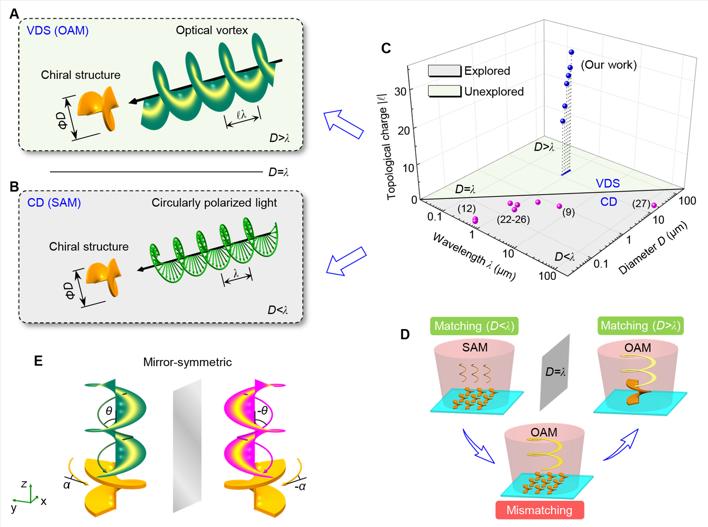
Recently, the Laboratory of Micro and Nano Engineering, School of Engineering Science, University of Science and Technology of China (USTC) has made important progress in the field of structural chirality detection research using vortex light and found that photon orbital angular momentum can efficiently detect the optical chiral signal of structures.

The achievement was published in an international well-known journal PNAS.

Chiral structures are widely found in nature, such as DNA double helix structures, plant tendrils and shells. In addition to observing the geometry of objects, their chirality can also be distinguished by the interaction of light with matter. For example, the detection of circular dichroism spectra can be achieved by studying the different optical response of structures to left and right spin circularly polarized light through the interaction of photon spin angular momentum with matter.

Similarly, can photon orbital angular momentum, which also has chiral characteristics, be used to detect chiral structures and how can the significant optical response signal be obtained?

To address the above scientific questions, the team found that the vortex light contains a helical phase (photon orbital angular momentum) that can interact with the chiral microstructure to produce significant vortex differential scattering by matching the size of the beam and the chiral structure.

It was found that the region of structure size versus operational wavelength where the vortex differential scattering peak is located lies in a region previously unexplored by the circular dichroism response and allows for monochromatic light detection.

The work also investigates the relationship between the vortex difference scattering spectrum and the geometry of the helical structure, as well as the means to enhance the detection signal of chiral molecules.

This technique is expected to provide a novel detection method in the field of subsequent chiral light-matter interaction studies.

###

Media Contact
Jane FAN Qiong
[email protected]

Related Journal Article

http://dx.doi.org/10.1073/pnas.2020055118

Tags: Chemistry/Physics/Materials SciencesOpticsResearch/DevelopmentTechnology/Engineering/Computer Science
Share12Tweet8Share2ShareShareShare2

Related Posts

Scientists uncover design rules for high-performance thermoelectric materials

Scientists uncover design rules for high-performance thermoelectric materials

August 22, 2026
Bringing Optical Fibre Materials to Photonic Chips

Bringing Optical Fibre Materials to Photonic Chips

August 22, 2026

Nanoscience and Liquid Crystals Unite in Functional Hybrids With Transformative Applications

August 22, 2026

Designing Better Biomedical Hydrogels Through Molecular Building Blocks and Hierarchical Structures

August 22, 2026
Please login to join discussion

POPULAR NEWS

  • Blocking glucosylceramide production kills cancer cells via lysosomal dysfunction, not ceramide buildup

    29 shares
    Share 12 Tweet 7
  • ZCCHC4 boosts replication-dependent histone mRNA translation by interacting with eIF3

    29 shares
    Share 12 Tweet 7
  • KAIST Surface Defects Boost Droplet Formation, Removal, and Heat Transfer by 5.5-Fold

    29 shares
    Share 12 Tweet 7
  • Dual-oxygen pancreatic cancer organoids mirror basal-classical diversity, spatial transcriptomics confirms

    29 shares
    Share 12 Tweet 7

About

We bring you the latest biotechnology news from best research centers and universities around the world. Check our website.

Follow us

Recent News

Blocking glucosylceramide production kills cancer cells via lysosomal dysfunction, not ceramide buildup

ZCCHC4 boosts replication-dependent histone mRNA translation by interacting with eIF3

KAIST Surface Defects Boost Droplet Formation, Removal, and Heat Transfer by 5.5-Fold

Subscribe to Blog via Email

Enter your email address to subscribe to this blog and receive notifications of new posts by email.

Join 85 other subscribers
  • Contact Us

Bioengineer.org © Copyright 2023 All Rights Reserved.

Welcome Back!

Login to your account below

Forgotten Password?

Retrieve your password

Please enter your username or email address to reset your password.

Log In
No Result
View All Result
  • Homepages
    • Home Page 1
    • Home Page 2
  • News
  • National
  • Business
  • Health
  • Lifestyle
  • Science

Bioengineer.org © Copyright 2023 All Rights Reserved.