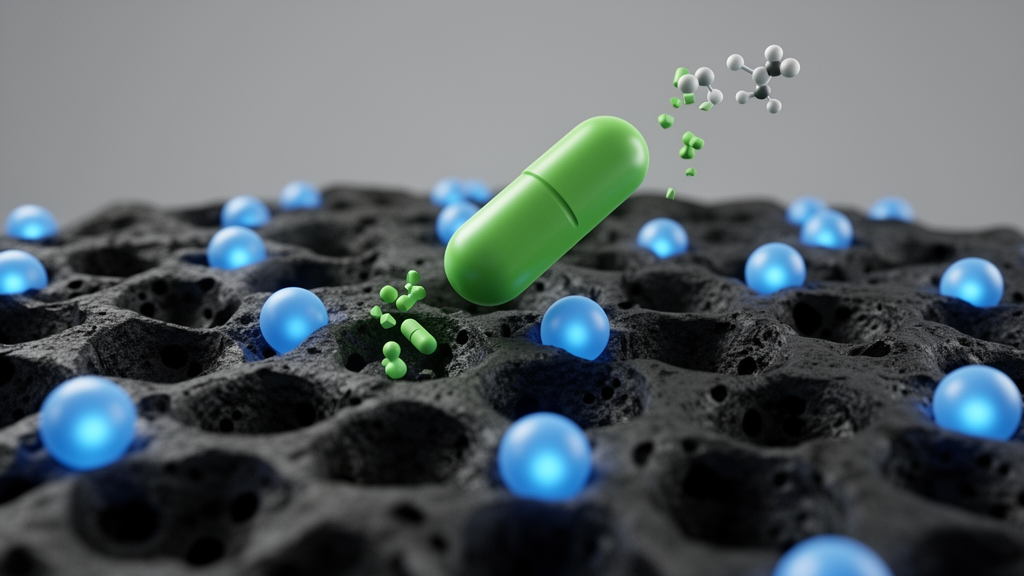
Antibiotic residues in rivers, lakes, and wastewater effluents have become one of the most stubborn pollution problems of the modern age, and one of the most dangerous. When drugs like levofloxacin slip through conventional treatment plants, they do not simply vanish. They linger at low concentrations, quietly training bacteria to resist the very medicines designed to kill them. Now, a study published in Catalysis Letters by Zheng Huang of Xiangtan Iron & Steel Group and Liang Zhou of East China University of Science and Technology offers a strikingly elegant answer: a metal-free carbon catalyst, grown from a covalent organic framework, that shreds this antibiotic with remarkable speed, stability, and precision.
The material, dubbed NOC-900, was synthesized through a deceptively simple two-step process of hydrothermal treatment followed by high-temperature calcination. What makes it special is not the recipe but the architecture it inherits. Covalent organic frameworks, or COFs, are crystalline lattices built entirely from light elements, stitched together by strong covalent bonds into porous, ordered structures. When such a framework is carbonized, much of that order collapses, but a chemical memory persists: nitrogen atoms remain embedded within the graphite-like carbon network in well-defined bonding configurations. In NOC-900, the dominant configuration is what the researchers call graphite-N-C₃, a nitrogen atom bonded to three carbon atoms within the graphitic lattice, sitting at the edge of the carbon planes like a single impurity atom in an otherwise perfect crystal.
That tiny structural detail turns out to be the whole story. When NOC-900 was added to water containing levofloxacin along with peroxymonosulfate, or PMS, a common oxidizing salt used in advanced oxidation processes, the antibiotic all but disappeared. Within sixty minutes, 97.6 percent of the levofloxacin had been removed. Even more impressive, the catalyst kept working: after five consecutive use-and-regeneration cycles, it still destroyed more than 80 percent of the pollutant, a level of durability that many metal-based catalysts struggle to match.
The system also shrugged off conditions that would cripple lesser catalysts. Real wastewater is a chemical minefield, full of dissolved salts, varying acidity, and competing organic matter. Yet the NOC-900/PMS pair maintained outstanding degradation performance across a pH range stretching from 3.16 to 10.50, and it continued to function in complex water matrices laced with ionic interference. For engineers dreaming of industrial deployment, that robustness matters as much as raw speed, because a catalyst that only works in ultrapure laboratory water is a catalyst that will never clean a real river.
But the central question the study set out to answer was mechanistic: which part of this complicated carbon material actually does the chemistry? Carbon catalysts are notoriously messy, a patchwork of defects, edges, oxygen groups, and nitrogen dopants, and pinpointing the true active site has long frustrated the field. Through a battery of characterization techniques, including X-ray photoelectron spectroscopy to map nitrogen species, electron paramagnetic resonance to spy on reactive intermediates, and quenching experiments with selective scavengers such as furfuryl alcohol, tert-butanol, and p-benzoquinone, the researchers converged on a clear verdict. The graphite-N-C₃ sites are intimately responsible for the system’s signature move: the highly selective production of singlet oxygen.
Singlet oxygen is an unusual weapon in the oxidation arsenal. Unlike hydroxyl radicals or sulfate radicals, which are brute-force, short-lived, and indiscriminate, singlet oxygen is a non-radical, electrophilic species that attacks electron-rich organic molecules with surgical selectivity. That selectivity explains why the NOC-900/PMS system performs so well in real water: radicals would be squandered instantly on chloride ions, bicarbonate, and natural organic matter, while singlet oxygen largely ignores these distractions and goes after the antibiotic. The non-radical pathway also means the catalyst does not depend on metal centers cycling through oxidation states, which is why no cobalt, iron, or manganese leaching complicates the picture. It is catalysis by geometry and electronics alone.
The team did not stop at destruction. Using high-performance liquid chromatography coupled with mass spectrometry, they tracked the intermediate molecules produced as levofloxacin broke apart, mapped the bonds that were cleaved first, and proposed plausible degradation pathways. Critically, they also assessed toxicity along the way, and the news was reassuring: most of the intermediates formed during degradation were more environmentally benign than the parent antibiotic. In other words, the process does not merely convert one invisible pollutant into a nastier one, a pitfall that has undermined other advanced oxidation schemes, but genuinely defuses the molecule’s biological threat as it dismantles it.
The choice of a COF precursor is what gives this approach its conceptual punch. Because COFs are built from molecular building blocks, chemists can, in principle, design the nitrogen environment of the resulting carbon before it ever exists, choosing monomers that place pyridinic, pyrrolic, or graphitic nitrogen exactly where they want it. NOC-900 demonstrates that this design philosophy works for environmental catalysis: the graphite-N-C₃ motif, inherited from the framework’s atomic precision, survives carbonization and becomes the engine of PMS activation. Previous work has shown COF-derived carbons carrying cobalt particles or other metal complexes activating PMS for levofloxacin degradation; this study proves the metal can be left out entirely.
The broader implications ripple outward in several directions. For water treatment, a durable, wide-pH, salt-tolerant, metal-free catalyst addresses many of the practical objections to peroxymonosulfate-based advanced oxidation, from secondary metal contamination to sensitivity to water chemistry. For catalysis science, the study adds a precise entry to the still-incomplete catalog of which nitrogen configurations in carbon do what, sharpening the field’s ability to move from empirical materials screening to rational design. And for the growing literature on non-radical oxidation, it supplies another well-documented case in which singlet oxygen, generated selectively at a defined site, outperforms the radical free-for-all that dominated the field for decades.
There remain, of course, the usual distances between a laboratory beaker and a municipal treatment tank: catalyst synthesis at scale, PMS dosing economics, and long-term performance under continuous flow all await demonstration. But the foundations laid here are solid. By showing that a single nitrogen bonding motif in a carbon lattice can choreograph the selective birth of singlet oxygen and the near-total destruction of a fluoroquinolone antibiotic, Huang and Zhou have turned an abstract materials-chemistry question into a concrete blueprint. The next generation of pollution-fighting carbons may well be designed atom by atom before a single gram of catalyst is ever made.
Subject of Research: Metal-free COF-derived carbon catalysts with graphite-N-C₃ sites activating peroxymonosulfate to degrade levofloxacin via singlet oxygen
Article Title: Mechanistic Insights into Antibiotic Degradation by Covalent Organic Framework-Derived Carbon: Role of Graphite-N-C3 Active Sites
Article References: Mechanistic Insights into Antibiotic Degradation by Covalent Organic Framework-Derived Carbon: Role of Graphite-N-C3 Active Sites. (n.d.). https://doi.org/10.1007/s10562-026-05543-w
Image Credits: AI Generated
DOI: 10.1007/s10562-026-05543-w
Keywords: covalent organic frameworks, peroxymonosulfate, levofloxacin, singlet oxygen, graphitic nitrogen, water treatment, advanced oxidation processes, non-radical oxidation, carbon catalysts, antibiotic pollution, degradation intermediates, toxicity assessment
News Source: Bethany Barker. (October 8, 2026). Hidden Nitrogen Sites Turn Simple Carbon Into a Powerful Antibiotic-Degrading Catalyst. Scienmag.