Analyses of the materials in the scrolls helps put the object into an historical context and guides conservators in future restoration efforts
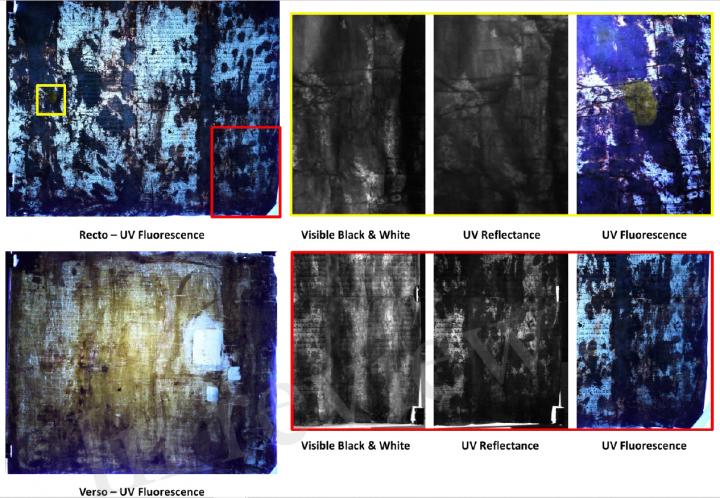
Credit: The authors
A picture may be worth a thousand words, but capturing multiple images of an artifact across the electromagnetic spectrum can tell a rich story about the original creation and degradation of historical objects over time. Researchers recently demonstrated how this was possible using several complementary imaging techniques to non-invasively probe a Jewish parchment scroll. The results were published in the journal Frontiers in Materials.
A team of scientists from Romania’s National Institute for Research and Development in Optoelectronics extracted details about the manuscript’s original materials and manufacturing techniques employing various spectroscopic instruments. These specialized cameras and devices capture images that the human eye normally can’t see.
“The goal of the study was … to understand what the passing of time has brought upon the object, how it was degraded, and what would be the best approach for its future conservation process,” explained Dr Luminita Ghervase, a co-author on the paper and research scientist at the institute.
The manuscript the team investigated was a poorly preserved but sacred scroll containing several chapters of the Book of Esther from the Hebrew Bible. An artifact from a private collection, little was known of the object’s provenance or history.
“The use of complementary investigation techniques can shed light on the unknown history of such an object,” Ghervase noted. “For some years now, non-invasive, non-destructive investigation techniques are the first choice in investigating cultural heritage objects, to comply with one of the main rules of the conservation practice, which is to not harm the object.”
One of the more common imaging techniques is multispectral imaging, which involves scanning an object within specific parts of the electromagnetic spectrum. Such images can show otherwise invisible details about the manuscript’s wear and tear. Different ultraviolet modes, for example, revealed a dark stain on the scroll that might indicate a repair using an organic material such as a resin, because the spot strongly absorbs UV light.
A related technique, hyperspectral imaging, was used to determine the material basis of the ink on the aged parchment. The scientists detected two distinct types of ink, another indication that someone may have attempted to repair the item in the past. They also used a computer algorithm to help characterize the spectral signals of individual pixels to further discriminate the materials – a method that holds promise for reconstructing the text itself.
“The algorithm used for materials classification has the potential of being used for identifying traces of the ink to infer the possible original shape of the letters,” Ghervase said.
The team also employed an imaging technique known as x-ray fluorescence (XRF), which can identify the kinds of chemicals used in both the ink and the manufacturing of the parchment. For instance, the XRF found rich concentrations of zinc, a chemical often linked to the bleaching process, but possibly another indication of past restoration efforts. Finally, the scientists employed a Fourier-transform infrared (FTIR) spectrometer to identify other chemicals present using an infrared light source to measure absorption. Specifically, the FTIR analysis provided an in-depth view regarding the deterioration rate of the collagen in the scroll, which is made from animal skin, among other insights.
Employing these various imaging techniques to dissect the parchment could help conservators restore the object closer to its original condition by identifying the materials used to create it.
“They can wisely decide if any improper materials had been used, and if such materials should be removed,” Ghervase said. “Moreover, restorers can choose the most appropriate materials to restore and preserve the object, ruling out any possible incompatible materials.”
###
Media Contact
Mischa Dijkstra
[email protected]
Related Journal Article
http://dx.