New study details the molecular-level design of materials that enable clean and sustainable water evaporation energy to be harvested and efficiently converted into motion with the potential to power future mechanical devices and machines
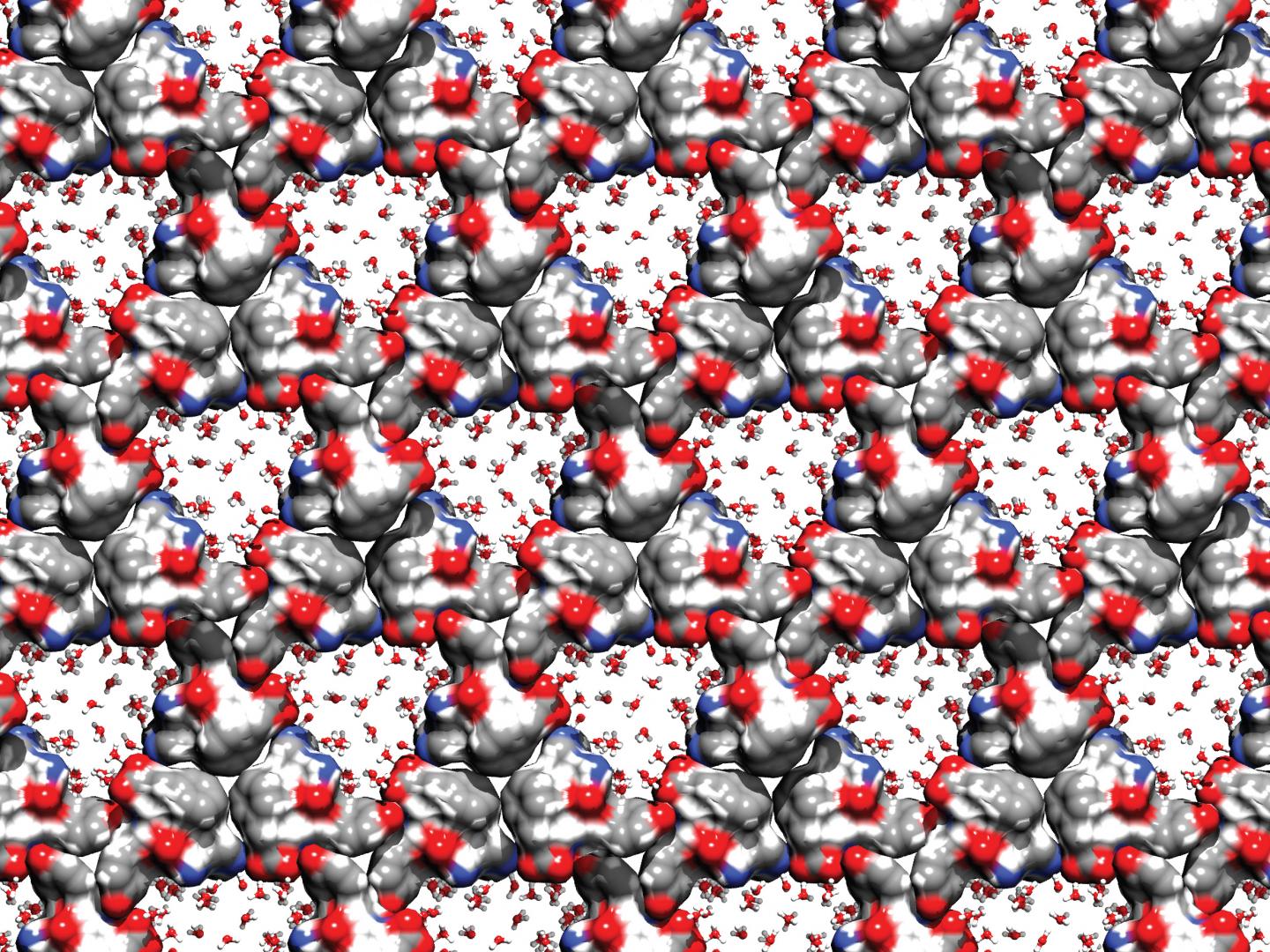
Credit: Tony Wang
NEW YORK, September 14, 2020 — Water evaporation, as observed when a puddle of water disappears on a summer day, is a remarkably powerful process. If it were harnessed, the process could provide a clean source of energy to power mechanical machines and devices. In a newly published paper in Nature Materials, an international team of scientists led by researchers at the Advanced Science Research Center at the Graduate Center, CUNY (CUNY ASRC) details the development of shape-shifting crystals that directly convert evaporation energy into powerful motions.
These water-responsive materials were created by using simple variants of biological building blocks, known as tripeptides, to create crystals that are simultaneously stiff and morphable. The materials are composed of three-dimensional patterns of nanoscale pores where water tightly binds, and these pores are interspersed with a molecular network of stiff and flexible regions. When humidity is lowered and reaches a critical value, the water escapes from the pores leading to a powerful contraction of the interconnected network. This results in the crystals temporarily losing their ordered patterns until humidity is restored and the crystals regain their original shape. This newly designed process can be repeated over and over and gives rise to a remarkably efficient method of harvesting evaporation energy to perform mechanical work.
“We essentially created a new type of actuator, which is driven by water evaporation,” said Graduate Center Ph.D. student Roxana Piotrowska, the study’s first author and a researcher at the CUNY ASRC Nanoscience Initiative. “By observing its activity we’ve been able to identify the fundamental mechanisms of how water-responsive materials can efficiently convert evaporation into mechanical energy.”
“Our work enables the direct observation of materials’ evaporation-driven actuation at the molecular scale,” said the study’s corresponding author Xi Chen, whose lab with CUNY ASRC Nanoscience Initiative co-led the research. “By learning how to efficiently extract energy from evaporation, and turn it into motion, better and more efficient actuators can be designed for many applications, including evaporation energy harvesting devices.”
“Importantly, our designed crystals are produced from the exact same building blocks that proteins are made of, but they are radically simplified and as a result, their properties can be precisely tuned and rationally optimized for this application,” said CUNY ASRC Nanoscience Initiative Director Rein Ulijn, whose lab, which co-led the work, is responsible for the biomolecular design aspects of the research. “The beauty of using biological building blocks to create this new technology is that the resulting morphogenic crystals are biocompatible, biodegradable, and cost-effective.”
By using a combination of laboratory-based experiments and computer simulations, the researchers were able to identify and study the factors that control the actuation of these crystals. This approach resulted in new insights that inform the design of more efficient ways to use evaporation for a variety of applications, which may include robotic components or mechanical micro- and nano-machines that are powered by water evaporation.
###
This study was executed in collaboration with researchers at the University of Strathclyde in Glasgow, Scotland, and New York University. The work was supported with funding from the Office of Naval Research, the Air Force Office of Scientific Research, National Science Foundation, and the United Kingdom’s Engineering and Physical Sciences Research Council.
About the Advanced Science Research Center
The ASRC elevates scientific research and education at CUNY and beyond through initiatives in five distinctive, but increasingly interconnected disciplines: environmental sciences, nanoscience, neuroscience, photonics, and structural biology. The ASRC promotes a collaborative, interdisciplinary research culture with renowned researchers from each of the initiatives working side-by-side in the ASRC’s core facilities, sharing equipment that is among the most advanced available.
About The Graduate Center of The City University of New York
The Graduate Center of The City University of New York is a leader in public graduate education devoted to enhancing the public good through pioneering research, serious learning, and reasoned debate. The Graduate Center offers ambitious students more than 40 doctoral and master’s programs of the highest caliber, taught by top faculty from throughout CUNY — the world’s largest public urban university. Through its nearly 40 centers, institutes, and initiatives, The Graduate Center influences public policy and discourse and shapes innovation. The Graduate Center’s extensive public programs make it a home for culture and conversation.
Media Contact
Shawn Rhea
[email protected]
Related Journal Article
http://dx.