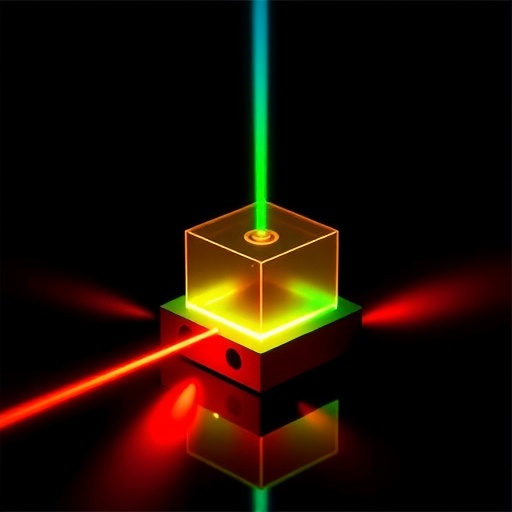
Researchers at the University of Turku in Finland have created a solid-state organic laser microcavity entirely through solution processing, demonstrating that sophisticated polariton laser physics may no longer require the costly, vacuum-based manufacturing techniques traditionally associated with advanced photonic devices. The experimental platform combines low-complexity fabrication with strong light–matter coupling, a regime in which photons and molecular excitations merge to form hybrid quasiparticles known as polaritons. The result is a solution-processed laser that does more than emit light: it offers a visible window into nonlinear interactions between light and matter.
Lasers are central to technologies ranging from telecommunications and medical diagnostics to industrial sensing, optical data storage and scientific instrumentation. Yet many high-performance laser structures depend on carefully engineered layers deposited under vacuum, often using energy-intensive equipment and tightly controlled manufacturing conditions. Organic materials can provide an attractive alternative because they are lightweight, chemically tunable and compatible with printing or coating methods. Their practical promise, however, depends on whether they can be integrated into optical cavities with sufficiently low losses and high precision to support advanced light-confinement effects.
The new device addresses that challenge by using spin coating to build every essential component of the microcavity. In spin coating, a liquid solution containing the desired material is placed on a rotating substrate. Centrifugal forces spread the solution into a thin, uniform film, while evaporation leaves behind a solid layer. By repeating the process with carefully selected materials, the researchers fabricated both the cavity mirrors and the organic light-emitting layer without relying on vacuum deposition. The approach is comparatively simple, scalable and compatible with solution-processable materials that could eventually be adapted for larger-area photonic manufacturing.
At the heart of the device is an optical microcavity, a structure designed to confine light between reflective mirrors. When the cavity is tuned correctly, photons can bounce back and forth many times, increasing their interaction with the organic molecules inside the structure. Under ordinary conditions, light is emitted by molecules and then escapes or propagates independently. In the strong light–matter coupling regime, the interaction becomes sufficiently intense and rapid that the photon and molecular excitation can no longer be treated as separate entities. Instead, they form new energy states called polaritons.
This hybrid character gives polaritons unusual properties. They inherit the low effective mass and ability to move rapidly associated with photons, while also retaining some of the interaction and material sensitivity of molecular excitations. When many polaritons occupy the same quantum state, they can produce highly directional and coherent emission resembling lasing. Unlike a conventional laser, in which stimulated emission is dominated by photons acting on excited atoms or molecules, a polariton laser is governed by the collective behaviour of these mixed light–matter states. The University of Turku team was able to observe this form of lasing in a fully solid-state structure made through liquid-based processing.
The researchers also discovered a striking optical response when the device was driven with intense pulsed light. Rather than remaining concentrated near the centre of the optically excited region, the emitted light redistributed outward and developed a ring-shaped pattern. This effect is linked to nonlinear polariton interactions, which become important as the density of polaritons increases. Polaritons can influence one another through their matter component, altering the local energy landscape and causing them to move away from regions of high density. What begins as a microscopic interaction therefore appears as a macroscopic transformation in the shape of the emitted beam.
The ring-like emission was reversible and could be adjusted by changing the optical design of the cavity. Small modifications to the cavity structure can alter the photon energy, the strength of light–matter coupling and the rate at which polaritons propagate or escape. This tunability gives the researchers a practical method for controlling nonlinear behaviour without changing the underlying organic material. Such visual and controllable effects could make the platform particularly valuable for studying polariton physics, because complex interactions become directly observable through the geometry and intensity of the emitted light.
The demonstration is significant not only because it produces a new type of organic laser, but also because it lowers the barrier to experiments in a rapidly developing field. Polariton devices have attracted interest for their potential in low-energy optical computing, nonlinear signal processing, switches and other forms of photonic technology. Many experimental systems, however, require elaborate fabrication facilities and highly specialized materials. A microcavity that can be assembled through solution processing could make polariton research more accessible to laboratories and manufacturing environments that do not possess sophisticated vacuum-deposition infrastructure.
The researchers emphasize that the current device remains an optically pumped laboratory system, meaning that an external laser is required to provide the energy needed for emission. The longer-term goal is to develop organic polariton lasers that can be driven electrically, which would be an important step toward practical devices. Electrical operation introduces additional challenges, including efficient charge injection, management of heat and preservation of strong light–matter coupling under operating conditions. Nevertheless, the new result shows that a liquid-based fabrication route can produce the optical quality needed for polariton lasing and nonlinear emission effects, offering a promising foundation for future organic photonic technologies.
Subject of Research: Fully solution-processed organic microcavity laser operating in the strong light–matter coupling regime
Article Title: A fully solution-processed organic microcavity laser in the strong light-matter coupling regime
Web References: https://doi.org/10.1038/s41467-026-75118-1
References: Nature Communications, DOI: 10.1038/s41467-026-75118-1
Image Credits: Mikael Nyberg
Keywords
Organic laser, polariton laser, solution processing, microcavity, strong light–matter coupling, nonlinear photonics, spin coating, organic photonics, University of Turku, Nature Communications
Tags: advancements in organic laser materialshybrid light-matter quasiparticleslow-cost laser production methodsnonlinear light-matter interactionsorganic microcavity laser fabricationpolariton laser physics in solid-state devicesscalable photonic device fabricationsolution-based photonic device manufacturingsolution-processed organic laser technologysolution-processed polariton laserspin coating for microcavity constructionvacuum-free manufacturing of optical components