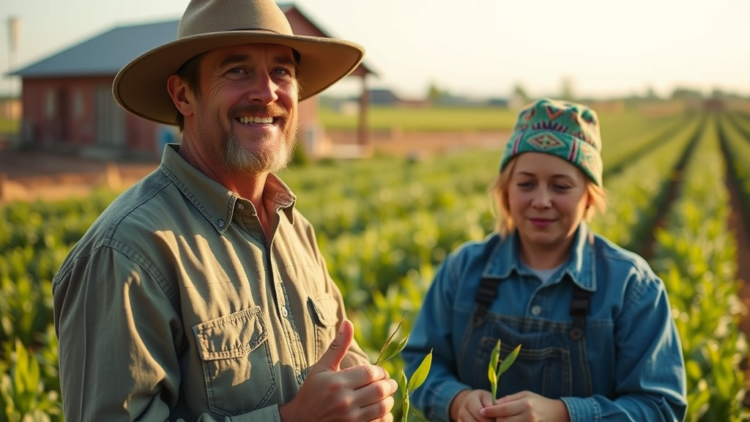
Across the United States, the farming population is aging out of agriculture faster than new growers are arriving, and many of the newcomers stepping into the gap have no farming parents, no inherited land, and no generational playbook to fall back on. A new study published in Discover Agriculture examines a small but strategically important slice of this cohort: first-generation farmers running small-acreage commercial operations in the American West. Led by Michael Pierce of the University of Missouri and the University of Arizona, together with Rebecca Mott and Jaron VanHouden, the research asks a deceptively simple question: why would anyone voluntarily enter a profession defined by negative net farm income, volatile markets, and crushing workloads? The answer, drawn from in-depth phenomenological interviews, turns out to have almost nothing to do with money and nearly everything to do with identity.
The study arrives at a moment when the structural data alone would seem to discourage anyone from starting a farm. The 2022 U.S. Census of Agriculture shows that many beginning farmers depend heavily on off-farm income, and small-scale farms frequently report negative or minimal net income. Land access, start-up capital, regulatory complexity, and market consolidation stack the odds against new entrants. Yet people keep coming, often after careers in engineering, food wholesale, or hospitality. Understanding what draws them in, and what keeps them hanging on once the romantic expectations collide with reality, has become a pressing question for rural economies that need new producers to sustain local food systems and to carry agricultural knowledge forward as older farmers retire.
Most previous research on beginning farmers has been quantitative, measuring farm income, program participation, or land tenure rates. Pierce and his colleagues took a deliberately different path. They used Heideggerian phenomenology, a philosophical approach rooted in Martin Heidegger’s concept of Dasein, or being-in-the-world, which holds that human meaning emerges through engagement with cultural, historical, and social contexts. Rather than treating the decision to farm as an economic calculation to be modeled, the researchers treated it as a lived experience to be interpreted. The choice of method was not academic decoration. The authors argue that survey instruments cannot easily capture the complexity, ambiguity, and emotional texture of why people farm, and that phenomenology is designed precisely for questions where conventional economic explanations fall short.
The study involved three participants, recruited through purposive sampling, each operating a small commercial farm in Yavapai County, Arizona, and each identifying as first-generation. Three participants may sound like a strikingly small sample, but the authors defend it as a deliberate methodological choice consistent with phenomenological inquiry, which prioritizes depth over statistical generalization. Citing a systematic review by Bartholomew and colleagues on sample sizes in qualitative research, they argue that larger samples risk producing a cacophony of voices in which individual meaning is lost, while a small focused sample allows each account to be heard with clarity. Interviews were conducted in person on the participants’ farms, followed by Zoom conversations, and analyzed through an interpretive process that began with repeated transcript readings and horizontalization, treating all significant statements as equally valuable before clustering them into patterns of meaning.
The analysis produced two overarching patterns. The first the researchers call farming as an existential commitment. Participants did not describe farming as something they did but as part of who they were. Jon, a former food wholesaler, put it bluntly: I’m a farmer now. That’s who I am. Even if we lose everything, that won’t change. Elena, a mother of four adult children, could not imagine a future outside agriculture even hypothetically, describing an alternative career only as farming adjacent, perhaps teaching or helping farmers. Marcus, a former mechanical engineer, described finding belonging on his land: I finally feel like I belong somewhere. This land makes sense to me. For these farmers, identity had fused with the work itself, a finding the authors link to Heidegger’s insight that meaning arises through engaged, situated activity rather than detached reflection.
The second thread within that existential pattern was responsibility, expressed most vividly through feeding others. Marcus described selling vegetables at his farm stand as nourishing people he cares about rather than merely completing a transaction. Elena described weekly donations to a local food bank as the best part of the work, saying that knowing someone will eat tonight because of her is what she called real. The researchers interpret these accounts as evidence that farming was embedded in relational, ethical frameworks extending far beyond profit. A parallel sub-pattern involved stewardship of the land itself. Elena planted cover crops and minimized chemical inputs because she wanted the soil to be better after she was gone, while Jon described a reciprocal relationship with his land, learned while working alongside his late father, in which taking care of the land meant the land took care of you. Farming even restructured how participants perceived time; Jon noted that the equinox had become significant to him in a way it never had before, and that being a farmer felt like being part of something ancient and necessary.
The second broad pattern was considerably darker: a life shaped by tension and tradeoffs. Financial uncertainty was described not as an occasional crisis but as a permanent condition. Jon, comparing his current life to his previous career in food wholesale, said this was the poorest he had been in his life, having made more money doing just about anything else, and yet immediately added that he liked what he was doing. Every year, he said, he wonders whether it will be the year they have to quit, but so far they are hanging on. Elena framed the same tension with economy: we don’t farm for the paycheck, we farm in spite of it, recounting gopher damage to a garlic crop and the loss of a greenhouse top in a windstorm. Farming also immersed participants completely; Elena could not remember her last real vacation, because the farm does not stop. Marcus summarized the dual character of this immersion, saying farming becomes your life, not just your job.
Perhaps the most unexpected finding concerns administrative labor. Participants described spending substantial portions of their weeks on paperwork, emails, invoices, marketing, and chasing payments, work that pulled them away from the tasks that had drawn them to farming in the first place. Elena estimated at least a day a week devoted to administration and noted that because her husband struggled with these tasks, the burden fell on her, an uneven distribution within the farm household. Jon joked that he had not realized he was starting a business when he decided to start a farm. Alongside this bureaucratic drag came social isolation. Jon described missing birthdays and weddings until people stopped inviting him, and Marcus said he sometimes forgot what it was like to hang out with people. The authors carefully distinguish this isolation from the meaningful solitude participants also treasured, such as Marcus’s quiet mornings harvesting before sunrise, noting that the same aloneness could be restorative or corrosive depending on its extent.
The study’s implications are practical rather than merely philosophical. Because the findings rest on three participants in one regional context, the authors explicitly caution against generalization. But the pattern they describe, in which identity, financial pressure, and isolation intersect, resonates with a growing scholarly literature documenting elevated rates of stress, anxiety, depression, and suicide among farming populations. When farming becomes central to a person’s sense of self, the authors argue, threats to the farm can feel like threats to identity itself. Their recommendation is that beginning-farmer programs, Extension services, and rural policymakers expand support beyond production skills, business planning, and capital access to include peer networks, farmer-to-farmer mentorship, realistic expectation-setting, community building, and mental health literacy. As the authors conclude, the future of agriculture depends not only on land, capital, and production knowledge, but on the people willing to build entire lives around farming, and supporting them means attending to the whole person, including their social connections, their sense of purpose, and their well-being.
Subject of Research: Lived experiences and motivations of first-generation small-acreage farmers in the Western United States
Article Title: Understanding the lived experiences and motivations of first generation small acreage farmers in the Western United States
Article References: Pierce, M., Mott, R., & VanHouden, J. (2026). Understanding the lived experiences and motivations of first generation small acreage farmers in the Western United States. Discover Agriculture, 4(1), Article 276. https://doi.org/10.1007/s44279-026-00753-7
Image Credits: AI Generated
DOI: 10.1007/s44279-026-00753-7
Keywords: first-generation farmers, small-acreage farming, Heideggerian phenomenology, agricultural identity, farmer mental health, land stewardship, Yavapai County Arizona, beginning farmer support, rural sociology, social isolation, local food systems, Discover Agriculture
Cite Scienmag News
APA MLA Chicago
Alan Morgan. (September 24, 2026). Why First-Generation Farmers Keep Farming Despite the Odds. Scienmag. https://scienmag.com/why-first-generation-farmers-keep-farming-despite-the-odds/
Alan Morgan. “Why First-Generation Farmers Keep Farming Despite the Odds.” Scienmag, 24 September 2026, https://scienmag.com/why-first-generation-farmers-keep-farming-despite-the-odds/. Accessed 24 September 2026.
Alan Morgan. “Why First-Generation Farmers Keep Farming Despite the Odds.” Scienmag. September 24, 2026. https://scienmag.com/why-first-generation-farmers-keep-farming-despite-the-odds/
Copy citation Download RIS
Tags: aging U.S. farming populationagricultural identityAmerican West small-scale agriculturebarriers to new farm entrybeginning farmer supportDiscover Agriculturefarm income volatilityfarmer mental healthfarming identity and motivationfirst-generation farmersHeideggerian phenomenologyimpact of off-farm income on farmingland access challenges for new farmersland stewardshiplocal food systemsphenomenological research on farmersreasons for continuing farming despite financial risksregulatory and market challenges in agriculturerural sociologysmall-acreage commercial farmingsmall-acreage farmingsocial isolationYavapai County Arizona