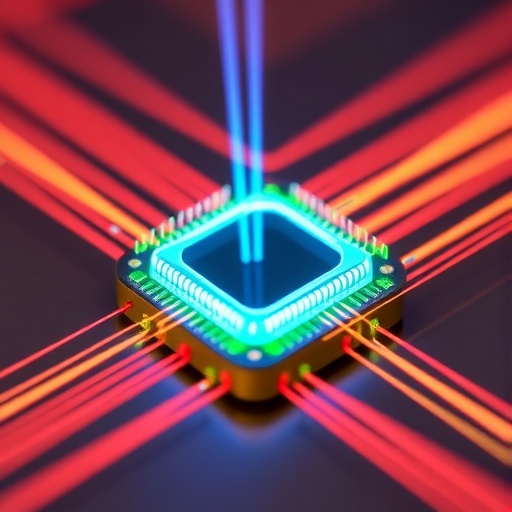
Modern photonic chips are already capable of performing remarkable optical tasks on surfaces smaller than a fingernail, but a new study suggests that the next major breakthrough may come not from replacing existing materials, but from making them work together. Researchers have developed an integrated photonic device that combines the distinct nonlinear properties of silicon nitride and silica, enabling the generation of widely spaced and broadband optical frequencies directly on a chip. The approach could open new possibilities for telecommunications, precision sensing, spectroscopy, and compact frequency-comb sources.
The device brings together two optical phenomena that are usually engineered separately. A silicon nitride ring resonator provides the strong Kerr nonlinearity needed to generate optical frequency combs—precisely spaced collections of laser lines that act like optical rulers. At the same time, the silica surrounding the waveguide supplies Raman gain, allowing light to be shifted to new frequencies through interactions with molecular vibrations. By allowing both processes to occur in the same resonator, the researchers created a hybrid system with capabilities that neither material could provide as effectively on its own.
The key insight was that the cladding surrounding a waveguide does not necessarily behave as an optically inactive shell. Although light is designed to remain concentrated in the silicon nitride core, a portion of the circulating electromagnetic field extends into the surrounding silica. In the new device, approximately 31 percent of the optical field overlaps with the cladding. That carefully engineered overlap gives the light enough exposure to the silica for Raman scattering to become significant while preserving the silicon nitride core’s ability to support efficient four-wave mixing.
The structure consists of a silicon nitride ring resonator coated or surrounded by silica. When continuous-wave laser light is coupled into the ring, it circulates repeatedly, building up optical intensity. Under these conditions, photons can interact with vibrational modes in the silica. In Raman scattering, some of the optical energy is transferred to or received from molecular vibrations, producing light at a different frequency. In the experiments, the researchers observed a new signal separated from the pump laser by 11 terahertz, a frequency shift characteristic of Raman activity in silica.
As the input power increased, the device displayed a sequence of increasingly complex nonlinear behaviors. Raman-generated Stokes and anti-Stokes signals appeared first, showing that the silica cladding was actively contributing optical gain. With additional power, four-wave mixing in the silicon nitride began generating new frequencies around the original pump and around the Raman-shifted signals. Four-wave mixing occurs when intense light waves interact through the material’s Kerr nonlinearity, transferring energy among frequencies and producing new spectral components. In this resonator, the process eventually expanded into broad optical frequency combs.
The observation of Raman lasing in this type of silicon nitride integrated photonic platform is particularly important because silicon nitride itself is not generally capable of providing sufficient Raman gain for efficient lasing. The material is prized for its low optical loss, broad transparency window, and strong Kerr nonlinearity, but it lacks the vibrational response required for the same kind of Raman amplification available in silica. Instead of abandoning silicon nitride or adding a separate active component, the researchers effectively borrowed the missing function from the surrounding material.
The team also refined the device geometry to improve the interaction among its optical modes. A small increase in the width of the silicon nitride waveguide changed the dispersion—the way different wavelengths travel through the resonator. Carefully controlling dispersion is essential in frequency-comb generation because it determines whether newly created frequencies remain aligned with the resonator’s allowed modes. After optimization, the device produced combs spanning more than 400 nanometers, with comb lines appearing not only near the pump wavelength but also around several Raman-shifted wavelengths.
The measurements closely agreed with theoretical predictions. Calculations indicated that Raman lasing should begin at an on-chip optical power of roughly 140 milliwatts, while the experiments recorded a threshold of 143 milliwatts. That close match supports the conclusion that the Raman gain originated in the silica cladding rather than in an unidentified effect elsewhere in the system. The researchers also measured a power-conversion efficiency above 32 percent, meaning that more than a third of the incoming optical power was converted into new frequencies. Although the resulting combs were not yet fully coherent, the efficiency demonstrates the potential of the architecture.
The broader significance of the work lies in its design philosophy. Photonic engineers have often searched for a single material that combines low loss, strong nonlinearity, efficient gain, and broad spectral performance. The new results show that a more practical strategy may be to distribute these functions across multiple materials and position them so that the same optical field can access each one. Future versions could combine additional nonlinear materials to create broadband supercontinuum sources, self-referenced frequency combs, and compact instruments for chemical analysis or precision measurement. By turning a normally passive cladding into an active optical component, the researchers have shown that even the supporting layers of a photonic chip can become central to its performance.
Subject of Research: Hybrid nonlinear effects in integrated photonic circuits using silicon nitride and silica
Article Title: Hybrid nonlinear effects in photonic integrated circuits
News Publication Date: 23-Jun-2026
Web References: Advanced Photonics article; DOI: 10.1117/1.AP.8.4.046008
References: A. Pal, A. Ghosh, et al., “Hybrid nonlinear effects in photonic integrated circuits,” Advanced Photonics 8(4), 046008.
Image Credits: Alekhya Ghosh
Keywords
Photonic chips, silicon nitride, silica, Raman scattering, optical frequency combs, nonlinear optics, integrated photonics, Raman lasing, four-wave mixing, frequency comb generation
Tags: advanced optical sensing and spectroscopybroadband optical frequency generationchip-scale optical frequency manipulationhybrid photonic devicesintegrated frequency comb sourcesKerr nonlinearity in silicon nitridemulti-material photonic systemsnonlinear optical phenomena on photonic chipsphotonic chip integrationRaman gain in silicasilicon nitride and silica nonlinear propertiestelecommunications and optical signal processing