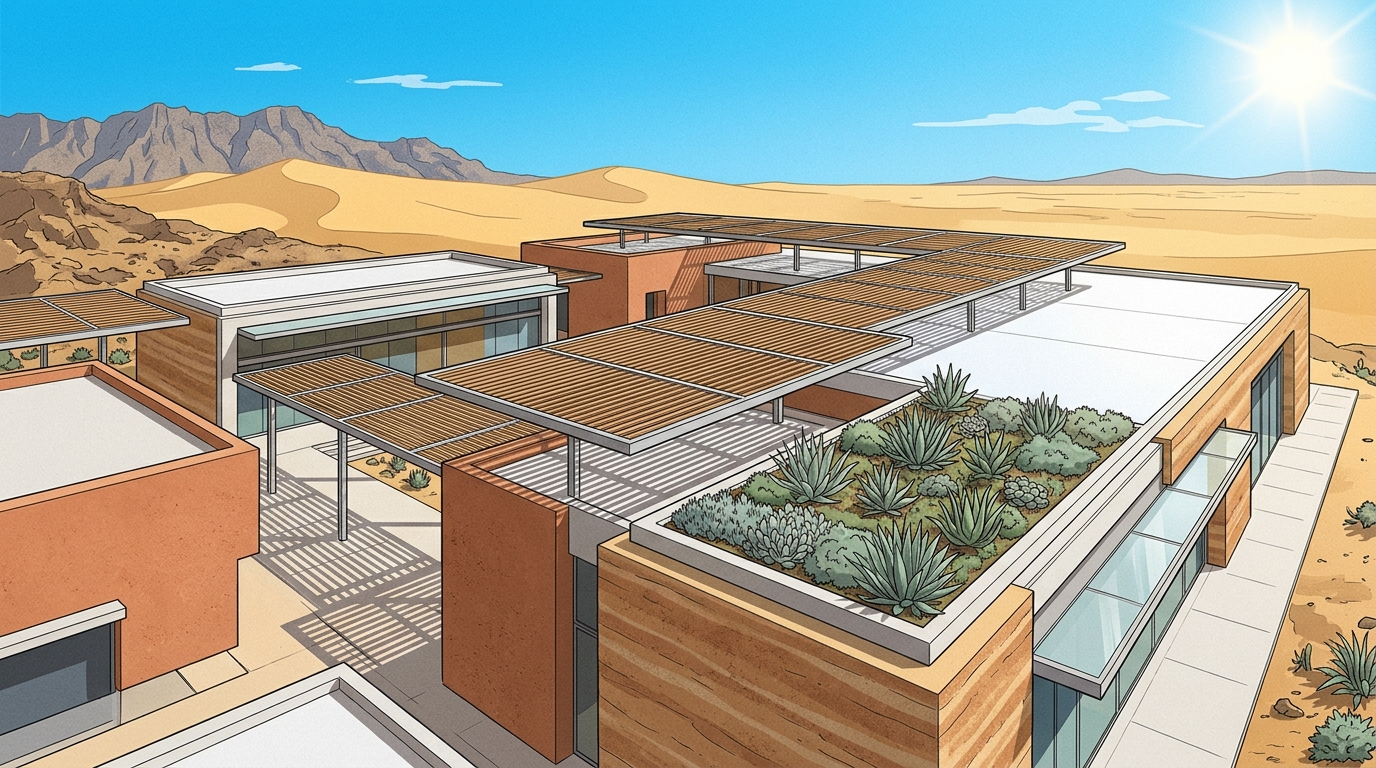
Egypt’s rooftops are dominated by one material: reinforced concrete. It holds up structurally, but it traps heat, drains budgets, and carries a heavy environmental burden. A new study argues that the country’s construction sector needs a systematic way to compare the alternatives—cool roofs, green roofs, photovoltaic panels, and roofs made from recycled waste—before it can make the switch. To that end, researchers have assembled an analytical framework that scores roofing systems against criteria calibrated to Egypt’s hot-arid climate, and they have published the tool as a decision-support guide for architects, engineers, and policymakers.
The work, led by Fiona Naoum and colleagues at institutions including Ain Shams University and Misr University for Science and Technology, appears in Architectural Research. The team stresses that the framework is built entirely from literature-based evidence and climate data, not from laboratory tests or field trials. Empirical validation, they write, is planned for future work. That distinction matters: the framework is a theoretical decision-support tool today, not a proven prescription for any specific building.
The case for rethinking Egyptian roofs rests on stark numbers drawn from national and international sources. Reinforced concrete production alone is responsible for nearly 8 percent of carbon dioxide emissions from the construction sector, according to figures the authors cite from Habert and colleagues and Egypt’s National Energy Efficiency Action Plan. Buildings in Egypt consume almost 25 to 30 percent of the nation’s total energy, and residential cooling loads account for roughly 50 to 60 percent of household electricity consumption during summer months, according to the International Energy Agency and Egypt’s statistics agency. Those cooling loads are the direct consequence of roofs that absorb and retain solar heat in a country where the overwhelming majority of territory is classified as hot desert.
Waste adds a second dimension to the problem. Egypt generates approximately 4.6 to 5 million tons of construction and demolition waste each year, alongside an estimated 5.4 to 8 million tons of plastic waste annually, according to the Egyptian Environmental Affairs Agency, Faragalla and colleagues, and the American University in Cairo. Much of that material is mismanaged or simply discarded. The study frames these streams as untapped resources: recycled plastics, rubber from tires, and demolition debris could be repurposed into lightweight blocks, insulation components, and alternative roofing panels. Globally, the plastic waste crisis is even larger—roughly 300 million tons of plastic are generated annually, and about 8 million tons leak into the oceans every year, according to UNEP and Jambeck and colleagues, with the economic cost of plastic pollution projected to reach 500 billion US dollars annually by 2030.
Recycled materials, however, are not interchangeable. The study’s authors caution that treating them as a single category produces misleading performance rankings. Recycled plastic polymer panels, particularly those based on high-density polyethylene and polyethylene terephthalate, typically show low thermal conductivity and light weight, making them candidates for insulation layers. Recycled concrete aggregates and demolition waste carry high thermal mass and conductivity, which can enhance structural stability but diminish insulation value. Tire-derived rubber composites fall in between, offering vibration resistance and moderate thermal performance. The researchers also note that recycled plastics require ultraviolet stabilizers and fire-retarding agents to achieve acceptable thermal stability, and that prolonged exposure to intense solar radiation in hot, dry conditions may accelerate polymer degradation when proper engineering controls are absent. Empirical studies indicate that volatile organic compound release stays within internationally recognized safety limits when materials are fabricated to building standards, but behavior under high temperature and particulate dust concentrations—conditions typical of the Egyptian environment—still requires additional examination.
To ground the framework in local reality, the team used high-resolution climatological data based on the Köppen–Geiger classification scheme. Egypt spans three zones: hot desert (BWh) across the overwhelming majority of the country, hot semi-arid steppe (BSh) in transitional deserts, and Mediterranean hot-summer (Csa) along the northern coastal strip. These zones are marked by extreme heat, minimal precipitation, and high solar radiation. Water scarcity compounds the challenge: Egypt’s per capita availability is less than 560 cubic meters per year, well below the global standard of 1,000 cubic meters, according to the OECD. That constraint effectively rules out irrigation-intensive green roofs unless they are adapted with drought-resistant vegetation or water-efficient strategies.
The framework itself integrates five interconnected criteria: thermal performance, cost efficiency, environmental impact, material availability, and sustainability integration. Weighting is derived from international sustainability standards—LEED v4, BREEAM, and ISO 14040-44—then calibrated to Egyptian priorities using the Analytic Hierarchy Process, a multi-criteria decision-making technique. Thermal performance receives the highest weight at 0.30, reflecting the country’s extended cooling season and intense solar irradiance. Cost efficiency follows at 0.25. Environmental impact and material availability receive weights of 0.20 and 0.15, respectively. Each roofing system is scored against these criteria, and the scores are combined into a single Sustainability Integration Index—a weighted sum that produces a composite ranking across multiple performance dimensions. The authors emphasize that the weighting approach will be further validated in the future through expert panels and consistency ratio methods.
What does the literature say about which roofs actually work in hot-arid conditions? Passive cooling systems, including cool roofs, can lead to significant heat gain reduction, according to the studies the team reviewed. Photovoltaic roofing systems show significant long-term energy mitigation potential. Green and bio-solar roofs offer durability and sustainability advantages in Mediterranean and temperate climates, but their irrigation demands make them less feasible in water-scarce regions. Recycled-material roofing opens promising avenues for waste valorisation, though its durability and climate resilience warrant further long-term validation. Insulated roofs, by contrast, perform best in cold regions where minimizing heating requirements matters most—a reminder that roofing solutions are climate-specific, not universal.
The critical review underpinning the framework reveals a broader gap in the research landscape. Global studies on sustainable roofing are heavily concentrated in temperate and Mediterranean climates, and most focus on thermal efficiency or energy savings in isolation, with limited integration of environmental, economic, and material-availability factors. Empirical data from hot-arid and semi-arid regions—especially Egypt—remains inadequate. Few studies propose standardized multi-criteria frameworks that connect performance with local constraints such as cost, waste generation, and water scarcity. The authors position their framework as a direct response to that deficiency, designed to be scalable so future research cycles can incorporate validated performance data from published studies or documented case analyses.
The conclusion is deliberately measured. The framework, the authors write, currently serves as a theoretical decision-support tool intended to guide contextually appropriate roofing selection; it does not include empirical validation or application data. What it does provide is a structured, transparent method for weighing trade-offs—heat rejection against water use, upfront cost against lifecycle savings, structural familiarity against circular-economy potential—before any roof is built. By clarifying that contribution, the research lays foundational groundwork for evidence-based sustainable roofing strategies in hot-arid regions and supports Egypt’s broader transition toward a circular, resource-efficient construction economy. The next step, the team indicates, is empirical: testing the framework’s predictions against real buildings, real climates, and real budgets.
Subject of Research: A multi-criteria analytical framework for evaluating sustainable roofing systems in Egypt's hot-arid climate
Article Title: Analytical Framework for Sustainable Roofing Systems in Hot-Arid Climates
Article References: Naoum, F., Al-Arnaouty, S., Mossad, G., El-Zayat, A., & Botros, Y. (2026). Analytical Framework for Sustainable Roofing Systems in Hot-Arid Climates. Architectural Research, 28(1), Article 7. https://doi.org/10.1007/s44515-026-00007-z
Image Credits: AI Generated
DOI: 10.1007/s44515-026-00007-z
Keywords: sustainable roofing, Egypt, hot-arid climate, cool roofs, green roofs, photovoltaic roofing, recycled materials, circular economy, multi-criteria decision analysis, thermal performance, water scarcity, construction waste
News Source: Sloane Callahan. (November 4, 2026). Researchers Build a Scoring Framework to Rank Sustainable Roofs for Egypt’s Scorching Deserts. Scienmag.