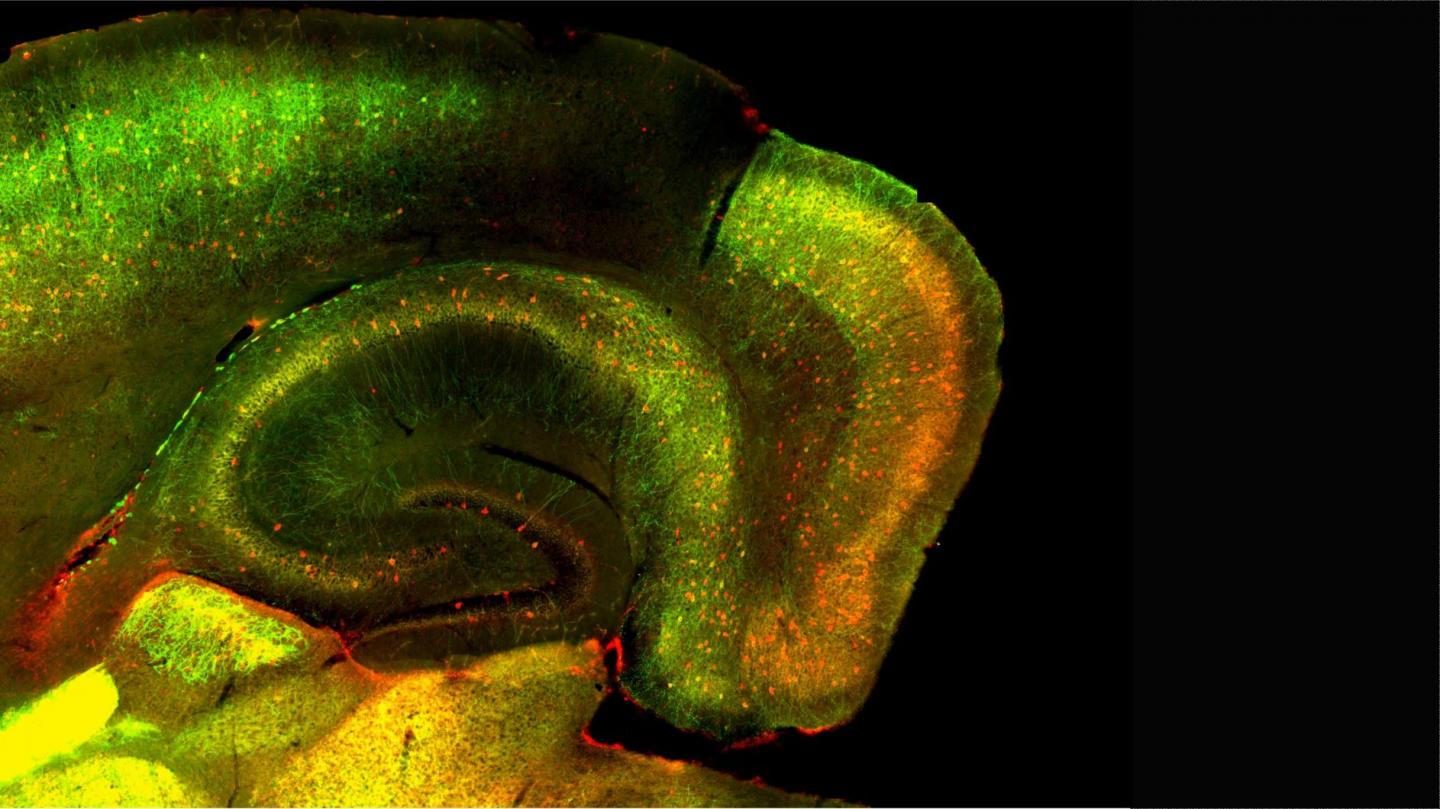
Credit: Matt Udakis
In years to come, our personal memories of the COVID-19 pandemic are likely to be etched in our minds with precision and clarity, distinct from other memories of 2020. The process which makes this possible has eluded scientists for many decades, but research led by the University of Bristol has made a breakthrough in understanding how memories can be so distinct and long-lasting without getting muddled up.
The study, published in Nature Communications, describes a newly discovered mechanism of learning in the brain shown to stabilise memories and reduce interference between them. Its findings also provide new insight into how humans form expectations and make accurate predictions about what could happen in future.
Memories are created when the connections between the nerve cells which send and receive signals from the brain are made stronger. This process has long been associated with changes to connections that excite neighbouring nerve cells in the hippocampus, a region of the brain crucial for memory formation.
These excitatory connections must be balanced with inhibitory connections, which dampen nerve cell activity, for healthy brain function. The role of changes to inhibitory connection strength had not previously been considered and the researchers found that inhibitory connections between nerve cells, known as neurons, can similarly be strengthened.
Working together with computational neuroscientists at Imperial College London, the researchers showed how this allows the stabilisation of memory representations.
Their findings uncover for the first time how two different types of inhibitory connections (from parvalbumin and somatostatin expressing neurons) can also vary and increase their strength, just like excitatory connections. Moreover, computational modelling demonstrated this inhibitory learning enables the hippocampus to stabilise changes to excitatory connection strength, which prevents interfering information from disrupting memories.
First author Dr Matt Udakis, Research Associate at the School of Physiology, Pharmacology and Neuroscience, said: “We were all really excited when we discovered these two types of inhibitory neurons could alter their connections and partake in learning.
“”It provides an explanation for what we all know to be true; that memories do not disappear as soon as we encounter a new experience. These new findings will help us understand why that is.
“The computer modelling gave us important new insight into how inhibitory learning enables memories to be stable over time and not be susceptible to interference. That’s really important as it has previously been unclear how separate memories can remain precise and robust.”
The research was funded by the UKRI’s Biotechnology and Biological Sciences Research Council, which has awarded the teams further funding to develop this research and test their predictions from these findings by measuring the stability of memory representations.
Senior author Professor Jack Mellor, Professor in Neuroscience at the Centre for Synaptic Plasticity, said: “Memories form the basis of our expectations about future events and enable us to make more accurate predictions. What the brain is constantly doing is matching our expectations to reality, finding out where mismatches occur, and using this information to determine what we need to learn.
“We believe what we have discovered plays a crucial role in assessing how accurate our predictions are and therefore what is important new information. In the current climate, our ability to manage our expectations and make accurate predictions has never been more important.”
“This is also a great example of how research at the interface of two different disciplines can deliver exciting science with truly new insights. Memory researchers within Bristol Neuroscience form one of the largest communities of memory-focussed research in the UK spanning a broad range of expertise and approaches. It was a great opportunity to work together and start to answer these big questions, which neuroscientists have been grappling with for decades and have wide-reaching implications.”
###
Paper
‘Interneuron-specific plasticity at parvalbumin and somatostatin inhibitory synapses onto CA1 pyramidal neurons shapes hippocampal output’ by Matt Udakis, Victor Pedrosa, Sophie Chamberlain, Claudia Clopath and Jack Mellor in Nature Communications
Media Contact
Victoria Tagg
[email protected]