• HOME
  • NEWS
  • EXPLORE
    • CAREER
      • Companies
      • Jobs
    • EVENTS
    • iGEM
      • News
      • Team
    • PHOTOS
    • VIDEO
    • WIKI
  • BLOG
  • COMMUNITY
    • FACEBOOK
    • INSTAGRAM
    • TWITTER
Sunday, August 16, 2026
BIOENGINEER.ORG
No Result
View All Result
  • Login
  • HOME
  • NEWS
  • EXPLORE
    • CAREER
      • Companies
      • Jobs
        • Lecturer
        • PhD Studentship
        • Postdoc
        • Research Assistant
    • EVENTS
    • iGEM
      • News
      • Team
    • PHOTOS
    • VIDEO
    • WIKI
  • BLOG
  • COMMUNITY
    • FACEBOOK
    • INSTAGRAM
    • TWITTER
  • HOME
  • NEWS
  • EXPLORE
    • CAREER
      • Companies
      • Jobs
        • Lecturer
        • PhD Studentship
        • Postdoc
        • Research Assistant
    • EVENTS
    • iGEM
      • News
      • Team
    • PHOTOS
    • VIDEO
    • WIKI
  • BLOG
  • COMMUNITY
    • FACEBOOK
    • INSTAGRAM
    • TWITTER
No Result
View All Result
Bioengineer.org
No Result
View All Result
Home NEWS Science News Health

Research shows that drinking Matcha tea can reduce anxiety

Bioengineer by Bioengineer
July 9, 2019
in Health
Reading Time: 2 mins read
0
IMAGE
Share on FacebookShare on TwitterShare on LinkedinShare on RedditShare on Telegram

IMAGE

Credit: Dr. Yuki Kurauchi

Many different countries have a tea culture, and Japanese Matcha tea is growing in popularity around the world. In Japan, Matcha has a long history of being used for various medicinal purposes. It has been suspected to have various beneficial effects to health, but relatively little scientific evidence supported that claim. Now, a group of Japanese researchers from Kumamoto University has shown that anxious behavior in mice is reduced after consuming Matcha powder or Matcha extract. Its calming effects appear to be due to mechanisms that activate dopamine D1 receptors and serotonin 5-HT1A receptors, both of which are closely related to anxious behavior.

Matcha is the finely ground powder of new leaves from shade-grown (90% shade) Camellia sinensis green tea bushes. The tea (and food flavoring) is enjoyed around the world. In Japan, historical medicinal uses for Matcha included helping people relax, preventing obesity, and treatment of skin conditions. The researchers, therefore, sought to determine its various beneficial effects.

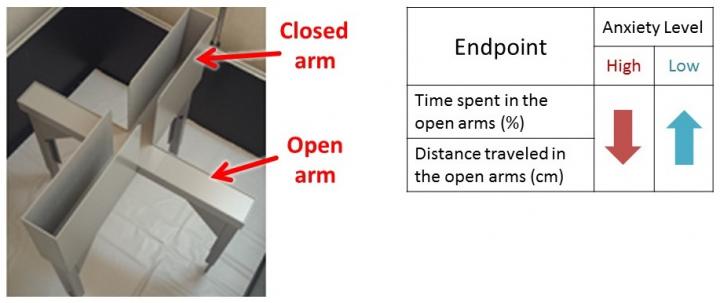
The “elevated plus maze” test is an elevated, plus-shaped, narrow platform with two walled arms that provide safety for the test subject, typically a mouse. It is used as an anxiety test for rodents with the idea that animals experiencing higher anxiety will spend more time in the safer walled-off areas. Using this test, researchers found that mouse anxiety was reduced after consuming Matcha powder or Matcha extract. In addition, when the anxiolytic activity of different Matcha extracts were evaluated, a stronger effect was found with the extract derived using 80% ethanol in comparison to the extract derived from only hot water. In other words, a poorly water-soluble Matcha component has stronger anxiolytic effects than a component that is easily soluble in water. A behavioral pharmacological analysis further revealed that Matcha and Matcha extracts reduce anxiety by activating dopamine D1 and serotonin 5-HT1A receptors.

“Although further epidemiological research is necessary, the results of our study show that Matcha, which has been used as medicinal agent for many years, may be quite beneficial to the human body,” said study leader, Dr. Yuki Kurauchi. “We hope that our research into Matcha can lead to health benefits worldwide.”

###

This research was published in the “Journal of Functional Foods” on 6 June 2019.

[Source]

Kurauchi, Y. et al., 2019. Anxiolytic activities of Matcha tea powder, extracts, and fractions in mice: Contribution of dopamine D1 receptor- and serotonin 5-HT1A receptor-mediated mechanisms. Journal of Functional Foods, 59, pp.301-308. Available at: http://dx.doi.org/10.1016/j.jff.2019.05.046.

Media Contact
J. Sanderson & N. Fukuda
[email protected]

Original Source

https://www.kumamoto-u.ac.jp/whatsnew/seimei/20190607

Related Journal Article

http://dx.doi.org/10.1016/j.jff.2019.05.046

Tags: BiochemistryDiet/Body WeightFood/Food ScienceMedicine/HealthNutrition/NutrientsStress/Anxiety
Share12Tweet8Share2ShareShareShare2

Related Posts

PARP1 Drives Neuropathic Pain Through GPX4-Dependent Ferroptosis in Injured Mice’s Sensory Neurons

August 15, 2026

Genome-wide skin pQTL map reveals genetic regulators and mechanisms underlying skin disorders

August 15, 2026

Levistilide A Drives Ferroptosis via RNF40-HSP90α Axis, Suppressing Colorectal Cancer Lung Metastasis

August 15, 2026

Sintilimab, IBI305, and Chemotherapy Show Promise in First-Line Advanced Gastric and GEJ Adenocarcinoma

August 15, 2026
Please login to join discussion

POPULAR NEWS

  • Imagining natural and extra robotic thumbs together strengthens kinesthetic sensorimotor networks

    29 shares
    Share 12 Tweet 7
  • PARP1 Drives Neuropathic Pain Through GPX4-Dependent Ferroptosis in Injured Mice’s Sensory Neurons

    29 shares
    Share 12 Tweet 7
  • Strubbelig–NHL3 Receptor Complex Helps Arabidopsis Respond to Cellulose Deficiency

    29 shares
    Share 12 Tweet 7
  • Bombyx mori Satellitome Analysis Reveals Evolutionary Stability, Dispersed Chromosomal Organization, Transposon Origins

    29 shares
    Share 12 Tweet 7

About

BIOENGINEER.ORG

We bring you the latest biotechnology news from best research centers and universities around the world. Check our website.

Follow us

Recent News

Imagining natural and extra robotic thumbs together strengthens kinesthetic sensorimotor networks

PARP1 Drives Neuropathic Pain Through GPX4-Dependent Ferroptosis in Injured Mice’s Sensory Neurons

Strubbelig–NHL3 Receptor Complex Helps Arabidopsis Respond to Cellulose Deficiency

Subscribe to Blog via Email

Enter your email address to subscribe to this blog and receive notifications of new posts by email.

Join 85 other subscribers
  • Contact Us

Bioengineer.org © Copyright 2023 All Rights Reserved.

Welcome Back!

Login to your account below

Forgotten Password?

Retrieve your password

Please enter your username or email address to reset your password.

Log In
No Result
View All Result
  • Homepages
    • Home Page 1
    • Home Page 2
  • News
  • National
  • Business
  • Health
  • Lifestyle
  • Science

Bioengineer.org © Copyright 2023 All Rights Reserved.