A new global study shows that mangroves provide billions of dollars worth of flood risk reduction benefits every year
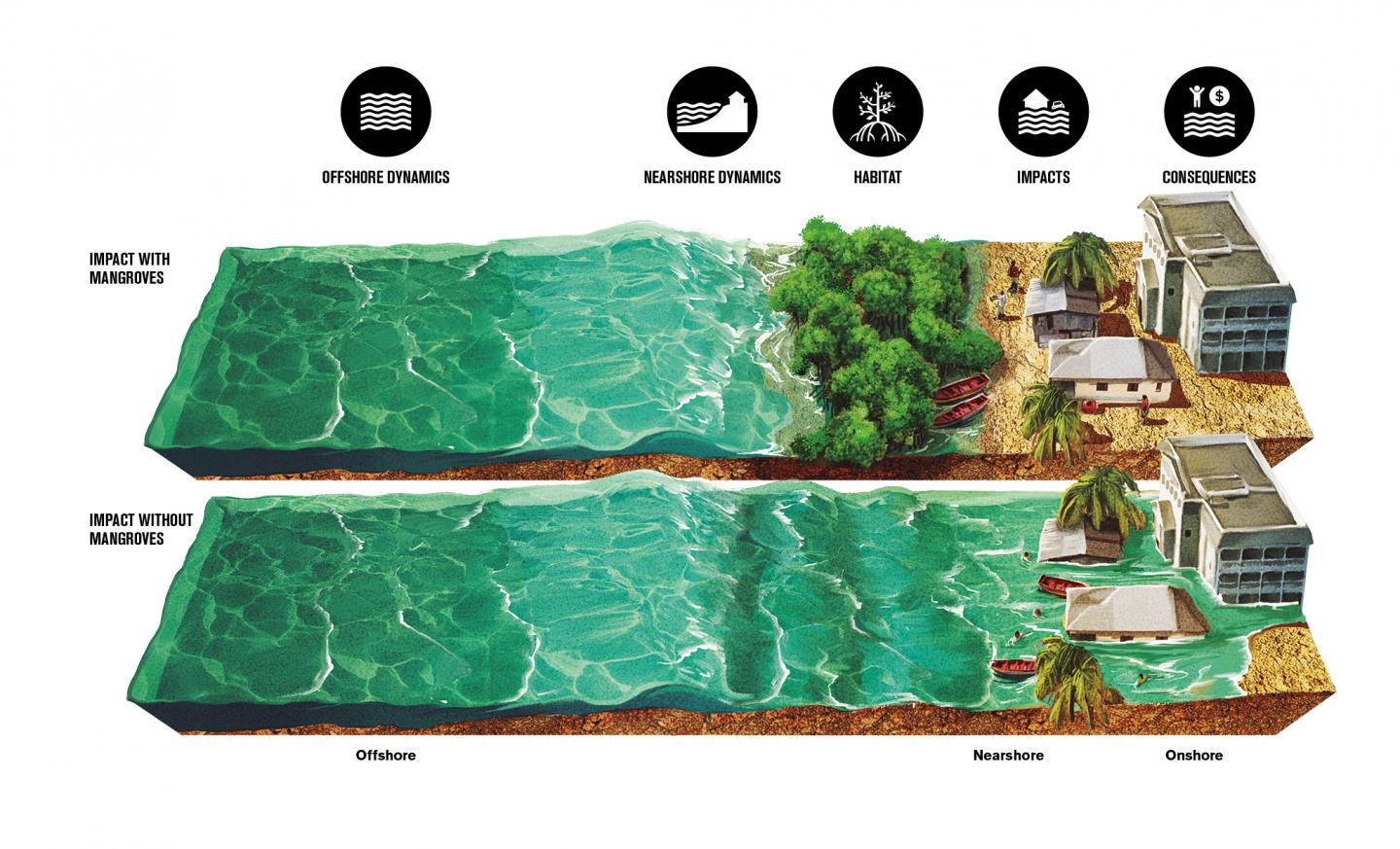
Credit: © World Bank and Punto Aparte
The natural coastal defenses provided by mangrove forests reduce annual flooding significantly in critical hotspots around the world. Without mangroves, flood damages would increase by more than $65 billion annually, and 15 million more people would be flooded, according to a new study published March 10 in Scientific Reports.
“Mangroves provide incredibly effective natural defenses, reducing flood risk and damages,” said Pelayo Menéndez, a postdoctoral fellow in the Institute of Marine Sciences at UC Santa Cruz and first author of the paper.
Climate change is increasing the risk of coastal flooding through its effects on sea level rise and the intensity of hurricanes. According to the study’s authors, conservation and restoration of natural defenses such as mangroves offers cost-effective ways to mitigate and adapt to these changes.
The researchers provided high-resolution estimates of the economic value of mangrove forests for flood risk reduction across more than 700,000 kilometers of coastlines worldwide. They combined engineering and economic models to provide the best analyses of coastal flood risk and mangrove benefits. Their results show when, where, and how mangroves reduce flooding, and they identified innovative ways to fund mangrove protection using economic incentives, insurance, and climate risk financing.
“Now that we can value these flood protection benefits, it opens all kinds of new opportunities to fund mangrove conservation and restoration with savings for insurance premiums, storm rebuilding, climate adaptation, and community development,” said coauthor Michael Beck, research professor in the Institute of Marine Sciences at UC Santa Cruz.
Mangrove forests occur in more than 100 countries globally. But many mangroves have been lost to aquaculture and coastal development, including the construction of public infrastructure such as ports and airports. In the early 1900s, vast areas of mangroves were filled throughout Florida, and whole developments were created where there once were islands and mangrove forests.
The loss of mangrove forests leads to increased coastal flooding, but these forests can be easily restored to make people and property safer, Beck said. Mangroves are resilient, and scientists know how to restore them–projects across Vietnam, Philippines, and Guyana have restored 100,000 hectares of mangroves.
“Mangroves are resilient and can grow like weeds, even around cities, if we give them half a chance,” Beck said.
The new study rigorously valued the social and economic coastal protection benefits provided by mangroves globally. Many 20-kilometer coastal stretches, particularly those near cities, receive more than $250 million annually in flood protection benefits from mangroves.
The researchers are working with insurance companies, the World Bank, and conservation groups to use these results for risk reduction and conservation.
The study used the “expected damage function” approach, commonly used in engineering and insurance sectors to assess flooding. Hydrodynamic models were used to calculate the flooding that occurs globally under current and no-mangrove scenarios. By identifying the places where mangroves provide the greatest flood reduction benefits, this study informs policies for adaptation, sustainable development, and environmental restoration.
“We have combined rigorous tools from engineering and economics to show that mangroves really work for flood risk reduction,” said coauthor Íñigo Losada, chief scientist at IH Cantabria.
###
In addition to Menéndez, Beck, and Losada, the coauthors of the paper include Saul Torres-Ortega at the University of Cantabria, Spain, and Siddharth Narayan at UC Santa Cruz. This work was supported by the World Bank and the German International Climate Initiative.
Media Contact
Tim Stephens
[email protected]
831-459-4352
Related Journal Article
http://dx.