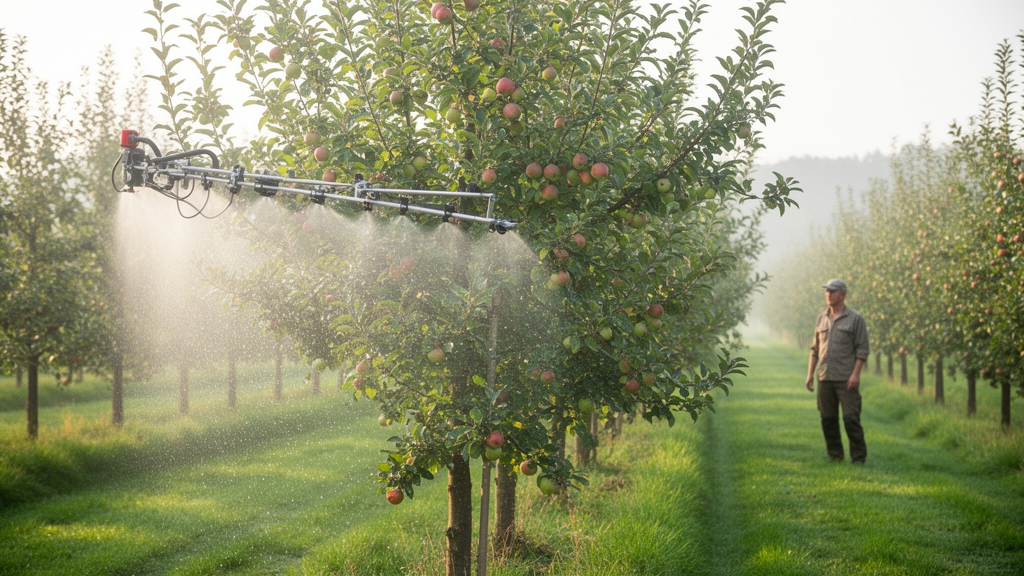
A two-factor field experiment in semi-arid northern China found that applying micro spray mist to the middle of apple-tree canopies for 1.5 hours produced the strongest combined effects on canopy cooling, humidity, stem growth and photosynthetic performance. The treatment, designated H2T2, ranked highest in a comprehensive evaluation of the configurations tested, while misting the upper canopy for 0.5 hours performed worst. Researchers tested four mist durations—2.0, 1.5, 1.0 and 0.5 hours—at three canopy heights: upper, middle and lower.
Measurements covered tree growth, orchard micrometeorological conditions, photosynthetic rate and chlorophyll fluorescence parameters. The investigators also characterized leaf water status, canopy temperature and humidity as part of their assessment of the trees’ response to the different mist treatments. Among the tested combinations, H2T2 delivered the best reported cooling and humidification effects.
It also promoted stem growth and was associated with higher photosynthetic rates during the sprouting and flowering period and during fruit setting. These observations show that the middle-canopy, 1.5-hour treatment performed well across multiple measurements and three stages of tree development. The findings do not establish that the same schedule would be optimal in other climates, orchards or experimental conditions.
To compare treatments that differed across several outcomes, the researchers constructed two comprehensive evaluation models using the entropy weight method. The models were designated EWM-MFM and EWM-VIKOR. The result therefore came from a multi-criteria assessment rather than a single measured variable alone.
Within the experimental conditions, the study identified 1.5 hours of micro spray mist at the middle canopy as the best-performing tested treatment for improving the canopy microenvironment and enhancing apple-tree growth and physiological performance. The authors presented the approach as a practical option for managing heat-and-drought stress in water-scarce agricultural regions. Further testing would be needed to establish its performance under varied locations, climates, orchard designs and management regimes.
Subject of Research: Effects of mist duration and canopy placement on apple-tree microclimate, growth and photosynthesis in a field experiment
Article Title: Spatiotemporal optimization of micro spray mist: effects on growth physiology in apple trees and comprehensive evaluation
Article References: Zhou, H., Peng, Z., Chen, C., Li, J., Su, Y., Ma, L., Wu, Q., Sun, Y., Lu, S., & Li, R. (2026). Spatiotemporal optimization of micro spray mist: effects on growth physiology in apple trees and comprehensive evaluation. BMC Plant Biology. https://doi.org/10.1186/s12870-026-10205-5
Image Credits: AI Generated
DOI: 10.1186/s12870-026-10205-5
Keywords: apple trees, micro spray mist, canopy microclimate, misting duration, stem growth, photosynthetic rate, chlorophyll fluorescence, leaf water status, precision irrigation, multi-criteria evaluation, Spatiotemporal, optimization
News Source: Alan Morgan. (October 20, 2026). Research report: Spatiotemporal optimization of micro spray mist: effects on growth physiology in apple trees and comprehensive evaluation. Scienmag.