Researchers have developed biodegradable composite films that combine poly(lactic acid), polypyrrole and oxidized multi-walled carbon nanotubes into a material with an electrical conductivity of 2.04 S/cm, a value they report as a 10.7-fold improvement over comparable binary composites at the same total filler loading. When exposed to ammonia vapor, the film’s specific conductivity dropped 255-fold, from 2.04 to 0.008 S/cm, suggesting a practical route to low-cost, eco-friendly chemiresistive indicators for environmental monitoring.
The choice of poly(lactic acid), or PLA, as the matrix reflects both environmental and functional considerations. PLA is a renewable, biodegradable thermoplastic that provides structural integrity to thin-film materials while remaining easy to process from solution. Polypyrrole, a well-studied conducting polymer, supplies the baseline electronic transport, and oxidized multi-walled carbon nanotubes act as high-aspect-ratio conductive bridges that connect otherwise isolated polymer aggregates. According to the authors, this ternary architecture addresses the high percolation thresholds and poor filler dispersion that typically plague simpler two-component blends.
Ultraviolet-visible spectroscopy of the real material told a different story: instead of the discrete peaks predicted for an idealized neutral polymer, the experimental spectrum showed broad absorption extending into the near-infrared region beyond 600 nm. That shift, the authors explain, marks the transition to a doped polaronic state induced by the hydrochloric acid medium, confirming the formation of a conductive conjugated system in which polarons and bipolarons within the bandgap serve as the primary charge-transport mechanism.
Synthesis conditions proved decisive for the conductivity of the polypyrrole itself. The researchers prepared a series of samples by oxidative polymerization of pyrrole with iron(III) chloride, varying reaction time, temperature and dopant. At a constant 20 °C, extending the reaction from 4 to 6 hours substantially increased conductivity, but pushing to 24 hours produced a slight decline, a trend the team attributes to structural degradation, defect formation or agglomeration that impairs charge transport. Lowering the synthesis temperature to around 0 °C favored higher conductivity, with the maximum observed at a 4-hour reaction time, likely because reduced temperature moderates side reactions and promotes more uniform polymer growth.
The standout material, designated PP-8, was made with the cationic surfactant cetyltrimethylammonium bromide, or CTAB, as a micellar template at 3–5 °C. Scanning electron microscopy showed spherical aggregated particles of uniform size, roughly 1.0 to 1.1 micrometers, and impedance spectroscopy in the 1 Hz to 1 MHz range recorded a conductivity of about 6.5 S/cm for the pressed powder. The authors note that CTAB’s benefit is usually linked to wire-like morphologies with improved chain ordering, but in their spherical particles they propose that π-electron delocalization in a more ordered, less cross-linked structure explains the gain. The surfactant also helps stabilize polypyrrole particles before they are mixed into the hydrophobic PLA matrix.
The carbon nanotube component required its own chemical preparation. Pristine multi-walled carbon nanotubes tangle into agglomerates held together by van der Waals forces, making uniform dispersion difficult. The team oxidized them with a mixture of nitric and sulfuric acid under ultrasonication at 50–55 °C, introducing oxygen-containing groups, including carbonyl, carboxyl and hydroxyl functions, confirmed by FT-IR absorption bands near 1630, 1700 and 3440 cm⁻¹. Energy-dispersive X-ray analysis quantified the result at approximately 7.38 wt% oxygen alongside 88.63 wt% carbon. These surface groups reduce agglomeration and allowed stable dispersion of the nanotubes in both organic solvents and water, a prerequisite for the solution-blending route.
Composite films about 60 micrometers thick were cast from chloroform solutions containing PLA at 60 mg/mL, with fillers first dispersed by an hour of ultrasonication. Impedance measurements revealed the central finding of the study: the film containing both oxidized nanotubes and polypyrrole reached 2.04 S/cm, the highest of the formulations tested. The comparison that matters is with a film containing the same total filler loading but only polypyrrole at 0.8 wt%, which managed just 0.64 S/cm. Substituting half the polymer filler mass with oxidized nanotubes therefore produced a 3.2-fold conductivity boost at identical loading, evidence that the enhancement is cooperative rather than a simple concentration effect. The proposed mechanism is a co-supporting network in which nanotubes bridge isolated polypyrrole aggregates within the insulating PLA matrix.
Set against the literature, the result is striking. Binary PLA/polypyrrole systems typically reach only about 0.0022 S/cm, nearly three orders of magnitude below the ternary films reported here, and thermoplastic polyurethane composites with polypyrrole and nanotubes made by similar blending often fall between 10⁻⁹ and 10⁻⁴ S/cm. More elaborate methods can go higher, including Pickering emulsion approaches reaching up to 59 S/cm in PLA systems or two-step dispersion strategies delivering 72.2 S/cm, but the authors emphasize that their straightforward solution blending achieves high performance without complex multi-step synthesis.
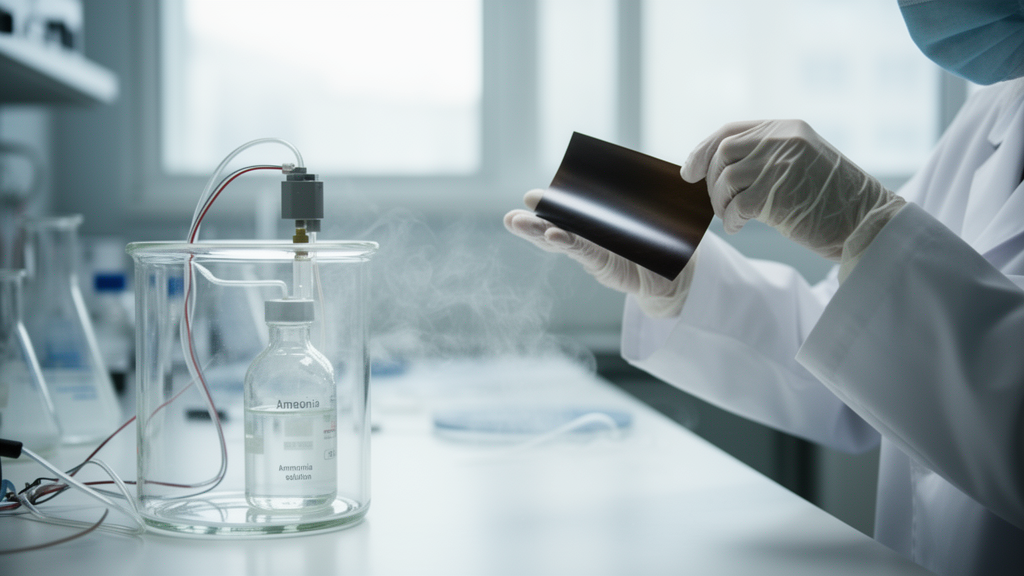
The ammonia test showcased the material’s most dramatic property. A film was sealed in a chamber with a fixed 1 V applied voltage, and 10 microliters of ammonia solution were introduced, yielding a calculated maximum vapor concentration of roughly 2800 ppm. Current declined gradually, with the I/I₀ ratio falling to 0.74 after about 10 minutes, and the total specific conductivity dropped from 2.04 to 0.008 S/cm, a 255-fold decrease. Recovery in clean air was slow, requiring about 24 hours for full relaxation. The authors contrast this with graphene-oxide-modified polypyrrole hybrids that achieved only a 5.81% response and needed an operating temperature of 150 °C, whereas their composite responds at room temperature.
The slow recovery is not incidental; it defines the material’s intended role. Because gas diffusion through the dense PLA matrix controls the response, the film behaves not as a fast reversible sensor but as an integrating, dosimetric-type indicator, suited to tracking cumulative ammonia exposure in industrial settings where total concentration over time matters more than instantaneous detection. The authors acknowledge the limitations openly: prolonged relaxation, untested selectivity and long-term stability, and a laboratory acid-oxidation step they hope to replace with greener alternatives such as plasma treatment or commercially carboxylated nanotubes. Future work will target thinner films and optimized structures to speed gas desorption.
Subject of Research: Conductive biodegradable composite films of poly(lactic acid), polypyrrole and oxidized carbon nanotubes with ammonia-responsive electrical behavior
Article Title: Preparation, physicochemical characterization, and ammonia-responsive behavior of poly(lactic acid) / polypyrrole / oxidized multi-walled carbon nanotube composite films with synergistically enhanced electrical conductivity
Article References: Ihnatovich, Z., Filippovich, L., Lemeshonok, S., Рetkevich, A., Petrova, E., Danilova, D., Shakhab, S. N., & Rogachev, A. (2026). Preparation, physicochemical characterization, and ammonia-responsive behavior of poly(lactic acid) / polypyrrole / oxidized multi-walled carbon nanotube composite films with synergistically enhanced electrical conductivity. Discover Industrial Chemistry and Materials, 1(1), Article 26. https://doi.org/10.1007/s44508-026-00028-5
Image Credits: AI Generated
DOI: 10.1007/s44508-026-00028-5
Keywords: polylactic acid, polypyrrole, carbon nanotubes, electrical conductivity, ammonia sensing, chemiresistive, composite films, solution blending, conducting polymers, environmental monitoring, biodegradable polymers, synergistic effect
News Source: Bethany Barker. (October 29, 2026). Research report: Preparation, physicochemical characterization, and ammonia-responsive behavior of poly(lactic acid) / polypyrrole / oxidized multi-walled carbon nanotube composite films with synergistically enhanced electrical conductivity. Scienmag.