• HOME
  • NEWS
  • EXPLORE
    • CAREER
      • Companies
      • Jobs
    • EVENTS
    • iGEM
      • News
      • Team
    • PHOTOS
    • VIDEO
    • WIKI
  • BLOG
  • COMMUNITY
    • FACEBOOK
    • INSTAGRAM
    • TWITTER
Monday, October 26, 2026
BIOENGINEER.ORG
No Result
View All Result
  • Login
  • HOME
  • NEWS
  • EXPLORE
    • CAREER
      • Companies
      • Jobs
        • Lecturer
        • PhD Studentship
        • Postdoc
        • Research Assistant
    • EVENTS
    • iGEM
      • News
      • Team
    • PHOTOS
    • VIDEO
    • WIKI
  • BLOG
  • COMMUNITY
    • FACEBOOK
    • INSTAGRAM
    • TWITTER
No Result
View All Result
Bioengineer.org
No Result
View All Result
Home NEWS Science News Technology

Research report: Preparation of N,P-synergistic flame-retardant phase change materials and their application for thermal management of lithium-ion batteries

by
October 26, 2026
in Technology
Reading Time: 2 mins read
0
Research report: Preparation of N,P-synergistic flame-retardant phase change materials and their application for thermal management of lithium-ion batteries

Research report: Preparation of N,P-synergistic flame-retardant phase change materials and their application for thermal management of lithium-ion batteries

Share on FacebookShare on TwitterShare on LinkedinShare on RedditShare on Telegram

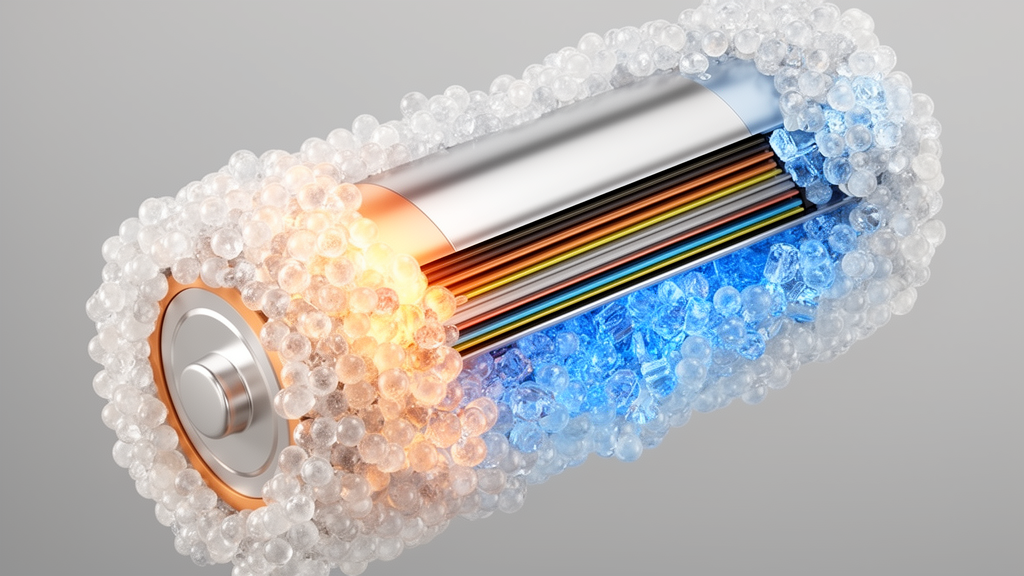
Researchers have developed a halogen-free, nitrogen- and phosphorus-flame-retardant phase change material for managing heat in lithium-ion batteries. The composite combined a covalently modified polyethylene glycol 2000 matrix with expanded graphite and reduced heat release in combustion tests. In battery-module tests, it lowered the maximum temperature to 43.9 °C and limited the maximum temperature difference to 3.33 °C during discharge at 2C, while also delaying thermal propagation under overheating conditions.

The study addressed compatibility, latent-heat loss and halogen contamination associated with physically blended flame-retardant phase change materials. Rather than physically mixing the components, the researchers synthesized a new phase change material, designated GPEG2000, through covalent bonding. Polyethylene glycol 2000 served as the phase change matrix, and sequential Schiff-base condensation and addition reactions involving 9,10-9-oxa-10-phosphaphenanthrene-10-oxide introduced the nitrogen- and phosphorus-containing flame-retardant functionality.

The resulting material was designed to combine thermal-energy storage with reduced combustibility. GPEG2000 exhibited a latent heat of 122.28 J g−1, enhanced thermal stability and improved char-forming capability. Combustion measurements showed that its peak heat release rate was reduced by 25.0% and its total heat release by 44.0% relative to the material used for comparison in those tests.

The researchers subsequently incorporated expanded graphite to produce a composite phase change material, or CPCM. This addition significantly increased the composite’s thermal conductivity while retaining the flame-retardant phase change matrix, creating a material intended for both heat management and thermal protection in lithium-ion batteries. Testing of battery modules showed that GPEG2000 with expanded graphite reduced both the maximum temperature and the maximum temperature difference during high-rate discharge from 0.75C to 2C.

At the highest tested rate of 2C, the maximum temperature was controlled at 43.9 °C and the maximum temperature difference at 3.33 °C. The composite also markedly delayed thermal propagation during overheating tests. These results support the potential of the halogen-free composite for battery thermal-management and thermal-protection applications, although the supplied research abstract does not provide the cell chemistry, module capacity, ambient conditions, test duration or absolute thermal conductivity.

Subject of Research: Development of a halogen-free N,P flame-retardant phase change composite for lithium-ion battery thermal management

Article Title: Preparation of N,P-synergistic flame-retardant phase change materials and their application for thermal management of lithium-ion batteries

Article References: Yong, C., Zheng, Z., Fang, C., Wang, H., Zhang, Y., Li, X., & Yang, X. (2026). Preparation of N,P-synergistic flame-retardant phase change materials and their application for thermal management of lithium-ion batteries. Journal of Materials Science, 61(40), 30992-31008. https://doi.org/10.1007/s10853-026-13553-7

Image Credits: AI Generated

DOI: 10.1007/s10853-026-13553-7

Keywords: phase change material, lithium-ion batteries, battery thermal management, flame retardancy, expanded graphite, polyethylene glycol, latent heat, thermal propagation, halogen-free material, Preparation, P-synergistic, flame-retardant

News Source: Denise Maddox. (October 26, 2026). Research report: Preparation of N,P-synergistic flame-retardant phase change materials and their application for thermal management of lithium-ion batteries. Scienmag.

Tags: Battery Thermal Managementexpanded graphiteflame retardancyflame retardanthalogen-free materiallatent heatlithium-ion batteriesP-synergisticphase-change materialpolyethylene glycolpreparationthermal propagation
Share12Tweet7Share2ShareShareShare1

Related Posts

Research report: External-catalyst-free transcarbamoylation in hydroxyurethane-modified epoxy vitrimer: enabling ultra-tough, rapidly welding, and self-healing carbon fiber/epoxy composites

Research report: External-catalyst-free transcarbamoylation in hydroxyurethane-modified epoxy vitrimer: enabling ultra-tough, rapidly welding, and self-healing carbon fiber/epoxy composites

October 26, 2026
Lab study links XPS charge neutralization to shifts on a graphite anode

Lab study links XPS charge neutralization to shifts on a graphite anode

October 26, 2026

Smartphone AI app guides strawberry nitrogen fertigation from leaf photos alone

October 26, 2026

Research report: Bayesian optimization-driven exploration of process–structure–property relationship for polyethylene composite films

October 26, 2026

POPULAR NEWS

  • Benzo[a]pyrene Damages Mouse Ovaries and Expands Cancer Stem-Like Progenitor Populations

    Benzo[a]pyrene Damages Mouse Ovaries and Expands Cancer Stem-Like Progenitor Populations

    29 shares
    Share 12 Tweet 7
  • Research report: Preparation of N,P-synergistic flame-retardant phase change materials and their application for thermal management of lithium-ion batteries

    29 shares
    Share 12 Tweet 7
  • Natural Compound α-Cyperone Shields Starved Neurons in Lab Study

    29 shares
    Share 12 Tweet 7
  • Saudi parent survey finds high childhood vaccination but uneven HPV awareness

    29 shares
    Share 12 Tweet 7

About

We bring you the latest biotechnology news from best research centers and universities around the world. Check our website.

Follow us

Recent News

Benzo[a]pyrene Damages Mouse Ovaries and Expands Cancer Stem-Like Progenitor Populations

Research report: Preparation of N,P-synergistic flame-retardant phase change materials and their application for thermal management of lithium-ion batteries

Natural Compound α-Cyperone Shields Starved Neurons in Lab Study

Subscribe to Blog via Email

Enter your email address to subscribe to this blog and receive notifications of new posts by email.

Join 85 other subscribers
  • Contact Us

Bioengineer.org © Copyright 2023 All Rights Reserved.

Welcome Back!

Login to your account below

Forgotten Password?

Retrieve your password

Please enter your username or email address to reset your password.

Log In
No Result
View All Result
  • Homepages
    • Home Page 1
    • Home Page 2
  • News
  • National
  • Business
  • Health
  • Lifestyle
  • Science

Bioengineer.org © Copyright 2023 All Rights Reserved.