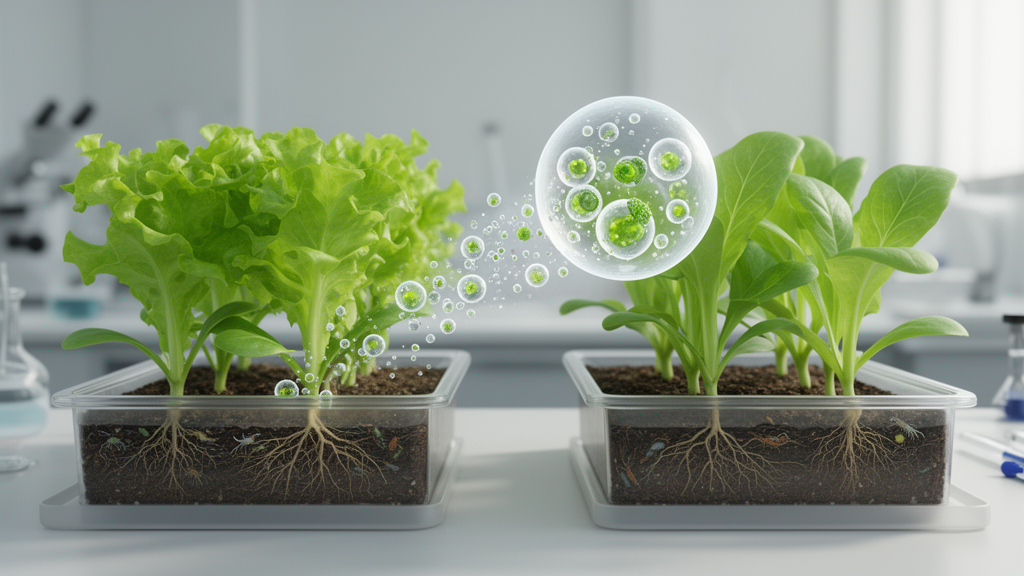
In a greenhouse experiment, lettuce exposed to 50 millimolar sodium chloride showed improved growth and biochemical performance when treated with peppermint essential oil loaded into chitosan nanoparticles, with the strongest effects recorded for the 500-parts-per-million formulation. The study found that this treatment increased the measured uptake of nitrogen, phosphorus and potassium, strengthened antioxidant enzyme activity, reduced markers of oxidative stress and increased several components of plant performance. The formulation also proved more effective than separate applications of peppermint essential oil and chitosan nanoparticles under the tested conditions.
The researchers used a factorial design that combined three salinity levels—0, 25 and 50 millimolar sodium chloride—with five foliar treatments. These treatments consisted of distilled water as a control, peppermint essential oil-loaded chitosan nanoparticles at 500 and 1,000 ppm, peppermint essential oil at 1,000 ppm, and chitosan nanoparticles at 0.5%. Lettuce, identified in the study as Lactuca sativa L., was assessed through its physiological, biochemical and nutritional responses.
Salt exposure at 50 millimolar sodium chloride reduced growth traits and the accumulation of photosynthetic pigments while increasing hydrogen peroxide and malondialdehyde, which the researchers used as markers of oxidative stress. Relative to the high-salinity comparison reported in the study, nitrogen, phosphorus and potassium uptake increased by 94%, 230% and 76%, respectively. The activities of ascorbate peroxidase, guaiacol peroxidase and superoxide dismutase also rose, by 219%, 225% and 165%.
These coordinated changes indicated that the treatment affected several measured aspects of plant physiology rather than a single growth indicator. The biochemical response included marked increases in total phenolics, total flavonoids, ascorbic acid and soluble proteins, alongside changes in the two oxidative-stress markers. Hydrogen peroxide decreased by 163% and malondialdehyde by 62% in the study’s reported comparison with the high-salinity control.
Together, the results showed stronger antioxidant and metabolic capacity together with reduced oxidative stress. The researchers also linked these changes to improved plant performance: treated lettuce had greater root and shoot biomass, more leaves, increased stem diameter and a higher fresh weight of the lettuce head. The 500 ppm nano-encapsulated treatment was more effective than the 1,000 ppm nanoparticle treatment, as well as the separate peppermint essential oil and chitosan nanoparticle applications.
These results support nano-encapsulation as a promising approach to mitigating salinity-induced damage in lettuce, but the evidence remains specific to the controlled greenhouse experiment. The authors state that field validation is required before the approach can be evaluated under agricultural conditions. Within the tested scope, however, the results indicate that packaging peppermint essential oil in chitosan nanoparticles produced a coordinated improvement in nutrient uptake, antioxidant defense, oxidative-stress regulation and growth.
The clearest effect occurred in lettuce exposed to 50 millimolar sodium chloride, where the 500 ppm formulation outperformed both nanoparticle concentrations and the separately applied materials.
Subject of Research: Greenhouse effects of nano-encapsulated peppermint essential oil on salinity-stressed lettuce
Article Title: Nano-encapsulation of peppermint essential oil in chitosan nanoparticles improves salinity tolerance in lettuce
Article References: Rasouli, F., Haghaninia, M., Golestaneh, S., Asadi, M., & Mahdavinia, G. (2026). Nano-encapsulation of peppermint essential oil in chitosan nanoparticles improves salinity tolerance in lettuce. BMC Plant Biology. https://doi.org/10.1186/s12870-026-10089-5
Image Credits: AI Generated
DOI: 10.1186/s12870-026-10089-5
Keywords: lettuce, salinity stress, peppermint essential oil, chitosan nanoparticles, nano-encapsulation, greenhouse experiment, antioxidant enzymes, nutrient uptake, plant growth, oxidative stress, peppermint, essential
News Source: Alan Morgan. (October 20, 2026). Research report: Nano-encapsulation of peppermint essential oil in chitosan nanoparticles improves salinity tolerance in lettuce. Scienmag.