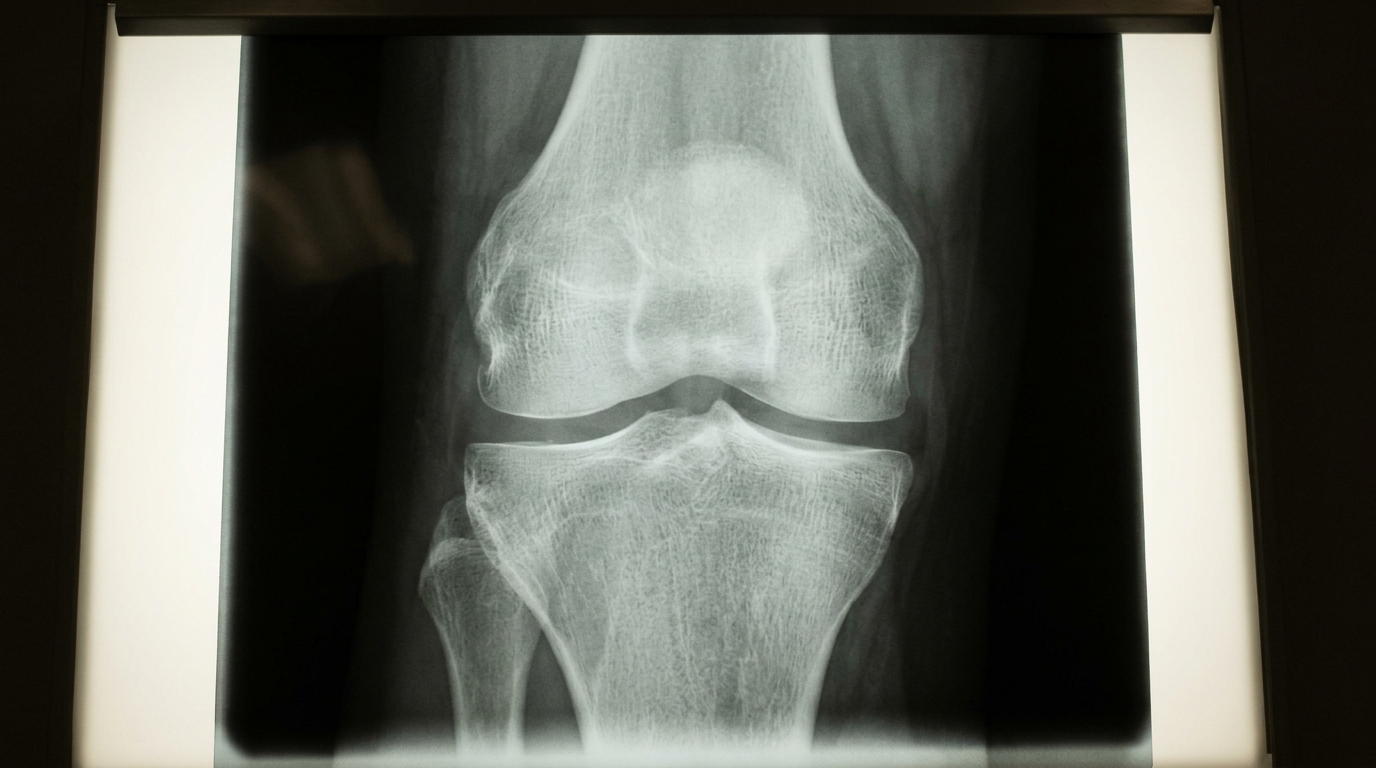
An investigation of bilateral knee dual-energy X-ray absorptiometry imaging from 53,609 UK Biobank participants has found that narrower medial compartment minimum joint space width is the compartment-specific measure most strongly associated with clinical knee osteoarthritis outcomes. While joint space width is an established radiographic component of knee osteoarthritis, the comparative clinical relevance of the medial versus lateral knee compartments has remained unclear.
To evaluate these compartment-specific associations, researchers applied machine-learning algorithms to bilateral knee scans to derive medial and lateral compartment minimum joint space widths, defining whole-joint minimum joint space width as the smaller of the two compartments. Knee alignment was independently derived from paired whole-body dual-energy X-ray absorptiometry scans. The investigators then deployed regression models accounting for bilateral knee imaging to evaluate associations with knee pain, hospital-diagnosed knee osteoarthritis, total knee replacement, autoimmune and crystal inflammatory arthritis, and knee alignment, alongside sex-stratified and mediation analyses.
Across the cohort, the mean minimum joint space width was 3.9 ± 0.7 mm in the medial compartment and 4.1 ± 0.9 mm in the lateral compartment, with smaller measurements observed in women than in men. In addition, approximately 60 percent of whole-joint minimum joint space width originated from the medial compartment.
Regression analyses demonstrated that narrower medial compartment minimum joint space width was associated with knee pain, with an odds ratio of 1.15 (95% CI 1.12, 1.18) per standard deviation decrease, and hospital-diagnosed knee osteoarthritis, with an odds ratio of 1.29 (95% CI 1.23, 1.35). The association was strongest for total knee replacement, yielding a hazard ratio of 1.73 (95% CI 1.58, 1.89), demonstrating progressively stronger relationships across these worsening clinical outcomes. Whole-joint minimum joint space width showed similar patterns, whereas lateral compartment minimum joint space width showed little evidence of association with knee osteoarthritis clinical outcomes.
The study also identified distinct patterns regarding inflammatory arthritis and anatomical alignment. Medial compartment minimum joint space width showed associations with rheumatoid arthritis (odds ratio 1.25 [95% CI 1.15, 1.37]) and psoriatic arthritis (odds ratio 1.29 [95% CI 1.09, 1.52]), while lateral compartment measurements did not. Furthermore, narrower medial and lateral compartment minimum joint space widths were associated with varus and valgus alignment, respectively. Mediation analyses indicated that varus alignment explained 16.8% (95% CI 0.13, 0.20) of the association with knee pain, 12.7% (95% CI 0.10, 0.16) of the association with knee osteoarthritis, and 6.9% (95% CI 0.05, 0.08) of the association with total knee replacement.
The authors concluded that medial compartment minimum joint space width was the compartment-specific measure most strongly associated with knee osteoarthritis clinical outcomes, relationships that were only partly explained by varus alignment. Additionally, there was no change in the pattern of associations between inflammatory arthritis and osteoarthritis clinical outcomes. Medial compartment minimum joint space width appears to provide the most informative quantitative marker for large-scale population and genetically informed studies of knee osteoarthritis.
Subject of Research: Knee joint space width and osteoarthritis clinical outcomes
Article Title: Compartment-specific associations between knee joint space width and clinical outcomes
Article References: Jung, M., Taylor, P., Saunders, F. R., Ebsim, R., Alomar, F., Hashmi, A., Gregory, J. S., Harvey, N. C., Lindner, C., Aspden, R. M., Abram, S. G. F., Cootes, T., Tobias, J. H., & Faber, B. G. (2026). Compartment-specific associations between knee joint space width and clinical outcomes. Arthritis Research & Therapy. https://doi.org/10.1186/s13075-026-03944-1
Image Credits: AI Generated
DOI: 10.1186/s13075-026-03944-1
Keywords: knee osteoarthritis, joint space width, UK Biobank, DXA imaging, total knee replacement, knee pain, varus alignment, rheumatoid arthritis, Compartment-specific, associations, between, knee
News Source: Ophelia Keating. (November 7, 2026). Research report: Compartment-specific associations between knee joint space width and clinical outcomes. Scienmag.