Kidney stones have a frustrating habit of trying to escape. When surgeons fragment a stone sitting in the upper or mid-ureter, the broken pieces can migrate backward, pushed by irrigation fluid toward the renal pelvis, where they become far harder to retrieve. A new prospective randomized study from a tertiary care teaching hospital, published in the African Journal of Urology, has directly compared two widely used mechanical devices designed to stop exactly that migration, and its central message is one of qualified equivalence rather than clear superiority.
The trial enrolled 56 patients aged 18 to 65 with upper or mid-ureteric calculi and randomized them, using sealed opaque envelopes prepared with computer-generated random numbers, into two groups of 28. Group A underwent ureteroscopic lithotripsy, or URSL, with the NTrap device deployed proximal to the stone, while Group B underwent the same operation with the Stone Cone. All procedures were performed under spinal or general anesthesia with a semirigid ureteroscope, and pneumatic lithotripsy was used for fragmentation in every case. A double-J stent was placed at the end of each procedure. Because the intervention itself is visible in the operating field, the trial was necessarily open-label for the surgical team, but the radiologist who read the postoperative scans was blinded to which device each patient had received, protecting the integrity of the primary outcome.
That primary outcome was the stone-free rate at one month, defined as the absence of any residual calculus larger than 2 millimeters on non-contrast CT of the kidneys, ureters and bladder. Secondary outcomes included operative time, intraoperative and postoperative complications graded by the Clavien-Dindo classification, the need for auxiliary procedures, and duration of hospital stay.
The results were close. Four patients in the NTrap group and one patient in the Stone Cone group had residual fragments larger than two millimeters at one month. The corresponding stone-free rates were 85.7 percent for NTrap and 96.4 percent for Stone Cone, a numerical gap of 10.7 percentage points that favored the coiled device. Yet the difference did not reach statistical significance, with a p-value of 0.160 and a 95 percent confidence interval for the difference spanning from minus 14.3 percent to plus 4 percent. In plain terms, the data are compatible with anything from a modest advantage for Stone Cone to a small advantage for NTrap.
The reason for that uncertainty is statistical power, and the authors are unusually candid about it. No prior power calculation was performed because the study was designed as an initial prospective randomized comparison. A post-hoc analysis showed the trial had only 29.7 percent power to detect the observed 10.7 percent difference at an alpha of 0.05 with 28 patients per group, and the limitations section reports an even lower figure of 7 percent. To detect an 11 percent difference with 80 percent power, roughly 111 patients per group would be required. The authors therefore frame their findings as hypothesis-generating rather than definitive, and they call for a larger, adequately powered, multicenter randomized controlled trial to establish equivalence or superiority between the devices.
The secondary outcomes told a story of practical similarity. Operative times were nearly identical, at 55.7 plus or minus 21.1 minutes for NTrap versus 56.2 plus or minus 20.6 minutes for Stone Cone, indicating that deploying either device did not prolong surgery. Mean hospital stay was 2.4 plus or minus 0.6 days and comparable between groups. The mean stone size across the cohort was 11.08 plus or minus 2.5 millimeters, and mean stone density was 1028 plus or minus 331 Hounsfield units, placing these firmly in the category of moderate-sized, reasonably hard ureteric stones that pneumatic lithotripsy handles routinely.
Safety signals were reassuring but statistically limited. Minor intraoperative mucosal abrasions occurred in a small number of patients in both groups, and no cases of ureteric perforation, avulsion, or significant hemorrhage were recorded. Postoperative complications were predominantly Clavien-Dindo Grade I, the mildest category. The authors note, however, that the small number of complication events precludes any meaningful statistical comparison of safety between the devices.
The new data fit into a thin evidence base. Most previous comparisons of anti-retropulsion devices have been retrospective or non-randomized, which is precisely the gap this trial was designed to address. The authors point to a prior randomized comparison by Farahat and colleagues in 60 patients, which reported stone-free rates of 83.3 percent for Stone Cone and 80.0 percent for NTrap with no significant difference, and to a retrospective series by Wang and colleagues that likewise found comparable outcomes. The present study adds prospective randomized evidence consistent with those earlier reports, and both devices in the new trial achieved stone-free rates within the published benchmark range of 80 to 96 percent for URSL performed with anti-retropulsion devices.
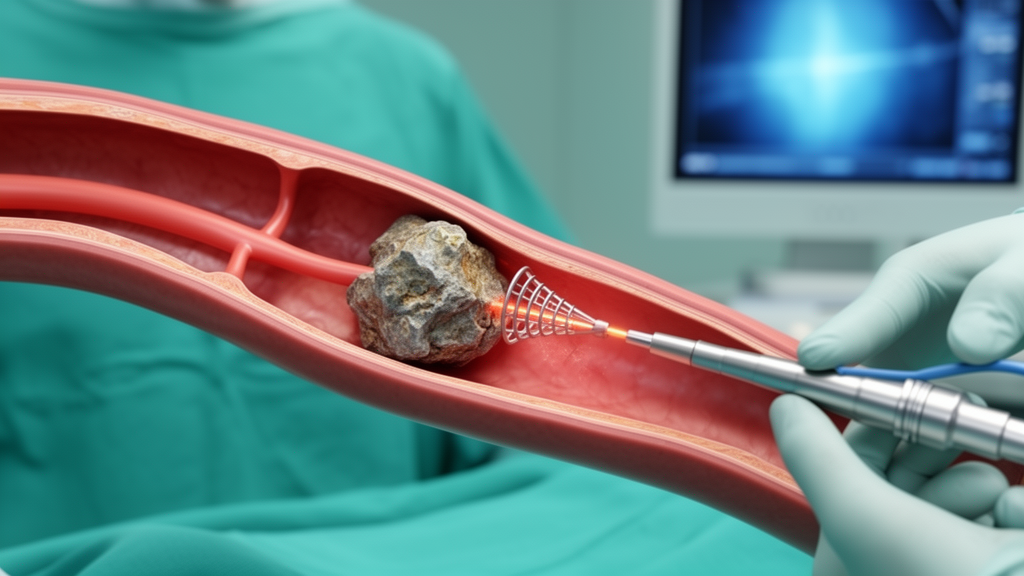
Why might Stone Cone have shown even a numerical edge? The authors speculate that its circumferential coil design provides more uniform occlusion of the ureteral lumen, while the umbrella-style mesh of the NTrap also effectively traps fragments as they are propelled upward. Both are wire-based devices passed beyond the stone before fragmentation begins, creating a physical barrier that keeps debris within reach of the ureteroscope. The alternative strategies, such as modulating lithotripsy energy or reducing irrigation pressure, address the same problem indirectly; mechanical occlusion attacks it directly at the site of fragmentation, which is particularly valuable with pneumatic lithotripsy, the energy source used in this study and one associated with vigorous fragment propulsion.
For surgeons, the practical takeaway is flexibility. The authors conclude that both devices are safe and effective, and that the choice between them can reasonably be guided by surgeon experience, institutional availability, and cost, a consideration they highlight as especially consequential in resource-limited settings where device price directly shapes procedural decisions. For patients, the more important message may be about the state of the evidence: a single-center, open-label trial of 56 patients operated on by a single surgeon, with follow-up limited to one month and no assessment of longer-term outcomes such as spontaneous fragment passage or stone recurrence, cannot settle which device is better. What it can do, and what the authors intend, is to serve as the foundation for the kind of large, multicenter, adequately powered trial that finally will.
Subject of Research: A randomized comparison of the Stone Cone and NTrap anti-retropulsion devices during ureteroscopic lithotripsy for upper and mid-ureteric calculi
Article Title: Comparative evaluation of Stone Cone and NTrap for prevention of stone retropulsion during ureteroscopic lithotripsy for upper and mid-ureteric calculi
Article References: Vivekanandam, V., Singla, A., Goel, H., & Varshney, A. (2026). Comparative evaluation of Stone Cone and NTrap for prevention of stone retropulsion during ureteroscopic lithotripsy for upper and mid-ureteric calculi. African Journal of Urology, 32(1), 80. https://doi.org/10.1186/s12301-026-00627-w
Image Credits: AI Generated
DOI: 10.1186/s12301-026-00627-w
Keywords: ureteroscopic lithotripsy, stone retropulsion, Stone Cone, NTrap, ureteric calculi, stone-free rate, pneumatic lithotripsy, randomized trial, urology, Clavien-Dindo complications, anti-retropulsion devices, non-contrast CT
News Source: Ophelia Keating. (October 29, 2026). Research report: Comparative evaluation of Stone Cone and NTrap for prevention of stone retropulsion during ureteroscopic lithotripsy for upper and mid-ureteric calculi. Scienmag.