


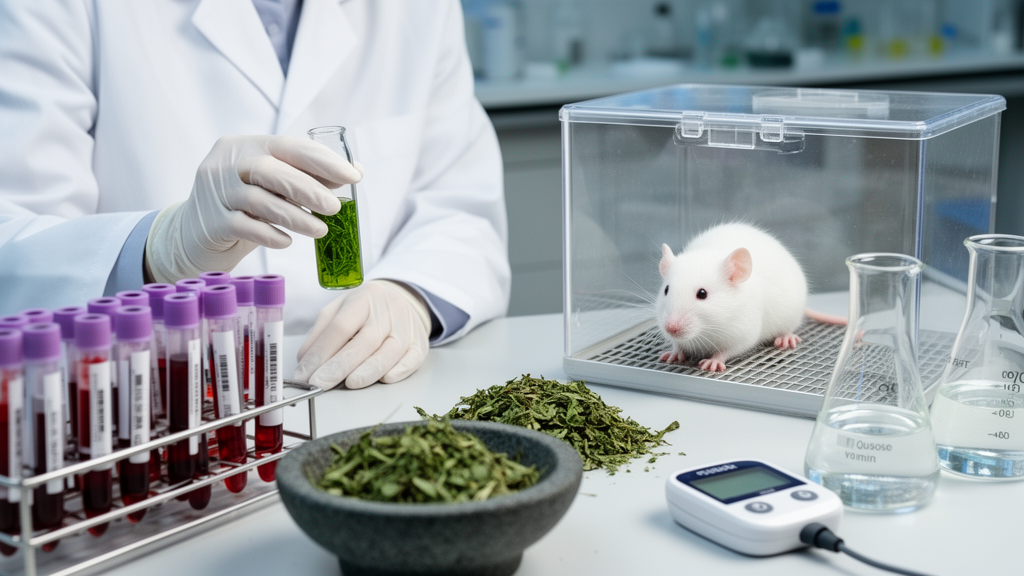
A weed that grows across Pakistan, North Africa and Europe has shown a striking ability to lower blood sugar and ease kidney-related biochemical damage in diabetic laboratory rats, according to a new preclinical study published in the journal Clinical Phytoscience. Researchers prepared a 70% aqueous methanolic extract of Chenopodium murale, commonly known as nettle-leaved goosefoot, and gave it daily by mouth to alloxan-induced diabetic rats for 21 days. By the end of the treatment period, both a 200 mg/kg and a 400 mg/kg dose had markedly reduced fasting blood glucose compared with untreated diabetic animals, while also blunting the body weight loss that typically accompanies uncontrolled diabetes in this model. The effects were described as broadly comparable to those of glibenclamide, a standard sulphonylurea drug used as the comparator in the experiment.
The study, led by Nisar Khan and colleagues at institutions in Pakistan, was designed as a small randomized animal experiment involving 36 albino rats of both sexes, each weighing between 169 and 175 grams. The animals were divided into six groups of six: a normal control group, a diabetic control group that received alloxan but no treatment, a diabetic group treated with glibenclamide at 10 mg/kg, two diabetic groups treated with the plant extract at 200 or 400 mg/kg, and a group of non-diabetic rats given the 200 mg/kg extract dose to examine the extract’s effects in healthy animals. Diabetes was induced with a single intraperitoneal injection of alloxan at 150 mg/kg after a 12 to 14 hour fast, and only rats whose fasting blood glucose exceeded 200 mg/dl three days later were considered diabetic and included in the diabetic groups.
Fasting blood glucose was measured from tail-vein blood on days 0, 7, 14 and 21 using a glucometer, and body weight was recorded at the same intervals. Serum urea, creatinine and total protein were analyzed with a biochemistry autoanalyzer, with day-21 values serving as the main endpoint for between-group comparisons. Statistically, the team used Student’s t-test for two-group comparisons and one-way analysis of variance followed by Dunnett’s multiple comparison test for the larger set of groups, taking the diabetic control group as the principal comparator and considering p-values of 0.05 or lower significant. Samples were processed with coded group labels where feasible to minimize assessment bias, although the authors acknowledge that complete blinding of animal handlers was not possible because treatments and group assignments were visible during administration.
The metabolic results were consistent across the measured endpoints. Untreated diabetic rats lost 12.09% of their body weight over the 21 days, a change the authors attribute to diabetes-associated catabolism in this experimental model. In contrast, diabetic rats receiving the extract gained weight, with increases of 11.43% in the 200 mg/kg group and 10.34% in the 400 mg/kg group. The normal control group gained 4.43%, while the glibenclamide-treated group showed an essentially unchanged weight of minus 0.85%. On the glycemic front, the diabetic control group developed progressive hyperglycemia, whereas both extract-treated groups and the glibenclamide group showed marked reductions in fasting blood glucose by day 21, with the extract’s effect approaching that of the standard drug.
The renal biochemical findings form a central part of the paper. Diabetic control rats displayed elevated serum urea and creatinine compared with normal controls, a pattern the authors interpret as renal biochemical disturbance accompanying the diabetic state. Treatment with either the extract or glibenclamide lowered both markers relative to the diabetic controls. Total protein, which was reduced in untreated diabetic rats, improved in the treated groups, with the most pronounced improvement seen in the 200 mg/kg extract group. Interestingly, the dose response was not uniform: the 200 mg/kg group showed greater improvement in creatinine and total protein, while the 400 mg/kg group achieved a greater reduction in urea. The authors conclude from this that the biochemical response was not strictly dose-dependent across all variables.
Safety was addressed through a separate acute oral toxicity assessment in which rats received progressively increasing oral doses of the extract up to 2000 mg/kg and were monitored for 10 days. No mortality or visible signs of toxicity, including tremors, convulsions, salivation, diarrhea, abnormal gait, lethargy, reduced feeding or drinking, piloerection or respiratory distress, were recorded at any dose. The authors note that this tolerability profile is compatible with the traditional use of Chenopodium murale as an edible plant, although they stress that acute tolerability says little about long-term safety and that subacute and chronic toxicity studies remain necessary before any therapeutic translation.
Chenopodium murale belongs to the Amaranthaceae family and has previously shown antibacterial, antifungal, antihypertensive, anti-inflammatory, hepatoprotective, antioxidant and antidiabetic activity in earlier laboratory work. These effects are attributed to secondary metabolites including flavonoids, phenolic acids, terpenoids, terpenes and steroidal glycosides. The authors argue that the novelty of the present study lies in evaluating a 70% aqueous methanolic whole-plant extract from a locally collected source in an alloxan-induced diabetic model while simultaneously assessing glycemic status, body weight and renal biochemical markers. Earlier work by Ahmed and colleagues had demonstrated antioxidant activity and inhibition of alpha-glucosidase and acetylcholinesterase in vitro, and had tested extracts in a streptozotocin-associated rat model, but the combination of glycemic and renal endpoints in the alloxan model had remained insufficiently characterized.
The authors are careful to frame the mechanistic interpretation as hypothetical. They suggest that the glucose-lowering activity may relate to phytochemicals such as flavonoids, phenolic compounds, tannins and terpenoids, which have been reported in other experimental models to support antioxidant activity, pancreatic beta-cell function, insulin secretion or peripheral glucose utilization. However, because the present study did not measure insulin concentrations, pancreatic histology, oxidative stress markers or molecular pathways, these mechanisms remain speculative. Similarly, the improvement in body weight may partly reflect better glycemic control and reduced catabolic stress, but food intake, insulin levels and muscle protein turnover were not directly measured, so the authors advise caution in this interpretation as well.
The renal findings carry a similar caveat. The authors explicitly state that the term nephroprotective should be used with restraint, because renal histopathology, urinary albumin, renal oxidative stress markers and inflammatory markers were not evaluated. What the data support, they write, is possible renal biochemical protection rather than confirmed structural nephroprotection. The study’s limitations section is candid: the sample size was small at six rats per group, the treatment duration was limited to 21 days, no non-diabetic group received the higher 400 mg/kg dose, and serum lipid parameters were not assessed, so effects on diabetic dyslipidemia could not be evaluated. In an unusual disclosure, the authors report that the original extraction weight sheet was unavailable, meaning the exact percentage yield of the extract could not be retrospectively verified, a point they acknowledge as a methodological limitation.
Within these constraints, the study adds to a growing body of preclinical literature on plant-derived antidiabetic candidates, a field driven in part by the limitations of existing therapies, including adverse effects, procedural discomfort and substantial cost, factors that can restrict adherence in resource-limited settings. The authors conclude that treatment with the 70% aqueous methanolic extract improved glycemic control, body weight and renal biochemical parameters in alloxan-induced diabetic rats, with effects broadly comparable to glibenclamide, and that the absence of acute toxicity up to 2000 mg/kg supports further investigation of Chenopodium murale as a potential antidiabetic agent. For now, the findings remain confined to a small, short-duration animal experiment, and the path from a Bannu-collected weed to any human application would require the mechanistic, histological and chronic toxicity work the authors themselves identify as the necessary next steps.
Subject of Research: Antidiabetic and renal biochemical effects of a Chenopodium murale extract in alloxan-induced diabetic rats
Article Title: Antidiabetic and renal biochemical effects of 70% aqueous methanolic Chenopodium murale extract in alloxan-induced diabetic rats
Article References: Khan, N., Gul, S., Iqbal, M., Shereen, M. I., Mushtaq, S., Shah, I., Ali, R., Ahmed, M., Bukhari, S. H., Bukhari, S. M. S., & Haseeb, A. (2026). Antidiabetic and renal biochemical effects of 70% aqueous methanolic Chenopodium murale extract in alloxan-induced diabetic rats. Clinical Phytoscience, 12(1), Article 30. https://doi.org/10.1186/s40816-026-00445-1
Image Credits: AI Generated
DOI: 10.1186/s40816-026-00445-1
Keywords: Chenopodium murale, diabetes, alloxan-induced diabetic rats, fasting blood glucose, serum urea, creatinine, renal biochemical markers, glibenclamide, acute oral toxicity, preclinical study, plant extract, Clinical Phytoscience
News Source: Ophelia Keating. (October 27, 2026). Research report: Antidiabetic and renal biochemical effects of 70% aqueous methanolic Chenopodium murale extract in alloxan-induced diabetic rats. Scienmag.



