


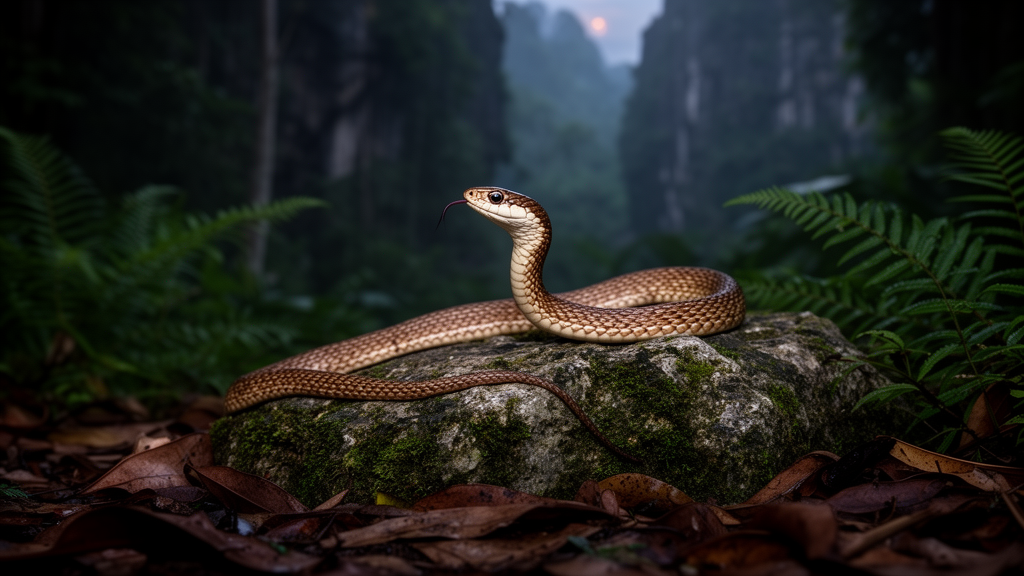
Researchers have documented the wolf snake Lycodon yunnanensis in Vietnam for the first time in Ha Tinh Province, extending the species’ known range roughly 470 kilometres south of its nearest previously documented location, and have reported new records of the closely related Lycodon truongi from Da Nang City and Quang Ngai Province in central Vietnam. The findings, published in the Biodiversity Data Journal, are based on fieldwork in protected forest areas and on genetic and morphological analyses of the collected specimens.
The genus Lycodon, commonly known as wolf snakes, is one of the most diverse groups of colubrid snakes, with 85 currently recognised species distributed from eastern Iran eastwards to Japan and southwards to the Philippines and the Indo-Australian Archipelago. Thirteen new species of the genus have been described in the last five years alone, reflecting how much basic taxonomic work remains to be done in this group. Vietnam is a particular hotspot for the genus: 19 species of Lycodon have been documented in the country to date, and six of the recently described taxa, including L. truongi, were discovered there.
Lycodon yunnanensis was originally described from Kunming City in Yunnan Province, China, and was previously known to occur in Yunnan, including Chuxiong, Lincang, Dali, Yuxi and Mengzi cities and Jingdong, Jianshui and Jinping counties, as well as in north-eastern Vietnam. The new specimen was collected in April 2025 in Vu Quang National Park, Ha Tinh Province, at an elevation of 1,980 metres. The adult male was found on the ground in leaf litter of evergreen forest at 21:10 hours, in habitat consisting of large, medium and small hardwoods mixed with shrubs. The newly documented locality lies approximately 350 kilometres from the type locality in China.
The specimen’s morphology matched the descriptions published in the most recent revision of the species. It measured 380.5 millimetres in snout-vent length, with a tail-length-to-total-length ratio of 0.20, and had 16 maxillary teeth, 203 ventral scales, 79 paired subcaudals, a single precloacal plate and dorsal scale rows arranged 17-17-15, with vertebral scales not enlarged. In life, the head was uniformly blackish-brown dorsally and laterally, the body and tail were dark blackish-brown with 20 greyish-pinkish-cream dorsal bands and nine light bands on the tail, and the ventral surface was mostly cream with black cross-bands. The specimen was deposited in the collections of the University of Science, Vietnam National University, Hanoi.
To confirm the identification, the team extracted DNA and amplified two mitochondrial fragments, cytochrome b (cyt b) and cytochrome c oxidase subunit I (COI). Sequences were aligned in ClustalX 2.1 and analysed under Maximum Parsimony in PAUP*4.0b10, Maximum Likelihood in IQ-TREE v.3.0.1 with 10,000 ultrafast bootstrap replications, and Bayesian Inference in MrBayes v.3.2.7. The phylogenetic analyses placed the Ha Tinh specimen firmly within L. yunnanensis, with strong support in all analyses, with posterior probability of 1 and bootstrap and ultrafast bootstrap values of 100. Genetic divergence between the Vietnamese specimen and sequences of L. yunnanensis from China was estimated at up to 2.06% for the cyt b fragment and 2.89% for COI, levels consistent with the two samples belonging to the same species.
The second part of the study concerns Lycodon truongi, a species described only in 2022 from Khanh Trung Commune, Khanh Vinh District, Khanh Hoa Province, Vietnam, on the basis of a single male holotype, and subsequently reported from Binh Thuan Province, now known as Lam Dong Province. The researchers collected eight additional specimens from Chu Mom Ray National Park in Quang Ngai Province, from the Elephant Habitat and Species Conservation Area in Da Nang City, and from Nam Giang Protection Forest, also in Da Nang City. The collections span several years, with the earliest specimens taken in Chu Mom Ray National Park in April 2014, one specimen from the Elephant Habitat and Species Conservation Area in April 2020, and further material from Nam Giang Protection Forest in December 2024 and from Chu Mom Ray in October 2024.
The newly collected L. truongi specimens showed some morphological variation from the holotype, but the authors judged their characters consistent with the descriptions in the original species description and in the subsequent report from Binh Thuan Province. Across the new series, the maximum snout-vent length was 881.3 millimetres in males and 626.7 millimetres in the female, with tail-length-to-total-length ratios of 0.208 to 0.244, 19 to 26 maxillary teeth, dorsal scales in 17-17-15 rows with four to eight weakly keeled vertebral scale rows from mid-body to vent, 197 to 210 ventral scales, 81 to 91 subcaudals, a single precloacal plate, and 19 to 25 narrowed greyish-cream bands on the dorsal surface of the body with 13 to 15 cream bands on the tail.
Genetic analysis supported the identification of the new L. truongi material. In the phylogenetic trees, the sequences of the specimens from Chu Mom Ray National Park clustered with that of L. truongi with strong support in both analyses, with posterior probability of 1 and bootstrap and ultrafast bootstrap values of 100. The uncorrected p-distance between the new sequences and the holotype of L. truongi, based on a fragment of the cyt b gene, was less than 2.0%. The final molecular matrix consisted of 1,707 aligned base pairs, 657 from COI and 1,050 from cyt b, of which 1,044 were constant, 526 parsimony-informative and 137 variable but parsimony-uninformative, and the resulting tree topologies were very similar to those recovered in earlier studies of the genus.
Ecologically, the L. truongi specimens were found on the ground in leaf litter of evergreen forest at night, between 19:00 and 23:00 hours, in habitat with large, medium and small hardwoods mixed with shrubs. Air temperatures at the sites ranged from 20.0 to 30.0 degrees Celsius and relative humidity was 70 to 90%. Sympatric amphibian and reptile species observed alongside L. truongi included Leptobrachella firthi, Leptobrachium pullus, Limnonectes bannaensis, Ophryophryne hansi, Xenophrys lancangica, Odorrana chloronota, a Scincella skink and the white-lipped pit viper Trimeresurus albolabris. At the Vu Quang site, L. yunnanensis was found near streams in evergreen forest together with Leptobrachella eos, Leptobrachium chapaense, Limnonectes bannaensis, Xenophrys lancangica, an Odorrana frog and the lizard Acanthosaura lepidogaster.
The authors note that L. truongi has not been reported from disturbed areas and appears to be strongly associated with evergreen tropical forests, a habitat type whose quality and extent continue to decline across much of the species’ range because of agricultural activities and tourism. Because the species was found to be widely distributed across the surveyed sites and relatively abundant there, the authors recommend listing it as Least Concern under the IUCN Red List Categories and Criteria, while stressing that further research is needed to clarify its population status and extent of occurrence and to determine threats from habitat loss and degradation and from poaching. They also point out that the original description of L. truongi rested on a single specimen and that only one prior study had examined its distribution and morphological variation, so the broader range now documented may still underestimate the species’ true extent, and additional surveys could expand the known distribution further.
Subject of Research: New distribution records and genetic assessment of two wolf snake species in Vietnam
Article Title: Additional records of Lycodon yunnanensis (Werner, 1922) and range extension of Lycodon truongi Nguyen, Duong, Wood & Grismer, 2022 ( Reptilia , Squamata , Colubridae ) from Vietnam
Article References: Pham, A., Pham, C., Ngo, H., Trinh, H., Dao, T., Pham, T., Pham, N., Dao, C., & Le, M. D. (2026). Additional records of Lycodon yunnanensis (Werner, 1922) and range extension of Lycodon truongi Nguyen, Duong, Wood & Grismer, 2022 (Reptilia, Squamata, Colubridae) from Vietnam. Biodiversity Data Journal, 14, Article e189836. https://doi.org/10.3897/bdj.14.e189836
Image Credits: AI Generated
Keywords: Lycodon, wolf snakes, Vietnam, herpetology, new records, cytochrome b, COI, phylogenetics, Vu Quang National Park, Chu Mom Ray National Park, range extension, reptiles
News Source: Margaret Porter. (October 28, 2026). Research report: Additional records of Lycodon yunnanensis (Werner, 1922) and range extension of Lycodon truongi Nguyen, Duong, Wood & Grismer, 2022 ( Reptilia , Squamata , Colubridae ) from Vietnam. Scienmag.



