• HOME
  • NEWS
  • EXPLORE
    • CAREER
      • Companies
      • Jobs
    • EVENTS
    • iGEM
      • News
      • Team
    • PHOTOS
    • VIDEO
    • WIKI
  • BLOG
  • COMMUNITY
    • FACEBOOK
    • INSTAGRAM
    • TWITTER
Saturday, June 27, 2026
BIOENGINEER.ORG
No Result
View All Result
  • Login
  • HOME
  • NEWS
  • EXPLORE
    • CAREER
      • Companies
      • Jobs
        • Lecturer
        • PhD Studentship
        • Postdoc
        • Research Assistant
    • EVENTS
    • iGEM
      • News
      • Team
    • PHOTOS
    • VIDEO
    • WIKI
  • BLOG
  • COMMUNITY
    • FACEBOOK
    • INSTAGRAM
    • TWITTER
  • HOME
  • NEWS
  • EXPLORE
    • CAREER
      • Companies
      • Jobs
        • Lecturer
        • PhD Studentship
        • Postdoc
        • Research Assistant
    • EVENTS
    • iGEM
      • News
      • Team
    • PHOTOS
    • VIDEO
    • WIKI
  • BLOG
  • COMMUNITY
    • FACEBOOK
    • INSTAGRAM
    • TWITTER
No Result
View All Result
Bioengineer.org
No Result
View All Result
Home NEWS Science News Biology

Research explains why crocodiles have changed so little since the age of the dinosaurs

Bioengineer by Bioengineer
January 7, 2021
in Biology
Reading Time: 2 mins read
0
IMAGE
Share on FacebookShare on TwitterShare on LinkedinShare on RedditShare on Telegram

IMAGE

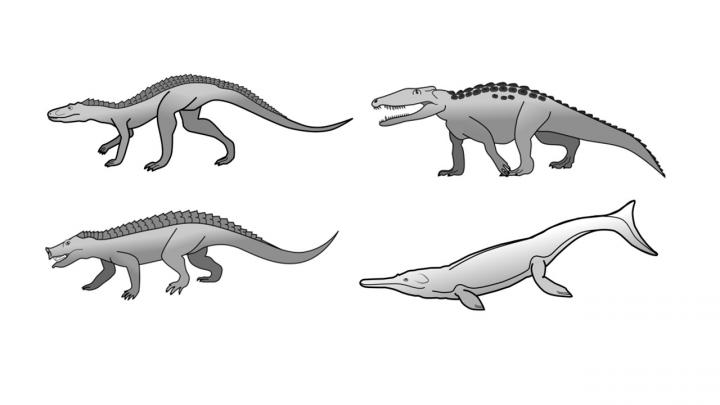
Credit: University of Bristol

New research by scientists at the University of Bristol explains how a ‘stop-start’ pattern of evolution, governed by environmental change, could explain why crocodiles have changed so little since the age of the dinosaurs.

Crocodiles today look very similar to ones from the Jurassic period some 200 million years ago. There are also very few species alive today – just 25. Other animals such as lizards and birds have achieved a diversity of many thousands of species in the same amount of time or less.

Prehistory also saw types of crocodile we don’t see today, including giants as big as dinosaurs, plant-eaters, fast runners and serpentine forms that lived in the sea.

In the new research, published today in the journal Nature Communications Biology, the scientists explain how crocodiles follow a pattern of evolution known as ‘punctuated equilibrium’.

The rate of their evolution is generally slow, but occasionally they evolve more quickly because the environment has changed. In particular, this new research suggests that their evolution speeds up when the climate is warmer, and that their body size increases.

Lead author Dr Max Stockdale from the University of Bristol’s School of Geographical Sciences, said: “Our analysis used a machine learning algorithm to estimate rates of evolution. Evolutionary rate is the amount of change that has taken place over a given amount of time, which we can work out by comparing measurements from fossils and taking into account how old they are.

“For our study we measured body size, which is important because it interacts with how fast animals grow, how much food they need, how big their populations are and how likely they are to become extinct.”

The findings show that the limited diversity of crocodiles and their apparent lack of evolution is a result of a slow evolutionary rate. It seems the crocodiles arrived at a body plan that was very efficient and versatile enough that they didn’t need to change it in order to survive.

This versatility could be one explanation why crocodiles survived the meteor impact at the end of the Cretaceous period, in which the dinosaurs perished. Crocodiles generally thrive better in warm conditions because they cannot control their body temperature and require warmth from the environment.

The climate during the age of dinosaurs was warmer than it is today, and that may explain why there were many more varieties of crocodile than we see now. Being able to draw energy from the sun means they do not need to eat as much as a warm-blooded animal like a bird or a mammal.

Dr Stockdale added: “It is fascinating to see how intricate a relationship exists between the earth and the living things we share it with. The crocodiles landed upon a lifestyle that was versatile enough to adapt to the enormous environmental changes that have taken place since the dinosaurs were around.”

The next step for the team’s research is to find out why some types of prehistoric crocodile died out, while others didn’t.

###

Media Contact
Dr Max Stockdale
[email protected]
Tags: Earth ScienceEvolutionPaleontology
Share13Tweet8Share2ShareShareShare2

Related Posts

Natural Hallucinogens: Evolution’s Ecological Tools, Not Mere Chemical Byproducts

June 25, 2026

This Famous Butterfly Revealed: Three Distinct Species Hidden in One

June 25, 2026

Scientists Attack Soybean Cyst Nematode by Starving Its Food Source

June 25, 2026

Decoding the Secret Code of a Crucial Immune Sensor

June 24, 2026
Please login to join discussion

POPULAR NEWS

  • Saying Goodbye to PGY-6: Pediatric Fellowship Realities

    103 shares
    Share 41 Tweet 26
  • Multi-Hospital Study Reveals Long Covid Burden Is Twice as High as Current Estimates

    92 shares
    Share 36 Tweet 23
  • Detection of EDCs in Breast Milk and Infant Urine Up to Six Months Highlights Early Exposure Risks

    77 shares
    Share 31 Tweet 19
  • New Drug Candidate Developed at McMaster Shows Potential for Treating Brain Cancer

    58 shares
    Share 23 Tweet 15

About

We bring you the latest biotechnology news from best research centers and universities around the world. Check our website.

Follow us

Recent News

Tracking Lanthanide-Labeled Microplastics in Plants

POSTECH Researchers Slash Cost of Reconstituted Cell-Free Systems by 95%

AI and Physics Collaborate to Design Advanced Hydrogen Storage Materials

Subscribe to Blog via Email

Success! An email was just sent to confirm your subscription. Please find the email now and click 'Confirm' to start subscribing.

Join 82 other subscribers
  • Contact Us

Bioengineer.org © Copyright 2023 All Rights Reserved.

Welcome Back!

Login to your account below

Forgotten Password?

Retrieve your password

Please enter your username or email address to reset your password.

Log In
No Result
View All Result
  • Homepages
    • Home Page 1
    • Home Page 2
  • News
  • National
  • Business
  • Health
  • Lifestyle
  • Science

Bioengineer.org © Copyright 2023 All Rights Reserved.