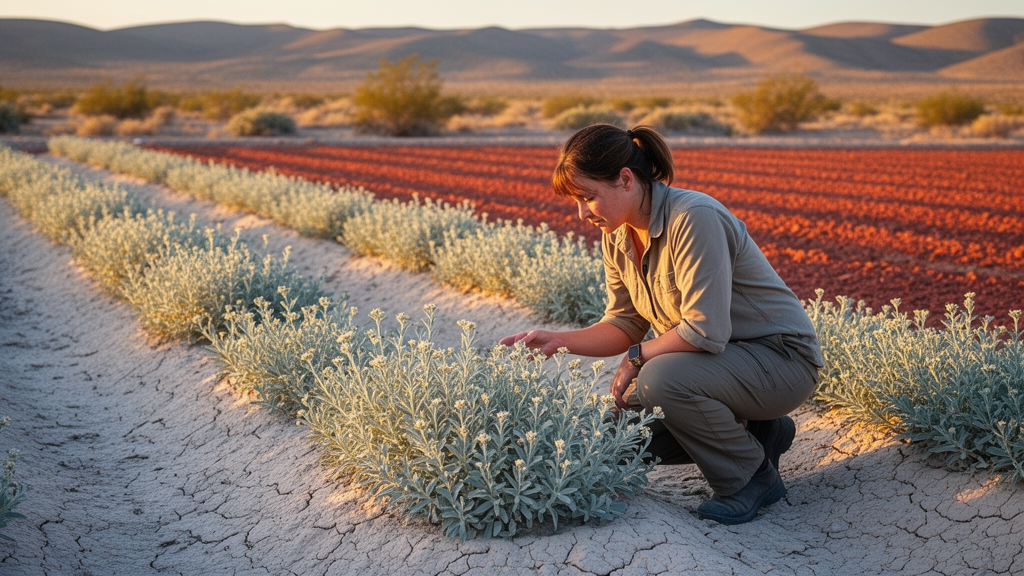
A new field study from the Horqin Sandy Land in Inner Mongolia shows just how costly that shortcut can be for Atractylodes chinensis, a medicinal herb prized in traditional Chinese medicine. Researchers at Inner Mongolia University for Nationalities ran a controlled field experiment comparing continuous cropping with rotation systems, and found that repeated planting significantly reduced both the yield of the plant and the concentrations of its three signature bioactive compounds: atractylodin, atractylon and β-eudesmol. The work, published in Frontiers in Microbiology, links those losses to measurable deterioration in the soil's chemistry and a pronounced shift in the microbial communities living around the plant's roots.
When the team analyzed soil chemical properties under the two cropping regimes, continuous cropping pushed soil pH, electrical conductivity and available potassium upward, while depleting alkali-hydrolyzable nitrogen and organic matter. The correlation analysis sharpened the picture: yield of A. chinensis was negatively correlated with soil electrical conductivity and positively correlated with organic matter content, suggesting that salt accumulation and carbon depletion travel together with the crop's declining productivity. The microbial story proved equally striking.
Using high-throughput sequencing of rhizosphere soil samples, the researchers found that continuous cropping reduced fungal richness, as measured by the Chao1 index, while increasing bacterial diversity and evenness, measured by the Shannon index and Pielou's evenness. At the genus level, the fungal taxa Fusarium and Volutella became significantly enriched under continuous cropping—Fusarium being a genus notorious for soil-borne plant pathogens—while the bacterial genera Nocardioides and Arthrobacter, both frequently associated with nutrient cycling and plant growth promotion, were depleted. The functional consequences extended beyond who was present to what the community could plausibly do.
Predicted functional potential tied to carbon and nitrogen cycling declined significantly under continuous cropping, implying a rhizosphere less capable of recycling the very nutrients the herb needs to build its medicinal chemistry. The correlations the team uncovered tie specific microbes to specific quality traits: atractylon content was positively correlated with the fungal genera Aleuria and Acremonium and negatively correlated with Volutella, while yield tracked positively with the relative abundances of Heydenia and Enterocarpus. These are associations, not proven causal chains, but they offer concrete leads for which organisms might mediate the continuous cropping obstacle.
By measuring yield, bioactive content, soil chemistry and microbial communities in the same experiment, the authors could connect the agronomic outcome to its ecological underpinnings rather than treating them as separate problems. A field that produces less root material that is also less potent represents a double loss, and the soil left behind is saltier, poorer in organic matter, and dominated by a microbial community whose carbon and nitrogen cycling capacity has measurably declined. The authors frame their findings as a theoretical foundation for optimizing cropping systems, maintaining soil ecological health, and improving the yield and quality of this medicinal herb.
Because the functional predictions come from bioinformatic inference rather than direct measurement of enzyme activity, and because the correlations do not establish causation, follow-up work would be needed to confirm which microbial shifts drive the quality decline and which merely accompany it. What the study establishes firmly is the pattern itself. In the Horqin Sandy Land, continuous cropping of A. chinensis is associated with lower yields, lower contents of its major bioactive compounds, altered soil chemistry, and a rhizosphere microbiome whose composition and predicted functions have shifted in ways consistent with dysbiosis.
Subject of Research: Effects of continuous cropping on yield, medicinal quality, and rhizosphere soil microecology of Atractylodes chinensis in the Horqin Sandy Land
Article Title: Effects of continuous cropping on yield, medicinal quality, and rhizosphere soil microecological environment of Atractylodes chinensis in the Horqin Sandy land
Article References: Wang, K., Li, K., Sun, D., Guo, Y., Li, Z., Zhao, Y., Yin, Y., & Jia, J. (2026). Effects of continuous cropping on yield, medicinal quality, and rhizosphere soil microecological environment of Atractylodes chinensis in the Horqin Sandy land. Frontiers in Microbiology, 17, 1943837. https://doi.org/10.3389/fmicb.2026.1943837
Image Credits: AI Generated
DOI: 10.3389/fmicb.2026.1943837
Keywords: Atractylodes chinensis, continuous cropping obstacle, rhizosphere microbiome, soil chemical properties, medicinal plants, Horqin Sandy Land, high-throughput sequencing, Fusarium, soil organic matter, bioactive compounds, crop rotation, soil microbial diversity
News Source: Morgan Morrow. (October 27, 2026). Replanting the Same Soil Strips a Desert-Grown Medicinal Herb of Its Potency. Scienmag.