Across 21 licensed premises in England, removing the largest individual serving size of wine from the menu reduced the volume of wine sold, according to a new study publishing January 18th in the open access journal PLOS Medicine by Theresa Marteau of the University of Cambridge, UK, and colleagues.
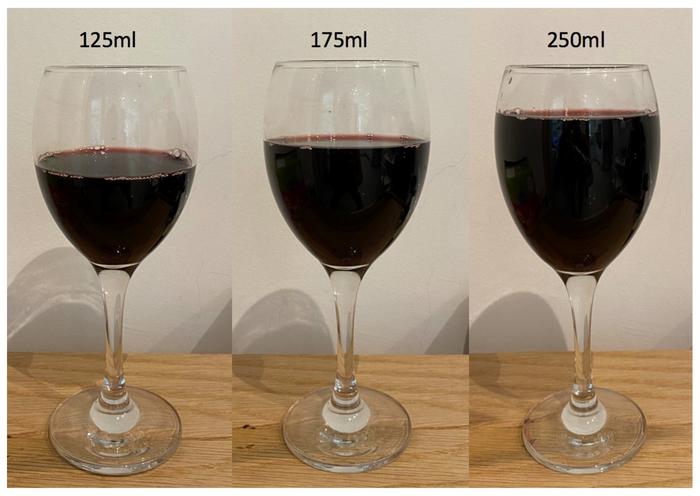
Credit: Eleni Mantzari and Theresa M Marteau, 2022, Nutrients, CC-BY 4.0 (https://creativecommons.org/licenses/by/4.0/)
Across 21 licensed premises in England, removing the largest individual serving size of wine from the menu reduced the volume of wine sold, according to a new study publishing January 18th in the open access journal PLOS Medicine by Theresa Marteau of the University of Cambridge, UK, and colleagues.
Alcohol consumption is the fifth largest contributor to premature death and disease globally. Many cues in physical and economic environments influence alcohol consumption across populations. One proposed intervention to excessive alcohol consumption is reducing the size of servings of alcoholic drinks sold by the glass, but there has been no real-world evidence for the effectiveness of this.
In the new study, researchers asked 21 licensed premises in England to remove from their menus their largest serving of wine by the glass — usually 250 mL — for four weeks. The researchers then tracked the total volume of wine, beer and cider sold by each establishment.
Over the course of the four weeks, the total volume of wine sold by the licensed premises decreased by 7.6%, and there was no overall increase in beer and cider sales. There was an increase in the sales of smaller servings of wine by the glass — generally 125 mL and 175 mL — but no impact on sales of wine by the bottle or beer or cider sales. Despite the decreased volume of wine sold, there was no change in daily revenue, likely reflecting an increased profit margin for smaller glasses of wine. Overall, the study suggests that when the largest serving of wine is not available, people shifted toward the smaller options and ultimately drank less alcohol.
“This suggests that this is a promising intervention for decreasing alcohol consumption across populations, which merits consideration as part of alcohol licensing regulations,” the authors say.
Marteau adds, “Removing the largest serving size of wine by the glass in 21 licensed premises reduced the volume of wine sold, in keeping with the wealth of research showing smaller serving sizes reduce how much we eat. This could become a novel intervention to improve population health by reducing how much we drink.”
#####
In your coverage, please use this URL to provide access to the freely available paper in PLOS Medicine: http://journals.plos.org/plosmedicine/article?id=10.1371/journal.pmed.1004313
Citation: Mantzari E, Ventsel M, Pechey E, Lee I, Pilling MA, Hollands GJ, et al. (2024) Impact on wine sales of removing the largest serving size by the glass: An A-B-A reversal trial in 21 pubs, bars, and restaurants in England. PLoS Med 21(1): e1004313. https://doi.org/10.1371/journal.pmed.1004313
Author Countries: United Kingdom
Funding: The work of this report was funded in whole by Wellcome [PI: TMM: ref 206853/Z/17/Z (Collaborative Award in Science: Behaviour Change by Design: Generating and Implementing Evidence to Improve Health for All)] The funders had no role in study design, data collection and analysis, decision to publish, or preparation of the manuscript.
Journal
PLoS Medicine
DOI
10.1371/journal.pmed.1004313
Method of Research
Experimental study
Subject of Research
People
COI Statement
Competing interests: The authors have declared that no competing interests exist.