• HOME
  • NEWS
  • EXPLORE
    • CAREER
      • Companies
      • Jobs
    • EVENTS
    • iGEM
      • News
      • Team
    • PHOTOS
    • VIDEO
    • WIKI
  • BLOG
  • COMMUNITY
    • FACEBOOK
    • INSTAGRAM
    • TWITTER
Tuesday, February 17, 2026
BIOENGINEER.ORG
No Result
View All Result
  • Login
  • HOME
  • NEWS
  • EXPLORE
    • CAREER
      • Companies
      • Jobs
        • Lecturer
        • PhD Studentship
        • Postdoc
        • Research Assistant
    • EVENTS
    • iGEM
      • News
      • Team
    • PHOTOS
    • VIDEO
    • WIKI
  • BLOG
  • COMMUNITY
    • FACEBOOK
    • INSTAGRAM
    • TWITTER
  • HOME
  • NEWS
  • EXPLORE
    • CAREER
      • Companies
      • Jobs
        • Lecturer
        • PhD Studentship
        • Postdoc
        • Research Assistant
    • EVENTS
    • iGEM
      • News
      • Team
    • PHOTOS
    • VIDEO
    • WIKI
  • BLOG
  • COMMUNITY
    • FACEBOOK
    • INSTAGRAM
    • TWITTER
No Result
View All Result
Bioengineer.org
No Result
View All Result
Home NEWS Science News Biology

Releasing brakes on biocatalysis

Bioengineer by Bioengineer
November 29, 2023
in Biology
Reading Time: 2 mins read
0
Group of authors
Share on FacebookShare on TwitterShare on LinkedinShare on RedditShare on Telegram

How a preservative affects H2-forming biocatalysts
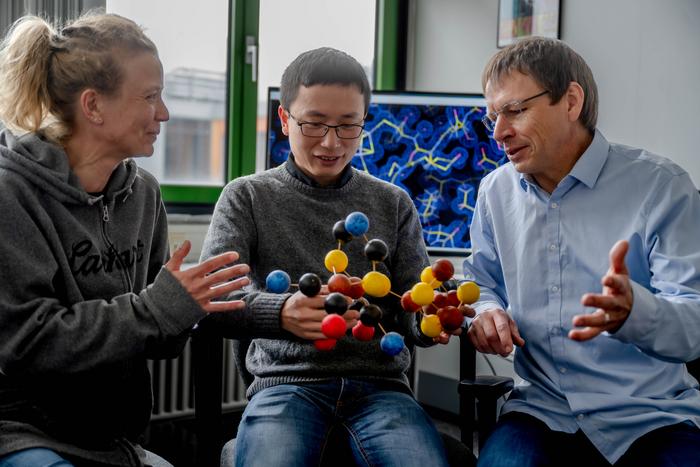
Group of authors

Credit: RUB, Marquard

How a preservative affects H2-forming biocatalysts

Formaldehyde is known as a preservative, among other things, but it also occurs as a natural metabolite in living cells. Twelve years ago, scientists from the University of Oxford, UK, and Ruhr University Bochum, Germany, showed that this omnipresent molecule inhibits a certain class of biocatalysts, namely the particularly efficient hydrogen-generating hydrogenases of the two-iron type – so-called [FeFe]-hydrogenases. “This was an interesting discovery, because formaldehyde could inhibit both the natural H2 metabolism of microorganisms and isolated hydrogenases in biotechnological applications,” explains Dr Jifu Duan, first author of the study.

Molecular mechanism of formaldehyde poisoning elucidated

After various theoretical studies had hypothesized how the formaldehyde molecule might influence [FeFe]-hydrogenases, a team of researchers led by Jifu Duan and Professor Eckhard Hofmann at Ruhr University has now succeeded in elucidating the molecular mechanism experimentally. Using structures of formaldehyde-treated [FeFe]-hydrogenases obtained by protein crystallography, they were able to show that formaldehyde reacts with the so-called active center of the biocatalysts – an inorganic protein part where protons and electrons are converted to H2. In addition, however, formaldehyde combines with another very important protein part, which is necessary for the transport of protons to the active center by means of a sulfur-containing chemical group. When the scientists replaced this part with another, formaldehyde was hardly able to exert its inhibitory effect.

The new findings could play a role in H2 technologies

“Future biotechnological applications of [FeFe]-hydrogenases may well involve the presence of formaldehyde, so that our modified formaldehyde-resistant biocatalysts could be used here,” explains Jifu Duan. “We also believe that our findings can be transferred to other biocatalysts.” This could play a role for bio-based industrial processes, but also for understanding metabolic pathways in living organisms.


Journal

Journal of the American Chemical Society

DOI

10.1021/jacs.3c07800

Method of Research

Experimental study

Subject of Research

Cells

Article Title

Insights Into the Molecular Mechanism of Formaldehyde Inhibition of [FeFe]-hydrogenases

Article Publication Date

20-Nov-2023

Share12Tweet8Share2ShareShareShare2

Related Posts

Celebrated Developmental Biologist Awarded Prestigious March of Dimes Prize

Celebrated Developmental Biologist Awarded Prestigious March of Dimes Prize

February 17, 2026
blank

Seizure Samples Uncover Complex Evolution in Pangolins

February 17, 2026

Creating Self-Incompatible Hybrid Potatoes via Haploid Breeding

February 17, 2026

Molecular Glue Discovery: From Lucky Strike to Large-Scale Breakthrough

February 17, 2026

POPULAR NEWS

  • Imagine a Social Media Feed That Challenges Your Views Instead of Reinforcing Them

    Imagine a Social Media Feed That Challenges Your Views Instead of Reinforcing Them

    935 shares
    Share 372 Tweet 233
  • Digital Privacy: Health Data Control in Incarceration

    64 shares
    Share 26 Tweet 16
  • New Record Great White Shark Discovery in Spain Prompts 160-Year Scientific Review

    59 shares
    Share 24 Tweet 15
  • Epigenetic Changes Play a Crucial Role in Accelerating the Spread of Pancreatic Cancer

    56 shares
    Share 22 Tweet 14

About

We bring you the latest biotechnology news from best research centers and universities around the world. Check our website.

Follow us

Recent News

SNCA Triplication Impairs Proteostasis, Architecture Before Neurodegeneration

Crossbar Chip Advances Semiconductor Spin Qubit Benchmarking

JMIR Bioinformatics and Biotechnology Calls for Submissions on Bridging Data, AI, and Innovation to Revolutionize Healthcare

Subscribe to Blog via Email

Enter your email address to subscribe to this blog and receive notifications of new posts by email.

Join 74 other subscribers
  • Contact Us

Bioengineer.org © Copyright 2023 All Rights Reserved.

Welcome Back!

Login to your account below

Forgotten Password?

Retrieve your password

Please enter your username or email address to reset your password.

Log In
No Result
View All Result
  • Homepages
    • Home Page 1
    • Home Page 2
  • News
  • National
  • Business
  • Health
  • Lifestyle
  • Science

Bioengineer.org © Copyright 2023 All Rights Reserved.