• HOME
  • NEWS
  • EXPLORE
    • CAREER
      • Companies
      • Jobs
    • EVENTS
    • iGEM
      • News
      • Team
    • PHOTOS
    • VIDEO
    • WIKI
  • BLOG
  • COMMUNITY
    • FACEBOOK
    • INSTAGRAM
    • TWITTER
Thursday, September 24, 2026
BIOENGINEER.ORG
No Result
View All Result
  • Login
  • HOME
  • NEWS
  • EXPLORE
    • CAREER
      • Companies
      • Jobs
        • Lecturer
        • PhD Studentship
        • Postdoc
        • Research Assistant
    • EVENTS
    • iGEM
      • News
      • Team
    • PHOTOS
    • VIDEO
    • WIKI
  • BLOG
  • COMMUNITY
    • FACEBOOK
    • INSTAGRAM
    • TWITTER
  • HOME
  • NEWS
  • EXPLORE
    • CAREER
      • Companies
      • Jobs
        • Lecturer
        • PhD Studentship
        • Postdoc
        • Research Assistant
    • EVENTS
    • iGEM
      • News
      • Team
    • PHOTOS
    • VIDEO
    • WIKI
  • BLOG
  • COMMUNITY
    • FACEBOOK
    • INSTAGRAM
    • TWITTER
No Result
View All Result
Bioengineer.org
No Result
View All Result
Home NEWS Science News Health

Rejuvenated fibroblasts can recover the ability to contract

Bioengineer by Bioengineer
May 26, 2020
in Health
Reading Time: 2 mins read
0
IMAGE
Share on FacebookShare on TwitterShare on LinkedinShare on RedditShare on Telegram

IMAGE

Credit: National University of Singapore

Fibroblasts are the most common connective tissue cells. They produce the structural framework for animal tissues, synthesise the extracellular matrix and collagen, and play a critical role in wound healing. However, during the cellular aging process, fibroblasts lose their ability to contract, leading to stiffness due to reduced connective tissues.

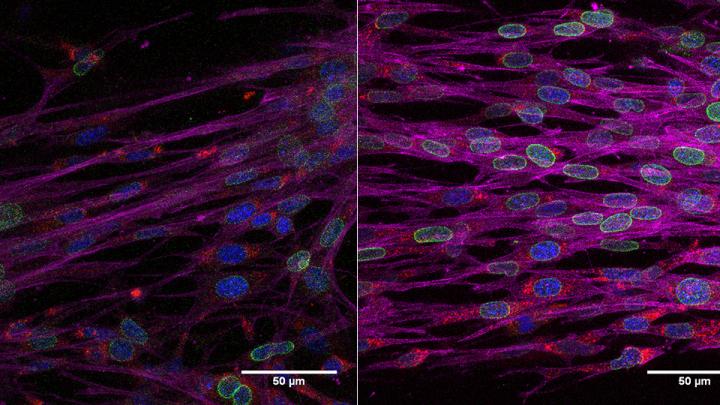
A study from the Mechanobiology Institute at the National University of Singapore has shown that these fibroblasts can be rejuvenated, or redifferentiated, by being geometrically confined on micropatterns. The above shows microscopic imaging of the control (left) and rejuvenated fibroblasts (right), with fluorescent labels highlighting the nucleus (blue), nuclear envelope (green), and cytoskeleton (in magenta). The presence of more contractile proteins (in red) in the rejuvenated fibroblasts indicates that they have recovered their ability to contract. These rejuvenated cells were observed to have reduced DNA damage, and enhanced cytoskeletal gene expression.

The results of this study were first published in the Proceedings of the National Academy of Sciences on 29 April 2020.

The research team believes that their mechanical reprogramming approach can overcome the shortcomings of conventional rejuvenation methods, including generation of short-lived or oncogenic fibroblasts. These mechanically rejuvenated fibroblasts could potentially be used as clinical implants in regenerative medicine and stem cell engineering.

###

Media Contact
Rachel Lim
[email protected]

Original Source

https://news.nus.edu.sg/research/rejuvenated-fibroblasts-can-recover-ability-contract

Related Journal Article

http://dx.doi.org/10.1073/pnas.1911497117

Tags: BiologyBiomedical/Environmental/Chemical EngineeringBiotechnologyCell BiologyMolecular BiologyRehabilitation/Prosthetics/Plastic SurgeryTransplantation
Share12Tweet8Share2ShareShareShare2

Related Posts

Swedish Birth Cohort Turns Its Lens on Mothers to Trace Breast Cancer’s Environmental Roots

September 24, 2026

New Risk Model Predicts Kidney Disease Years Before It Strikes People With Prediabetes

September 24, 2026

Hand-Sewn Suture Technique Achieves Coupler-Level Vessel Results in Head and Neck Rebuilds

September 24, 2026

Stigma in the Clinic Strongly Predicts HIV Treatment Interruption in Kenya

September 24, 2026
Please login to join discussion

POPULAR NEWS

  • Staphylococcal Protein Reprograms Liver Tumor Macrophages to Boost Immunotherapy

    29 shares
    Share 12 Tweet 7
  • Hidden Microbes Inside Mung Bean Show Striking Stress Tolerance and Fungal-Fighting Power

    29 shares
    Share 12 Tweet 7
  • Noisy Gates Put Gate Teleportation to the Test

    29 shares
    Share 12 Tweet 7
  • Prenatal BPA Exposure Rewires the Cerebellum Differently in Male and Female Rat Offspring

    29 shares
    Share 12 Tweet 7

About

BIOENGINEER.ORG

We bring you the latest biotechnology news from best research centers and universities around the world. Check our website.

Follow us

Recent News

Staphylococcal Protein Reprograms Liver Tumor Macrophages to Boost Immunotherapy

Hidden Microbes Inside Mung Bean Show Striking Stress Tolerance and Fungal-Fighting Power

Noisy Gates Put Gate Teleportation to the Test

Subscribe to Blog via Email

Enter your email address to subscribe to this blog and receive notifications of new posts by email.

Join 85 other subscribers
  • Contact Us

Bioengineer.org © Copyright 2023 All Rights Reserved.

Welcome Back!

Login to your account below

Forgotten Password?

Retrieve your password

Please enter your username or email address to reset your password.

Log In
No Result
View All Result
  • Homepages
    • Home Page 1
    • Home Page 2
  • News
  • National
  • Business
  • Health
  • Lifestyle
  • Science

Bioengineer.org © Copyright 2023 All Rights Reserved.