• HOME
  • NEWS
  • EXPLORE
    • CAREER
      • Companies
      • Jobs
    • EVENTS
    • iGEM
      • News
      • Team
    • PHOTOS
    • VIDEO
    • WIKI
  • BLOG
  • COMMUNITY
    • FACEBOOK
    • INSTAGRAM
    • TWITTER
Monday, October 5, 2026
BIOENGINEER.ORG
No Result
View All Result
  • Login
  • HOME
  • NEWS
  • EXPLORE
    • CAREER
      • Companies
      • Jobs
        • Lecturer
        • PhD Studentship
        • Postdoc
        • Research Assistant
    • EVENTS
    • iGEM
      • News
      • Team
    • PHOTOS
    • VIDEO
    • WIKI
  • BLOG
  • COMMUNITY
    • FACEBOOK
    • INSTAGRAM
    • TWITTER
No Result
View All Result
Bioengineer.org
No Result
View All Result
Home NEWS Science News Biology

Reindeer grazing protects tundra plant diversity in a warming climate

Bioengineer by Bioengineer
September 4, 2017
in Biology
Reading Time: 2 mins read
0
Share on FacebookShare on TwitterShare on LinkedinShare on RedditShare on Telegram
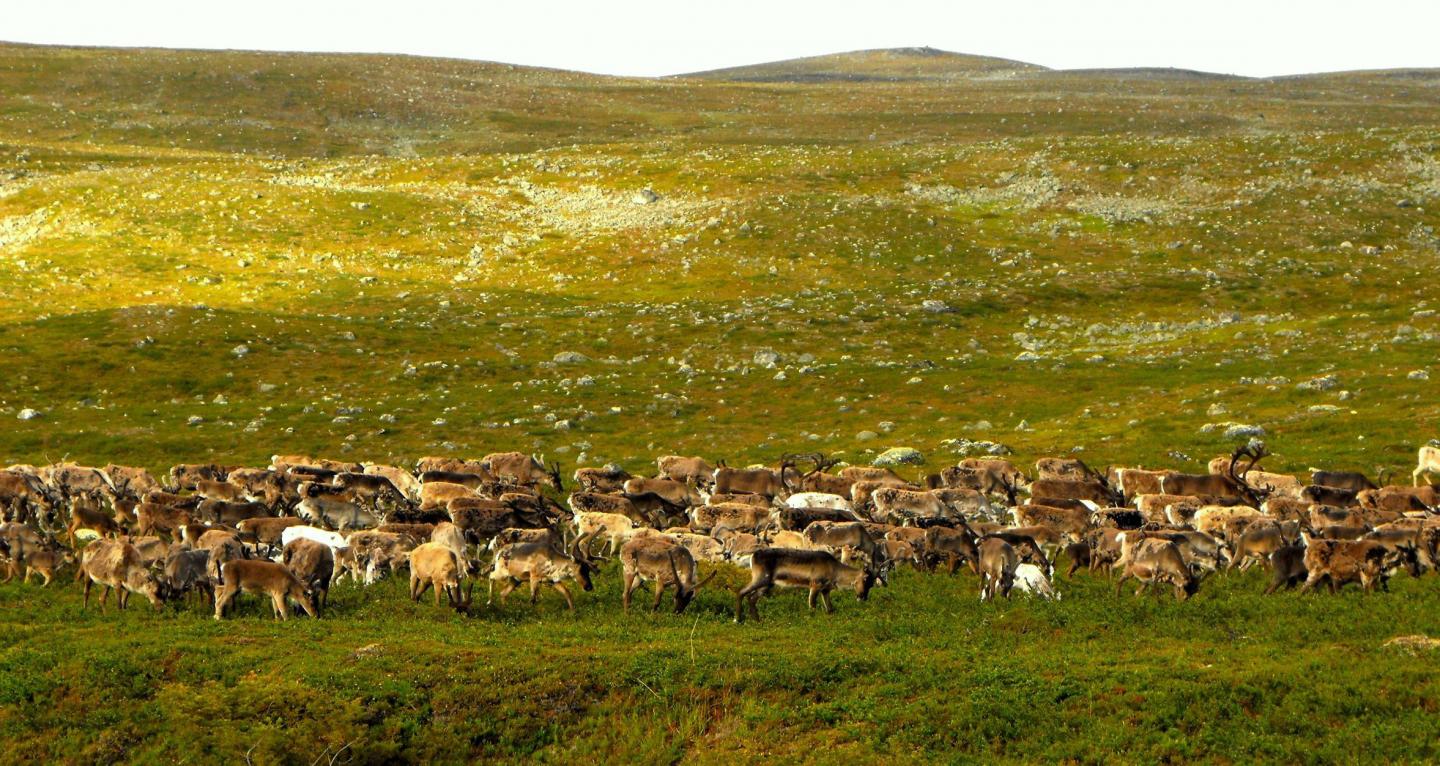
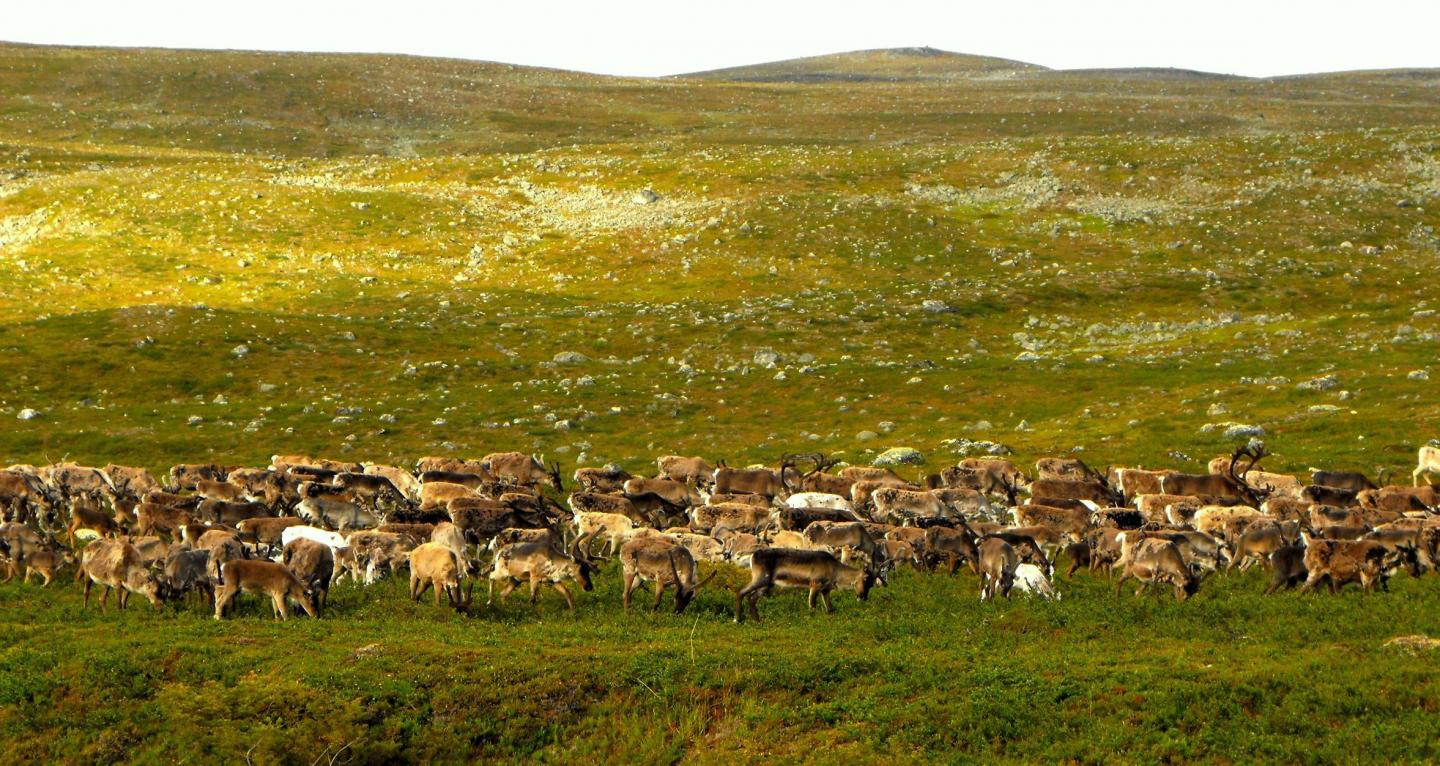
IMAGE

Credit: Elina Kaarlejärvi

Climate warming reduces the number of plant species in the tundra, but plant-eating animals, such as reindeer and voles, can turn this negative effect into something positive. The results of a study coordinated from Umeå University in Sweden are now published in Nature Communications.

"By eating tall and wide-leaved plants, reindeer can increase light availability and thus allow more plant species to co-exist and benefit from warmer conditions," says Elina Kaarlejärvi, post-doctoral researcher at Umeå University, who led the study.

Earlier studies suggest that tundra plant diversity will decrease in response to a warmer climate. However, it is important to know whether the response depends on the abundance of grazing animals, particularly reindeer, voles and lemmings, which are very common in tundra ecosystems. Researchers at Umeå University in Sweden, and Oulu University in Finland, tested this through experimental warming of vegetation on tundra meadows with and without reindeer and voles.

"We found that the warming increased the number of species in plots that were grazed, because it enabled small tundra plants to appear and grow there. But when we fenced reindeer, voles and lemmings out, vegetation became denser and the light was limited. As a result, many small and slowly-growing plant species were lost," says Elina Kaarlejärvi.

The researchers investigated what species appeared and disappeared from the study plots over the course of five years. By doing so, they could test what kinds of species were most affected by warming and grazing. The newly published results suggest that mammalian herbivores could generally help protect diversity in warmer climates by preventing losses of small and slowly-growing species.

The study was performed in Kilpisjärvi in northwest Finland, where the research team tested the importance of grazing animals, warming and nutrient availability by combining small greenhouses that increased the summer temperature by 1-2 degrees Celsius, small fences that excluded reindeer, voles and lemmings, as well as by use of fertilization.

###

Elina Kaarlejärvi is a post-doctoral researcher funded by the Swedish Research Council, VR. She is affiliated to the Climate Impacts Research Centre (CIRC) at Umeå University, but she currently works at Vrije Universiteit Brussel in Belgium.

The research team includes Anu Eskelinen, academy research fellow at the University of Oulu. She currently works at the Helmholtz Centre for Environmental Research and the German Centre for Integrative Biodiversity Research in Germany, and Johan Olofsson, associate professor at the Department of Ecology and Environmental Science and at CIRC at Umeå University.

About the study

Herbivores rescue diversity in warming tundra by modulating trait-dependent species losses and gains, Elina Kaarlejärvi, Anu Eskelinen och Johan Olofsson, Nature Communications, DOI: 10.1038/s41467-017-00554-z

Media Contact

Anna-Lena Lindskog
[email protected]
46-907-865-878
@UmeaUniversity

http://www.umu.se/umu/index_eng.html

Related Journal Article

http://dx.doi.org/10.1038/s41467-017-00554-z

Share12Tweet8Share2ShareShareShare2

Related Posts

Novel De Novo MTM1 Frameshift Variant Drives Severe Muscle Disease in a Young Chinese Woman

Novel De Novo MTM1 Frameshift Variant Drives Severe Muscle Disease in a Young Chinese Woman

October 5, 2026
Cheap Gel Test Reveals Hidden Coral Species Without Sequencing

Cheap Gel Test Reveals Hidden Coral Species Without Sequencing

October 5, 2026

Blood Tests of Ageing Face Off: Brain Scans and Epigenetic Clocks Beat Organ Clocks at Predicting Death

October 5, 2026

AI Learns to Spot Plant Enzymes with Pre-Trained Protein Embeddings

October 5, 2026
Please login to join discussion

POPULAR NEWS

  • Alloys That Shrink Their Own Grains: New PIX Mechanism Refines Metals With Heat Alone

    Alloys That Shrink Their Own Grains: New PIX Mechanism Refines Metals With Heat Alone

    29 shares
    Share 12 Tweet 7
  • Endurance Exercise Reshapes the Liver in Males and Females Through Distinct Molecular Routes

    29 shares
    Share 12 Tweet 7
  • Single Transcription Factor PU.1 Rapidly Converts Fibroblasts into Macrophage-Lineage Cells

    29 shares
    Share 12 Tweet 7
  • New Scale Measures How Ready Nurse Educators Really Are for the AI Era

    29 shares
    Share 12 Tweet 7

About

We bring you the latest biotechnology news from best research centers and universities around the world. Check our website.

Follow us

Recent News

Alloys That Shrink Their Own Grains: New PIX Mechanism Refines Metals With Heat Alone

Endurance Exercise Reshapes the Liver in Males and Females Through Distinct Molecular Routes

Single Transcription Factor PU.1 Rapidly Converts Fibroblasts into Macrophage-Lineage Cells

Subscribe to Blog via Email

Success! An email was just sent to confirm your subscription. Please find the email now and click 'Confirm' to start subscribing.

Join 85 other subscribers
  • Contact Us

Bioengineer.org © Copyright 2023 All Rights Reserved.

Welcome Back!

Login to your account below

Forgotten Password?

Retrieve your password

Please enter your username or email address to reset your password.

Log In
No Result
View All Result
  • Homepages
    • Home Page 1
    • Home Page 2
  • News
  • National
  • Business
  • Health
  • Lifestyle
  • Science

Bioengineer.org © Copyright 2023 All Rights Reserved.