• HOME
  • NEWS
  • EXPLORE
    • CAREER
      • Companies
      • Jobs
    • EVENTS
    • iGEM
      • News
      • Team
    • PHOTOS
    • VIDEO
    • WIKI
  • BLOG
  • COMMUNITY
    • FACEBOOK
    • INSTAGRAM
    • TWITTER
Saturday, December 27, 2025
BIOENGINEER.ORG
No Result
View All Result
  • Login
  • HOME
  • NEWS
  • EXPLORE
    • CAREER
      • Companies
      • Jobs
        • Lecturer
        • PhD Studentship
        • Postdoc
        • Research Assistant
    • EVENTS
    • iGEM
      • News
      • Team
    • PHOTOS
    • VIDEO
    • WIKI
  • BLOG
  • COMMUNITY
    • FACEBOOK
    • INSTAGRAM
    • TWITTER
  • HOME
  • NEWS
  • EXPLORE
    • CAREER
      • Companies
      • Jobs
        • Lecturer
        • PhD Studentship
        • Postdoc
        • Research Assistant
    • EVENTS
    • iGEM
      • News
      • Team
    • PHOTOS
    • VIDEO
    • WIKI
  • BLOG
  • COMMUNITY
    • FACEBOOK
    • INSTAGRAM
    • TWITTER
No Result
View All Result
Bioengineer.org
No Result
View All Result
Home NEWS Science News Chemistry

Regulating off-centering distortion maximizes photoluminescence in halide perovskites

Bioengineer by Bioengineer
December 21, 2020
in Chemistry
Reading Time: 2 mins read
0
IMAGE
Share on FacebookShare on TwitterShare on LinkedinShare on RedditShare on Telegram

IMAGE

Credit: Xujie Lü

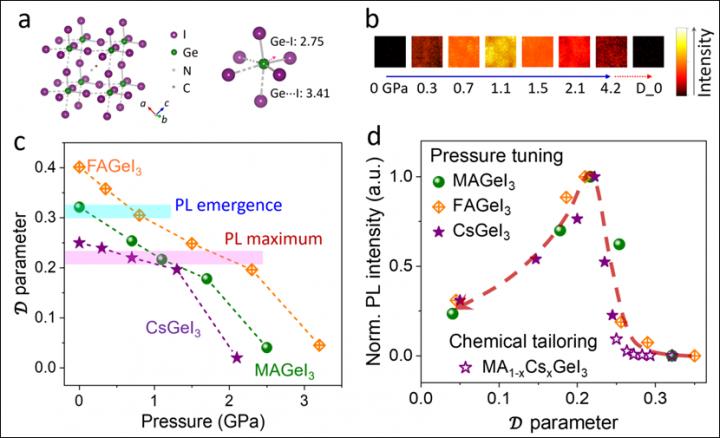
In work published in the National Science Review (nwaa288), a team at HPSTAR led by Dr. Xujie Lü applied high pressure to tune the remarkable photoluminescence (PL) properties in halide perovskites. For the first time, they reveal a universal relationship whereby regulating the level of off-centering distortion (towards 0.2) can achieve optimal PL performance.

The extraordinary electronic and optical properties that halide perovskites possess have revolutionized next-generation photovoltaics and optoelectronics’ prospects. However, the underlying mechanisms responsible for their unique functionalities are still not fully understood. Developing our fundamental understanding of how structural configurations affect their properties is crucial. As a thermodynamic variable, pressure can effectively tune the lattice and electronic configurations, resulting in concomitant changes in materials’ properties.

Using advanced in situ/operando high-pressure techniques in combination with theoretical calculations yielded fascinating results. “By carefully selecting and regulating the highly-distorted halide perovskites, we reached an otherwise unreachable structural region for probing properties that affords a great opportunity to understand the structure-property relationship,” said Dr. Lü.

The team applied their obtained principle as a guideline to achieve bright PL in (CH3NH3)1-xCsxGeI3 by chemically substituting CH3NH3+ with smaller sized Cs+. The chemical substitution tunes the distortion, much like external pressure. The compression of CsGeI3 further regulates the distortion to the optimal value at 0.7 GPa, which maximizes the emission with a ten-fold enhancement. These findings open new paths to high-performance optoelectronic materials by leveraging the distortion and strain degrees of freedom.

“This work not only demonstrates the quantitative relationship between structural distortion and the PL property of halide perovskites,” said Dr. Lü. “But also illustrates the use of the extracted knowledge for the virtuous cycle of materials design and optimization.”

This direct use of knowledge gained from high-pressure research to purposefully design and synthesize materials with desired properties at ambient conditions is rarely reported.

###

More information: “Regulating off-centering distortion maximizes photoluminescence in halide perovskites”, Lü et al., National Science Review, nwaa288, https://doi.org/10.1093/nsr/nwaa288.

Media Contact
Haini Dong
[email protected]

Related Journal Article

http://dx.doi.org/10.1093/nsr/nwaa288

Tags: Atomic PhysicsAtomic/Molecular/Particle PhysicsChemistry/Physics/Materials SciencesEnergy/Fuel (non-petroleum)Industrial Engineering/ChemistryMaterials
Share12Tweet8Share2ShareShareShare2

Related Posts

Cutting Electrolyte Reduction Boosts High-Energy Battery Performance

Cutting Electrolyte Reduction Boosts High-Energy Battery Performance

December 19, 2025
Microenvironment Shapes Gold-Catalysed CO2 Electroreduction

Microenvironment Shapes Gold-Catalysed CO2 Electroreduction

December 11, 2025

Photoswitchable Olefins Enable Controlled Polymerization

December 11, 2025

Cation Hydration Entropy Controls Chloride Ion Diffusion

December 10, 2025
Please login to join discussion

POPULAR NEWS

  • Robotic Waist Tether for Research Into Metabolic Cost of Walking

    NSF funds machine-learning research at UNO and UNL to study energy requirements of walking in older adults

    71 shares
    Share 28 Tweet 18
  • Nurses’ Views on Online Learning: Effects on Performance

    70 shares
    Share 28 Tweet 18
  • Exploring Audiology Accessibility in Johannesburg, South Africa

    51 shares
    Share 20 Tweet 13
  • Unraveling Levofloxacin’s Impact on Brain Function

    54 shares
    Share 22 Tweet 14

About

We bring you the latest biotechnology news from best research centers and universities around the world. Check our website.

Follow us

Recent News

Sustainable Equatorial Forest Management: A Decision-Making Framework

Umbilical Cord Milking: Harvesting Cells for Regeneration

Insights on Dementia Care in Nursing Homes

Subscribe to Blog via Email

Enter your email address to subscribe to this blog and receive notifications of new posts by email.

Join 71 other subscribers
  • Contact Us

Bioengineer.org © Copyright 2023 All Rights Reserved.

Welcome Back!

Login to your account below

Forgotten Password?

Retrieve your password

Please enter your username or email address to reset your password.

Log In
No Result
View All Result
  • Homepages
    • Home Page 1
    • Home Page 2
  • News
  • National
  • Business
  • Health
  • Lifestyle
  • Science

Bioengineer.org © Copyright 2023 All Rights Reserved.