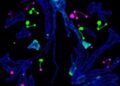
UConn bioengineers successfully regrew cartilage in a rabbit’s knee, a promising hop toward healing joints in humans, they report in the 12 January issue of Science Translational Medicine.
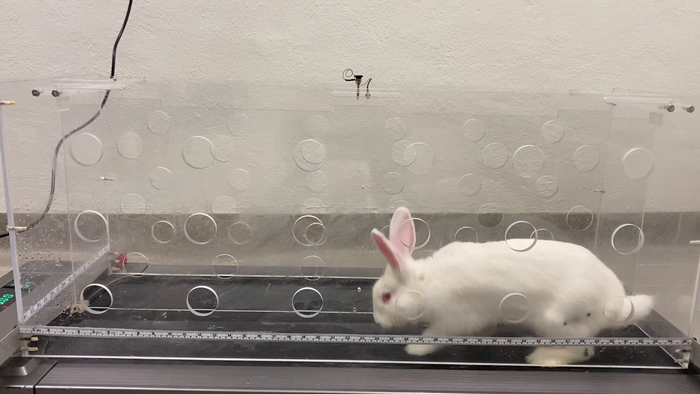
Credit: Thanh Nguyen/University of Connecticut and UConn Health
UConn bioengineers successfully regrew cartilage in a rabbit’s knee, a promising hop toward healing joints in humans, they report in the 12 January issue of Science Translational Medicine.
Arthritis is a common and painful disease caused by damage to our joints. Normally pads of cartilage cushion those spots. But injuries or age can wear it away. As cartilage deteriorates, bone begins to hit bone, and everyday activities like walking become terribly painful.
The best treatments available try to replace the damaged cartilage with a healthy piece taken from elsewhere in the body or a donor. But healthy cartilage is in limited supply. If it’s your own, transplanting it could injure the place it was taken from; if it’s from someone else, your immune system is likely to reject it.
The best possible treatment would be to regrow healthy cartilage in the damaged joint itself. Some researchers have tried amplifying chemical growth factors to induce the body to grow cartilage on its own; other attempts rely on a bioengineered scaffold to give the body a template for the fresh tissue. But neither of these approaches works, even in combination.
“The regrown cartilage doesn’t behave like native cartilage. It breaks, under the normal stresses of the joint”, says UConn bioengineer Thanh Nguyen.
Nguyen’s lab has also been working on cartilage regeneration, and they’ve discovered that electrical signals are key to normal growth. They designed a tissue scaffold made out of nanofibers of poly-L lactic acid (PLLA), a biodegradable polymer often used to stitch up surgical wounds. The nanomaterial has a neat property called piezo-electricity. When it is squeezed, it produces a little burst of electrical current. The regular movement of a joint, such as a person walking, can cause the PLLA scaffold to generate a weak but steady electrical field that encourages cells to colonize it and grow into cartilage. No outside growth factors or stem cells (which are potentially toxic or risk undesired adverse events) are necessary, and crucially, the cartilage that grows is mechanically robust.
The team recently tested the scaffold in the knee of an injured rabbit. The rabbit was allowed to hop on a treadmill to exercise after the scaffold was implanted, and just as predicted, the cartilage grew back normally. “Piezoelectricity is a phenomenon that also exists in the human body. Bone, cartilage, collagen, DNA and various proteins have a piezoelectric response. Our approach to healing cartilage is highly clinically translational, and we will look into the related healing mechanism”, says Dr. Yang Liu, a postdoctoral fellow in Nguyen’s group and the lead author of the published work.
The results are exciting, but Nguyen is cautious.
“This is a fascinating result, but we need to test this in a larger animal,” one with a size and weight closer to a human, Nguyen says. His lab would want to observe the animals treated for at least a year, probably two, to make sure the cartilage is durable. And it would be ideal to test the PLLA scaffolds in older animals, too. Arthritis is normally a disease of old age in humans. Young animals heal more easily than old—if the piezoelectric scaffolding helps older animals heal as well, it truly could be a bioengineering breakthrough.
This work is supported by the NIH (grants # R21EB024787 and R21AR078744). Other co-authors in the STM publication include Godwin Dzidotor, Thinh T. Le, Tra Vinikoor, Kristin Morgan, Eli J. Curry, Ritopa Das, Aneesah McClinton, Ellen Eisenberg, Lorraine N. Apuzzo, Khanh T. M. Tran, Pooja Prasad, Tyler J. Flanagan, Ho-Man Kan, Meysam T. Chorsi, Dr. Seok-Woo Lee, Dr. Kevin W. H. Lo and Dr. Cato T. Laurencin.
Journal
Science Translational Medicine
Method of Research
Experimental study
Subject of Research
Animals
Article Title
Exercise-induced piezoelectric stimulations for cartilage regeneration in rabbits
Article Publication Date
12-Jan-2022