• HOME
  • NEWS
  • EXPLORE
    • CAREER
      • Companies
      • Jobs
    • EVENTS
    • iGEM
      • News
      • Team
    • PHOTOS
    • VIDEO
    • WIKI
  • BLOG
  • COMMUNITY
    • FACEBOOK
    • INSTAGRAM
    • TWITTER
Monday, May 18, 2026
BIOENGINEER.ORG
No Result
View All Result
  • Login
  • HOME
  • NEWS
  • EXPLORE
    • CAREER
      • Companies
      • Jobs
        • Lecturer
        • PhD Studentship
        • Postdoc
        • Research Assistant
    • EVENTS
    • iGEM
      • News
      • Team
    • PHOTOS
    • VIDEO
    • WIKI
  • BLOG
  • COMMUNITY
    • FACEBOOK
    • INSTAGRAM
    • TWITTER
  • HOME
  • NEWS
  • EXPLORE
    • CAREER
      • Companies
      • Jobs
        • Lecturer
        • PhD Studentship
        • Postdoc
        • Research Assistant
    • EVENTS
    • iGEM
      • News
      • Team
    • PHOTOS
    • VIDEO
    • WIKI
  • BLOG
  • COMMUNITY
    • FACEBOOK
    • INSTAGRAM
    • TWITTER
No Result
View All Result
Bioengineer.org
No Result
View All Result
Home NEWS Science News Chemistry

Reducing traps increases performance of organic photodetectors

Bioengineer by Bioengineer
January 22, 2021
in Chemistry
Reading Time: 2 mins read
0
IMAGE
Share on FacebookShare on TwitterShare on LinkedinShare on RedditShare on Telegram

IMAGE

Credit: Christian Körner

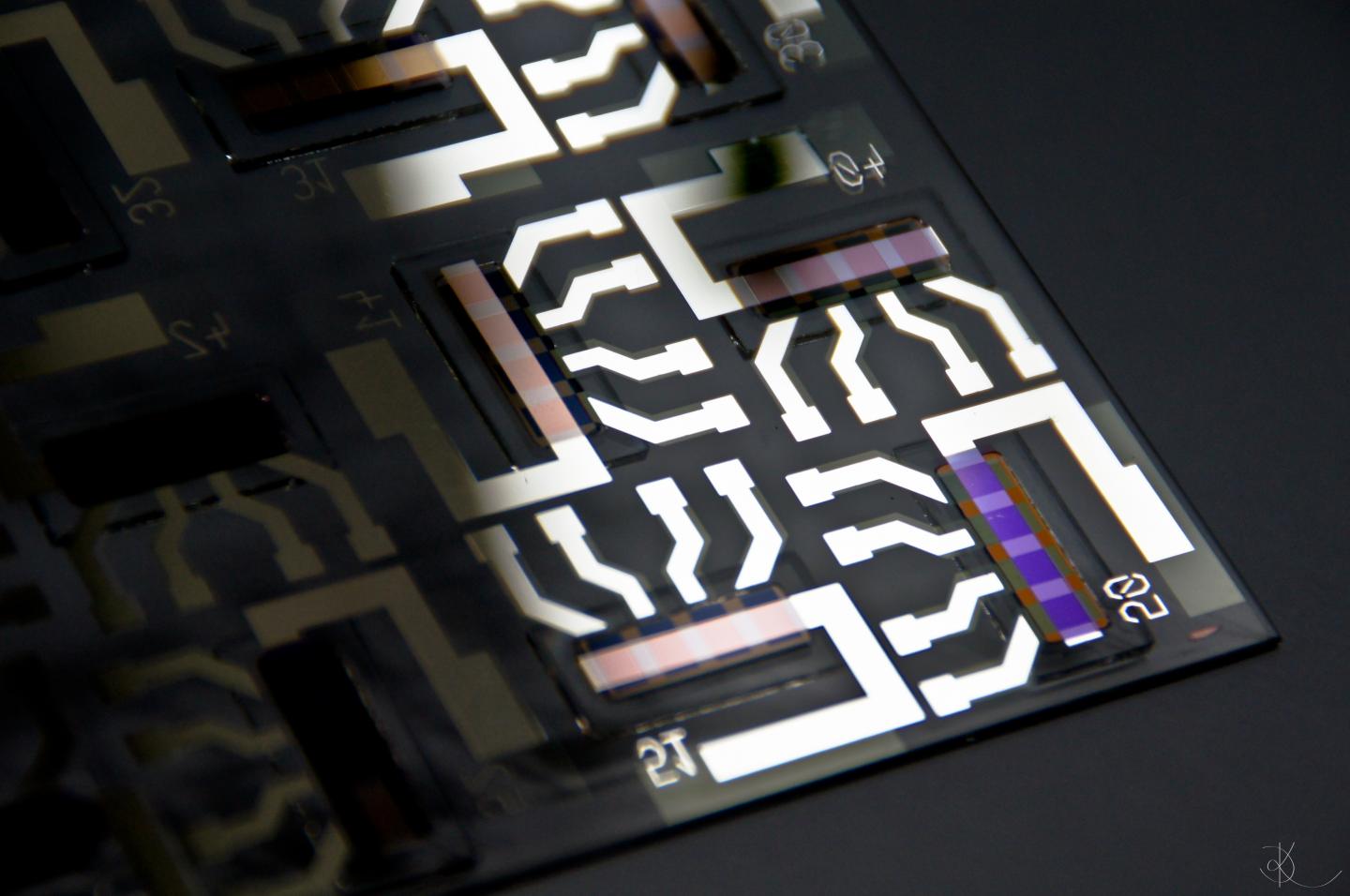
Organic photodetectors (OPDs) have a huge potential for applications in low-cost imaging, health monitoring and near infrared sensing. Yet, before industrially realizing these applications, the performance of these devices still needs to be improved.

Recent research on organic photodetectors based on donor-acceptor systems has resulted in narrow-band, flexible and biocompatible devices, of which the best reach external photovoltaic quantum efficiencies of close to 100%. However, the high noise in the off state produced by these devices limits their specific detectivity, severely reducing the performance, for example measuring faint light.

Jonas Kublitski and his colleagues at the Dresden Integrated Center for Applied Physics and Photonic Materials (IAPP) and the Institute of Applied Physics (IAP) at TU Dresden now found out that the high noise in the off state is a consequence of unwanted trap states distributed near the mid-gap of organic semiconductors. By measuring the amount of traps, the physicists draw a direct correlation between the characteristics of the trap states and the off state of OPDs.

Building on these results, Mr. Kublitski was able to draw a model depicting this relation:

“By modelling the dark current of several donor-acceptor systems, we reveal the interplay between traps and charge-transfer states as a source of dark current and show that traps dominate the generation processes, thus being the main limiting factor of OPD detectivity.

The newly discovered relation does only clarify the operation of OPDs but gives guidance for further research in the field. This work is a result of four years of research during my Ph.D. I am very happy to share these results, as they can refocus the attention of our field into understanding the origin of the limited performance of OPDs, which was so far unknown.”

###

Original publication:

Kublitski, Jonas; Hofacker, Andreas; K. Boroujeni, Bahman; Benduhn, Johannes; C. Nikolis, Vasileios; Kaiser, Christina; Spoltore, Donato; Kleemann, Hans; Fischer, Axel; Ellinger, Frank; Vandewal, Koen; Leo, Karl. Reverse dark current in organic photodetectors and the major role of traps as source of noise, Nature Communications.

DOI: https://dx.doi.org/10.1038/s41467-020-20856-z

Media Contact
Jonas Kublitski
[email protected]

Related Journal Article

http://dx.doi.org/10.1038/s41467-020-20856-z

Tags: Chemistry/Physics/Materials Sciences
Share12Tweet8Share2ShareShareShare2

Related Posts

New Drexel Study Reveals Key to Keeping Students on Track in Physics Learning — Chemistry

New Drexel Study Reveals Key to Keeping Students on Track in Physics Learning

May 15, 2026
Reversible Glue Technology Powers Up with Electric Activation — Chemistry

Reversible Glue Technology Powers Up with Electric Activation

May 15, 2026

Sweet as Honey: Unveiling a New Heat Transport Regime in Ultrathin Semiconductors

May 15, 2026

High-Precision Boltzmann Luminescent Nanothermometry Achieved Through Predictive Rules

May 15, 2026
Please login to join discussion

POPULAR NEWS

  • Research Indicates Potential Connection Between Prenatal Medication Exposure and Elevated Autism Risk

    844 shares
    Share 338 Tweet 211
  • New Study Reveals Plants Can Detect the Sound of Rain

    731 shares
    Share 292 Tweet 182
  • Salmonella Haem Blocks Macrophages, Boosts Infection

    62 shares
    Share 25 Tweet 16
  • Breastmilk Balances E. coli and Beneficial Bacteria in Infant Gut Microbiomes

    58 shares
    Share 23 Tweet 15

About

We bring you the latest biotechnology news from best research centers and universities around the world. Check our website.

Follow us

Recent News

Micronutrients Linked to Mood and Psychotic Disorders

AI Tool in Radiotherapy Advances Global Fight to Eradicate Cervical Cancer

Detecting Illicit Bitcoin Transactions with Temporal Graph Learning

Subscribe to Blog via Email

Enter your email address to subscribe to this blog and receive notifications of new posts by email.

Join 82 other subscribers
  • Contact Us

Bioengineer.org © Copyright 2023 All Rights Reserved.

Welcome Back!

Login to your account below

Forgotten Password?

Retrieve your password

Please enter your username or email address to reset your password.

Log In
No Result
View All Result
  • Homepages
    • Home Page 1
    • Home Page 2
  • News
  • National
  • Business
  • Health
  • Lifestyle
  • Science

Bioengineer.org © Copyright 2023 All Rights Reserved.