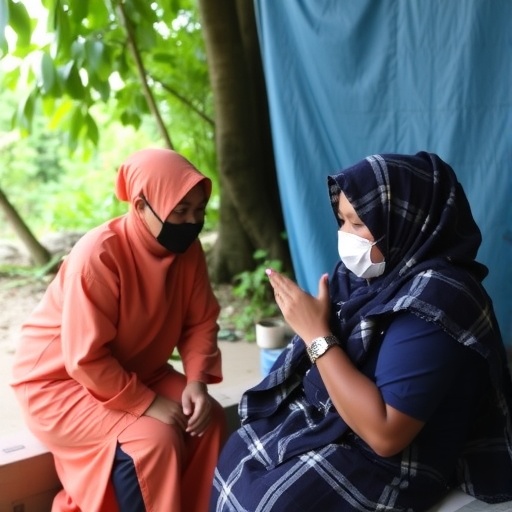
In a region of Malaysian Borneo better known to travelers as the gateway to Borneo’s rainforests and wildlife, researchers have uncovered a striking paradox in how communities respond to the global threat of mpox. Adults living in Southern Sarawak, Malaysia—home to the bustling city of Kuching and the peri-urban and rural communities of Padawan—are practicing mpox prevention at remarkably high levels, with 95 percent of survey respondents classified as having good preventive practices. Yet the same survey found that nearly two-thirds of these adults possess poor knowledge of the disease itself, and fewer than six in ten demonstrate adequate digital health literacy, the very skill needed to find and evaluate reliable health information online. The findings, published in BMC Public Health, come from one of the most detailed community-based assessments of mpox preparedness conducted in a non-endemic but travel-connected setting in Southeast Asia.
Mpox, formerly known as monkeypox, is a viral disease caused by an orthopoxvirus related to smallpox. It produces fever, rash, and swollen lymph nodes, and can spread through close physical contact, contaminated materials, and respiratory droplets during prolonged face-to-face interaction. While the 2022 multinational outbreak brought the disease to global attention, transmission in most countries outside endemic regions of Africa has remained sporadic, driven largely by imported cases rather than sustained community spread. That epidemiological reality creates a distinctive challenge for places like Southern Sarawak: even without ongoing local transmission, the region’s connectivity—Kuching serves as a major administrative and travel hub—means that imported cases could arrive at any time, and public readiness depends on behaviors that are easy to abandon once the sense of crisis fades. The new study set out to measure exactly that readiness and to understand which factors predict whether people actually take precautions.
The research team, led by Faiz Mazlan of Universiti Malaysia Sarawak and the Sarawak State Health Department, together with colleagues including corresponding author Sam Froze Jiee, Romano Ngui, Siong Hee Lim, Melvin Hsien Liang Chung, and Fabiolla Lea, conducted a community-based cross-sectional survey between January and August 2025. The study enrolled 442 adults from Southern Sarawak using a rigorous multistage sampling design intended to produce a sample that genuinely reflects the region’s socio-demographic diversity. Kuching District and Padawan sub-district were purposively selected to capture both urban and peri-urban or rural populations. Within these areas, residential localities were chosen by simple random sampling, households by systematic random sampling, and when more than one eligible adult was present in a household, one respondent was randomly selected. The minimum sample size was calculated with a single-proportion formula and inflated by 15 percent to account for anticipated non-response, refusals, vacant households, and ineligible participants.
Participants completed a structured questionnaire that assessed five dimensions: sociodemographic characteristics, mpox knowledge, attitudes toward the disease and its prevention, digital health literacy, and self-reported preventive practice. Knowledge was measured with ten items, with scores of seven or higher indicating good knowledge. Attitude was scored across seven Likert-scale items, with 26 points or more classified as a positive attitude. Digital health literacy was evaluated using ten items adapted from the HLS19-DIGI framework, an internationally validated instrument, with respondents scoring above 76.19 percent considered to have good digital health literacy. Preventive practice—the study’s central outcome—was measured through six Likert-type items covering precautionary measures, willingness to quarantine or isolate, avoidance of crowded places, mask use and hand hygiene, engagement in public awareness efforts, and perceptions of whether local authorities were acting adequately. Total scores of 22 or above were classified as good preventive practice.
The headline result was the near-universal adoption of protective behaviors. Ninety-five percent of participants reported good mpox preventive practices, and a nearly identical proportion—95.2 percent—held positive attitudes toward prevention. The median age of respondents was 37.5 years, roughly half were male (50.5 percent), and 61.8 percent lived in urban areas. But beneath this encouraging surface lay a troubling imbalance. Sixty-four percent of participants had poor mpox-specific knowledge, meaning they failed to answer enough of the ten knowledge items correctly, and only 56.3 percent demonstrated good digital health literacy. In other words, people were largely doing the right things without deeply understanding why, a pattern that public health experts consider fragile because practices rooted in habit or generalized caution, rather than informed understanding, tend to erode over time and are harder to adapt when guidance changes.
To identify who was most likely to practice good prevention, the researchers built a multivariable binary logistic regression model, which estimates the independent effect of each factor while statistically controlling for all others. The final model was statistically significant, with a chi-square value of 102.66 across ten degrees of freedom and a p-value below 0.001, indicating that the set of predictors reliably distinguished between good and poor preventive practice. The analysis revealed that good preventive practice was independently associated with younger age, male gender, self-employment, unemployment, a positive attitude, and good digital health literacy. The adjusted odds ratios and confidence intervals reported in the study quantify how strongly each factor contributed after accounting for confounding, and the researchers assessed multicollinearity using variance inflation factors to ensure the predictors were not redundant.
Several of these associations invite careful interpretation. The link between younger age and better preventive practice may reflect the lasting imprint of pandemic-era health habits among younger cohorts, or greater receptiveness to circulating health messaging. The associations with self-employment and unemployment are less intuitive: both groups may have more flexible schedules that make quarantine, isolation, or avoiding crowds practically easier, whereas employees in fixed workplaces may face pressure to continue working even when unwell. The finding that positive attitude and good digital health literacy independently predict good practice underscores a core tenet of health behavior theory—that what people believe about a disease and how well they can navigate health information shape what they do, sometimes more powerfully than what they know in a factual sense.
The coexistence of high practice with low knowledge and mediocre digital health literacy is the study’s most consequential message for public health planners. The authors argue that this combination demands targeted risk communication—messaging that fills specific knowledge gaps rather than simply exhorting behavior—and deliberate investment in digital health literacy so that residents can distinguish credible guidance from misinformation. They also call for workplace-based guidance, given the occupational patterns in the data, and for locally adapted community engagement that respects the cultural and linguistic diversity of Sarawak, a region whose population includes numerous indigenous groups alongside urban Malay, Chinese, and expatriate communities. The framework of Risk Communication and Community Engagement, widely used by the World Health Organization, is explicitly relevant here.
The study’s setting gives its findings broader resonance. Non-endemic but travel-connected regions around the world face the same structural vulnerability: sufficient connectivity to import cases, insufficient local transmission to sustain public attention. Malaysia itself recorded imported mpox cases following the 2022 global outbreak, and Sarawak’s economy is intertwined with tourism, cross-border trade within Borneo, and labor migration—all pathways by which infectious diseases move. The KAP (knowledge, attitude, and practice) framework used in this study has long been a staple of outbreak preparedness research because it captures the full chain from understanding to belief to behavior. By extending that framework with a validated digital health literacy instrument, the Southern Sarawak study offers a template for how other travel-connected regions can diagnose their own readiness before the next alert.
Methodological strengths of the study include its probability-based multistage sampling, its use of validated instruments, and its adherence to the STROBE reporting guidelines for observational studies. The researchers tested their regression model for multicollinearity and conducted the analysis using standard statistical software, and the open-access publication allows public health agencies elsewhere to scrutinize and adapt the approach. Limitations inherent to cross-sectional designs apply: the data capture practices and beliefs at a single point in time, self-reported behaviors may not perfectly match real-world actions, and the findings describe association rather than causation. Even so, a 95 percent rate of good preventive practice in a community with limited mpox knowledge is a finding worth understanding thoroughly, because it suggests that behavioral momentum from recent public health experience—likely the COVID-19 pandemic—can carry protective behavior even where disease-specific education lags.
The study received no external funding and was approved by the Medical Research Ethics Committee of Universiti Malaysia Sarawak under reference number FME/25/36, with all participants providing informed consent in accordance with the Declaration of Helsinki. The authors, who span the university’s Department of Community Medicine and Public Health and Department of Para-Clinical Sciences as well as the Sarawak State Health Department, emphasize that the work represents a collaboration between academic researchers and the public health practitioners who would be responsible for any real-world response. Their conclusion is measured but clear: Southern Sarawak’s residents have, for now, the right habits. Sustaining those habits—and making them resilient to misinformation, complacency, and the next imported case—will require closing the knowledge gap, raising digital health literacy, and embedding prevention guidance in the workplaces and community structures where daily life actually happens.
Subject of Research: Mpox preventive practices and their associated sociodemographic, knowledge, attitude, and digital health literacy factors among adults in Southern Sarawak, Malaysia
Subject of Research: Medicine
Article Title: Mpox preventive practices and associated factors among adults in a travel-connected setting in Southern Sarawak, Malaysia: a community-based cross-sectional study
Article References: Mazlan, F., Jiee, S. F., Ngui, R., Lim, S. H., Chung, M. H. L., & Lea, F. (2026). Mpox preventive practices and associated factors among adults in a travel-connected setting in Southern Sarawak, Malaysia: a community-based cross-sectional study. BMC Public Health. https://doi.org/10.1186/s12889-026-29271-3
Image Credits: AI Generated
DOI: 10.1186/s12889-026-29271-3
Keywords: Mpox, Preventive practice, Knowledge, Attitudes, Digital health literacy, Health literacy, Sarawak, Malaysia, Cross-sectional study, Public health, Disease prevention, Risk communication
Cite Scienmag News
APA
MLA
Chicago
Phoebe Ingram. (September 4, 2026). Mpox prevention practices and factors among adults in Southern Sarawak, Malaysia. Scienmag. https://scienmag.com/mpox-prevention-practices-and-factors-among-adults-in-southern-sarawak-malaysia/
Phoebe Ingram. “Mpox prevention practices and factors among adults in Southern Sarawak, Malaysia.” Scienmag, 4 September 2026, https://scienmag.com/mpox-prevention-practices-and-factors-among-adults-in-southern-sarawak-malaysia/. Accessed 4 September 2026.
Phoebe Ingram. “Mpox prevention practices and factors among adults in Southern Sarawak, Malaysia.” Scienmag. September 4, 2026. https://scienmag.com/mpox-prevention-practices-and-factors-among-adults-in-southern-sarawak-malaysia/
Copy citation
Download RIS
Tags: behavioral health practices in rural Malaysiacommunity health awareness about mpoxcommunity health awareness in Malaysiacommunity-based health assessments in Southeast Asiadigital health literacy and disease knowledgedigital health literacy in infectious disease preventionepidemiology of mpox in Malaysian Borneohealth education gaps in rural Malaysian communitieshealth promotion strategies in peri-urban communitiesimpact of health knowledge on preventive behaviorsimpact of health literacy on disease preventionmonkeypox outbreak response in non-endemic regionsmpox outbreak preparedness in BorneoMpox prevention practicesMpox prevention practices in Malaysiampox transmission and risk factorsmpox transmission routes and risk factorsnon-endemic mpox outbreak responsepublic health education for infectious diseasespublic health strategies for mpox awarenessrole of digital literacy in infectious disease controltravel-related disease transmission and preventionviral diseases related to smallpox