• HOME
  • NEWS
  • EXPLORE
    • CAREER
      • Companies
      • Jobs
    • EVENTS
    • iGEM
      • News
      • Team
    • PHOTOS
    • VIDEO
    • WIKI
  • BLOG
  • COMMUNITY
    • FACEBOOK
    • INSTAGRAM
    • TWITTER
Monday, May 11, 2026
BIOENGINEER.ORG
No Result
View All Result
  • Login
  • HOME
  • NEWS
  • EXPLORE
    • CAREER
      • Companies
      • Jobs
        • Lecturer
        • PhD Studentship
        • Postdoc
        • Research Assistant
    • EVENTS
    • iGEM
      • News
      • Team
    • PHOTOS
    • VIDEO
    • WIKI
  • BLOG
  • COMMUNITY
    • FACEBOOK
    • INSTAGRAM
    • TWITTER
  • HOME
  • NEWS
  • EXPLORE
    • CAREER
      • Companies
      • Jobs
        • Lecturer
        • PhD Studentship
        • Postdoc
        • Research Assistant
    • EVENTS
    • iGEM
      • News
      • Team
    • PHOTOS
    • VIDEO
    • WIKI
  • BLOG
  • COMMUNITY
    • FACEBOOK
    • INSTAGRAM
    • TWITTER
No Result
View All Result
Bioengineer.org
No Result
View All Result
Home NEWS Science News Biology

Reduced microbial stability linked to soil carbon loss in active layer under alpine permafrost degra

Bioengineer by Bioengineer
September 6, 2025
in Biology
Reading Time: 2 mins read
0
IMAGE
Share on FacebookShare on TwitterShare on LinkedinShare on RedditShare on Telegram

Chinese researchers have recently discovered links between reduction in microbial stability and soil carbon loss in the active layer of degraded alpine permafrost on the Qinghai-Tibet Plateau (QTP).

The researchers, headed by Prof. CHEN Shengyun from the Northwest Institute of Eco-Environment and Resources (NIEER) of the Chinese Academy of Sciences (CAS), and XUE Kai from University of Chinese Academy of Sciences, conducted a combined in-depth analysis of soil microbial communities and their co-occurrence networks in the active permafrost layer along an extensive gradient of permafrost degradation.

The QTP encompasses the largest extent of high-altitude mountain permafrost in the world. This permafrost is different than high-latitude permafrost and stores massive soil carbon. An often ignored characteristic of permafrost is that the carbon pool in the active layer soil is more active and directly affected by climate change, compared to deeper layers.

Triggered by climate warming, permafrost degradation may decrease soil carbon stability and induce massive carbon loss, thus leading to positive carbon-climate feedback. However, microbial-mediated mechanisms for carbon loss from the active layer soil in degraded permafrost still remain unclear.

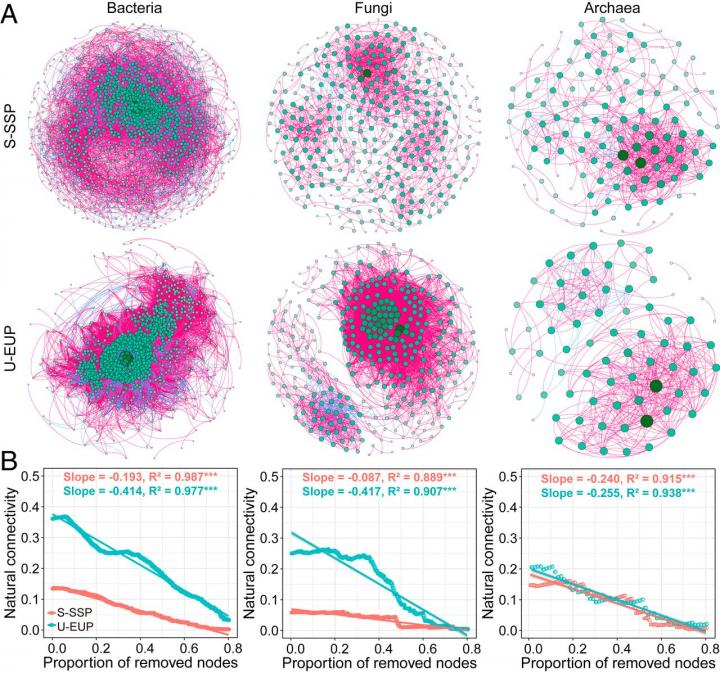
In this study, the researchers found that alpine permafrost degradation reduced the stability of active layer microbial communities as evidenced by increased sensitivity of microbial composition to environmental change, promoted destabilizing network properties and reduced resistance to node or edge attacking of the microbial network.

They discovered that soil organic carbon loss in severely degraded permafrost is associated with increased microbial dissimilarity, thereby potentially contributing to a positive carbon feedback in alpine permafrost on the QTP.

###

The results were published in PNAS in an article entitled “Reduced microbial stability in the active layer is associated with carbon loss under alpine permafrost degradation”.

This research was financially supported by the National Natural Science Foundation of China, the Strategic Priority Research Program (A) of CAS and the Second Tibetan Plateau Scientific Expedition and Research Program.

Media Contact
CHEN Shengyun
[email protected]

Original Source

http://english.cas.cn/newsroom/research_news/earth/202106/t20210616_272059.shtml

Related Journal Article

http://dx.doi.org/10.1073/pnas.2025321118

Tags: Climate ChangeEarth ScienceGeology/SoilMicrobiologyTemperature-Dependent Phenomena
Share13Tweet8Share2ShareShareShare2

Related Posts

Ancient Plant Populations Reveal Fresh Insights into Climate Resilience — Biology

Ancient Plant Populations Reveal Fresh Insights into Climate Resilience

May 8, 2026
Rare Brain Disorders in Children Linked to Mutations in Lesser-Known Protein Complex — Biology

Rare Brain Disorders in Children Linked to Mutations in Lesser-Known Protein Complex

May 8, 2026

From Odd Insect to Underwater Predator: The Remarkable Evolution of a Bloodthirsty Fruit Fly

May 8, 2026

SNU Professor Sangwoo Seo’s Team Develops Next-Generation CRISPR Biocontainment Technology to Control Microbial Survival Without DNA Cleavage

May 8, 2026
Please login to join discussion

POPULAR NEWS

  • Research Indicates Potential Connection Between Prenatal Medication Exposure and Elevated Autism Risk

    840 shares
    Share 336 Tweet 210
  • New Study Reveals Plants Can Detect the Sound of Rain

    727 shares
    Share 290 Tweet 181
  • Salmonella Haem Blocks Macrophages, Boosts Infection

    61 shares
    Share 24 Tweet 15
  • Breastmilk Balances E. coli and Beneficial Bacteria in Infant Gut Microbiomes

    57 shares
    Share 23 Tweet 14

About

We bring you the latest biotechnology news from best research centers and universities around the world. Check our website.

Follow us

Recent News

New Post-Hoc Analysis Explores Daily Oral Orforglipron Use in Adults Over 65 with Obesity, Regardless of Diabetes Status

Evaluating Digoxin Use in Patients with Symptomatic Rheumatic Heart Disease

Evaluating the Effectiveness and Safety of Digitalis Glycosides in Treating Heart Failure

Subscribe to Blog via Email

Enter your email address to subscribe to this blog and receive notifications of new posts by email.

Join 82 other subscribers
  • Contact Us

Bioengineer.org © Copyright 2023 All Rights Reserved.

Welcome Back!

Login to your account below

Forgotten Password?

Retrieve your password

Please enter your username or email address to reset your password.

Log In
No Result
View All Result
  • Homepages
    • Home Page 1
    • Home Page 2
  • News
  • National
  • Business
  • Health
  • Lifestyle
  • Science

Bioengineer.org © Copyright 2023 All Rights Reserved.