Between 2000 and 2020, national policies in China aimed at constructing approximately 400 new cities, an urban expansion of a scale and speed the authors of a new study describe as unprecedented. A study published in the journal City, Territory and Architecture examines what this transformation has produced on the ground and proposes a design methodology for correcting its most visible failures.
The research, authored by Roberto Podda and Alessandro Cece, focuses on newly established settlements that, according to the study, do not function as mere extensions of existing urban fabric. Instead, the authors characterise them as strategic nodes for the active remodelling of regional systems, supporting a transition from industrial satellite towns toward integrated, polycentric urban regions.
That accelerated development, however, has exposed what the paper identifies as a fundamental tension in the Chinese urbanisation process: the often-problematic integration of globally circulated urban models with local socio-spatial, economic and cultural specificities. The resulting landscapes, the study reports, frequently show morphological fragmentation, a lack of cohesive identity, and a misalignment between physical form and lived experience.
In the authors’ assessment, these outcomes highlight the limitations of a purely technocratic approach to city-making. Their response is not a set of technical fixes but a methodological framework intended to mediate critically between global imperatives and local contexts, grounded in what they term the “discretized city” and implemented through localised urban densification devices.
These devices draw conceptual inspiration from architect Aldo Rossi’s notion of “primary elements”, described in the study as stable, sense-generating urban structures. Conceived as catalytic interventions, the devices are designed to guide expansion, regulate density, harmonise growth and foster the emergence of a local identity within rapidly growing territories.
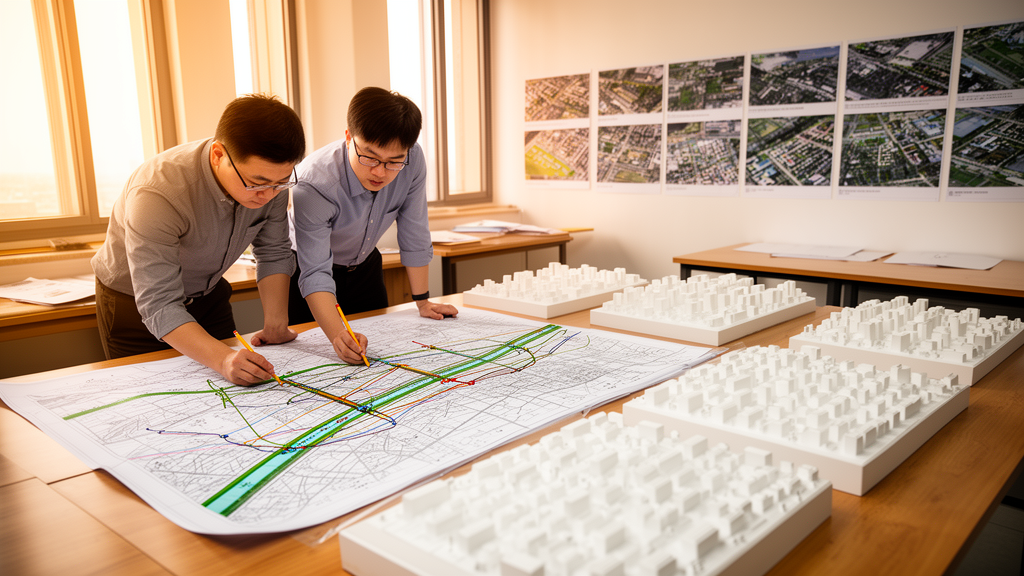
To test the hypothesis, the researchers applied their framework to the Danyang–Changzhou corridor in Jiangsu Province. The study characterises this linear system as supported by major transport infrastructure yet layered upon pre-existing agricultural patterns, making it, in the authors’ view, an emblematic case for evaluating the methodology’s implications.
The application unfolded within a learning-by-doing appraisal context, functioning both as a teaching device and as a test of the original hypotheses. A three-phase operational strategy, labelled Re-cognise, Re-signify and Re-configure, was applied to the corridor.
According to the study, this strategy demonstrates how an approach guided by targeted devices could design the transformation of unstructured urban expansion into a polycentric network endowed with greater morphological cohesion and a defined identity. The authors present this as a design experimentation and critical analysis rather than as an evaluation of implemented, built outcomes.
The study concludes that the central challenge of contemporary Chinese urbanisation is not technological but cultural and philosophical. In the authors’ framing, the success of China’s new cities will depend not only on technical proficiency but on the capacity to critically transcend reference models, forging a paradigm in which urbanity is realised through a conscious and contextual synthesis of the global and the local.
The article is published open access, with the version shared carrying a permanent DOI and remaining subject to further editorial edits before the final Version of Record replaces it.
Subject of Research: A design methodology for urban densification and morphological cohesion in China's new cities, tested on the Danyang–Changzhou corridor in Jiangsu Province.
Article Title: The discretized city. Exploration of urban densification through morphotypological devices on the Danyang-Changzhou corridor
Article References: Podda, R., & Cece, A. (2026). The discretized city. Exploration of urban densification through morphotypological devices on the Danyang-Changzhou corridor. City, Territory and Architecture. https://doi.org/10.1186/s40410-026-00324-9
Image Credits: AI Generated
DOI: 10.1186/s40410-026-00324-9
Keywords: urban densification, China, new cities, Danyang–Changzhou corridor, Jiangsu Province, morphotypology, polycentric urban regions, urban design methodology, Rossi primary elements, morphological fragmentation, open access research, discretized
News Source: Denise Maddox. (October 29, 2026). Redesigning China’s New Cities: A Three-Phase Method Tested on the Danyang–Changzhou Corridor. Scienmag.