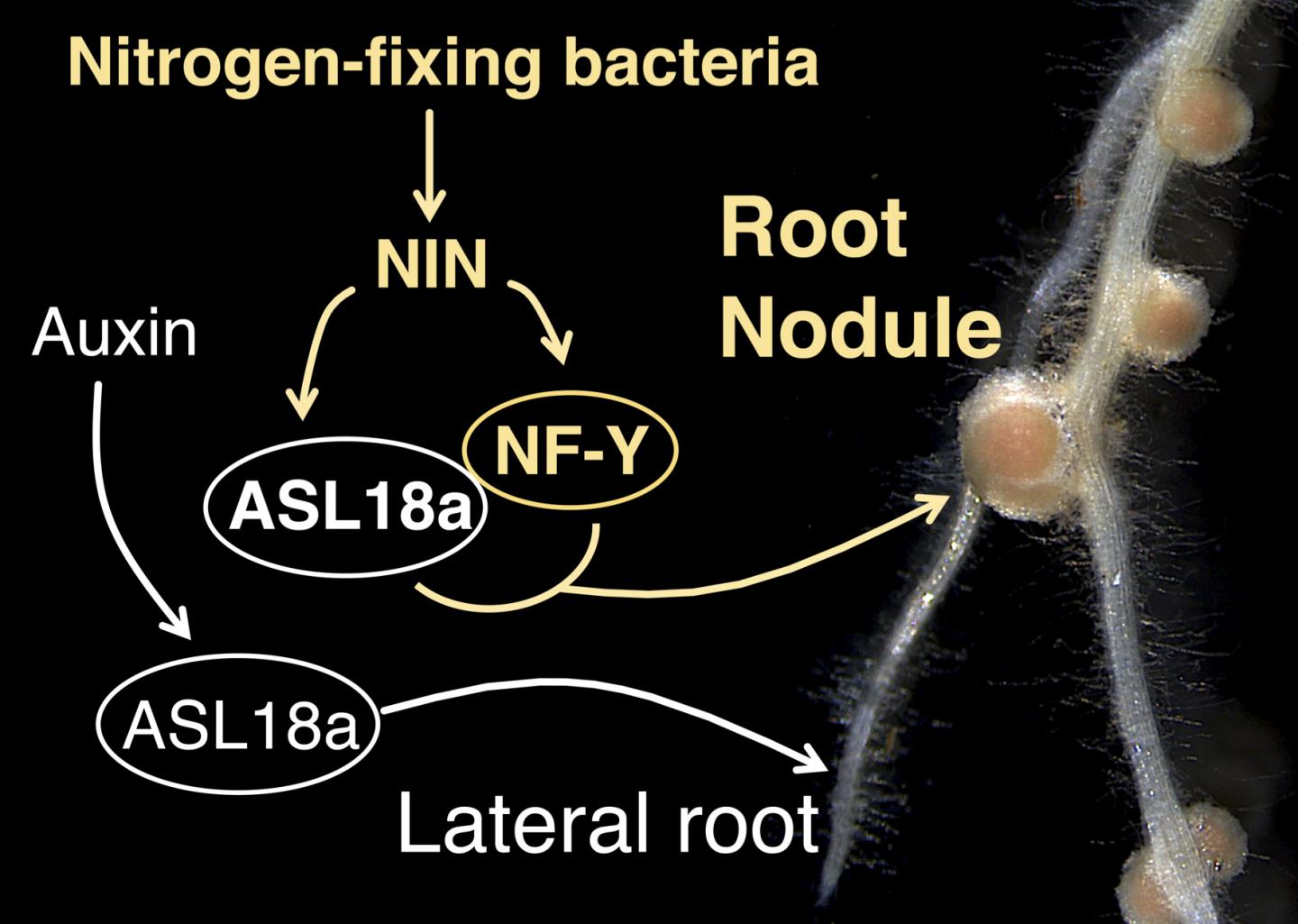
Credit: Takashi Soyano
Peas and other legumes develop spherical or cylindrical structures — called nodules — in their roots to establish a mutually beneficial relationship with bacteria that convert atmospheric nitrogen into a useable nutrient for the legume plant. Root nodule symbiosis enables legumes to grow under nitrogen-limiting conditions where most of non-leguminous plants cannot survive. Researchers in Japan now have a better understanding of how the symbiotic relationship evolved.
They published their results on November 2019 in Science.
“We set out to understand how legumes acquired the ability to form root nodules that are essential for establishing the symbiotic relationship between host and nitrogen-fixing bacteria,” said paper author Takashi Soyano of the National Institute for Basic Biology. “Our findings clarify how legumes acquired the ability to produce root nodules.”
Root nodules normally form in response to a bacteria called rhizobia. Legumes have evolved genes that specifically tell the host cells that rhizobia is present, triggering the formation of root nodules, but it was unclear how these genetic factors could trigger the development of these root organs.
The researchers explored this organ development using a model legume, Lotus japonicus, and found that this happened via a gene involved in the formation of lateral roots. Typically, plants develop lateral roots that spread out instead of deep vertical roots, as water and nutrients tend to be denser in the soil surface.
“This gene — called ASL18a — is co-opted from lateral root developmental programs common to most of plants to form root nodules in the presence of rhizobia,” Soyano said.
The cooperative action of two genes, ASL18a and NF-Y, is necessary to induce cell division to develop root nodules. Another gene, called NIN, specifically directs ASL18a and NF-Y to work together when rhizobia is present. According to Soyano, ASL18a in legumes possesses a regulatory element that binds with NIN and allows for the cooperative work between genes.
“Root organ development is tightly regulated through complex interactions among various signaling components and pathways,” Soyano said. “Acquisition of this element may have led to recruitment of this gene into root nodule formation.”
Next, Soyano and his team plan to investigate how the lateral root development and symbiosis-specific pathways influence each other to help form root nodules.
“Detailed investigation of how these two pathways have been integrated could provide important insights into a better understanding of evolutionary pathways in leguminous plants.” Soyano said.
He also noted that the basic molecular mechanism of this nodule formation may also be present in other plants, such as tomatoes, and could lead to application of nodule symbiosis in sustainable agricultural practices.
###
This work was carried out as a collaborative research between Takashi Soyano and Masayoshi Kawaguchi of the National Institute for Basic Biology, Yoshikazu Shimoda of the National Agriculture and Food Research Organization and Makoto Hayashi of RIKEN.
This work was supported by the Japan Society for the Promotion of Science (JSPS) Grants-in-Aid for Scientific Research and a Next Generation World-Leading Researchers grant form JSPS and a RIKEN Research Incentive Award.
The research has been published in Science
“A shared gene drives lateral root development and root nodule symbiosis pathways in Lotus” by Takashi Soyano, Yoshikazu Shimoda, Masayoshi Kawaguchi, Makoto Hayashi
DOI: 10.1126/science.aax2153 (https:/
Media Contact
NIBB Office of Public Relations
[email protected]
Original Source
http://www.
Related Journal Article
http://dx.