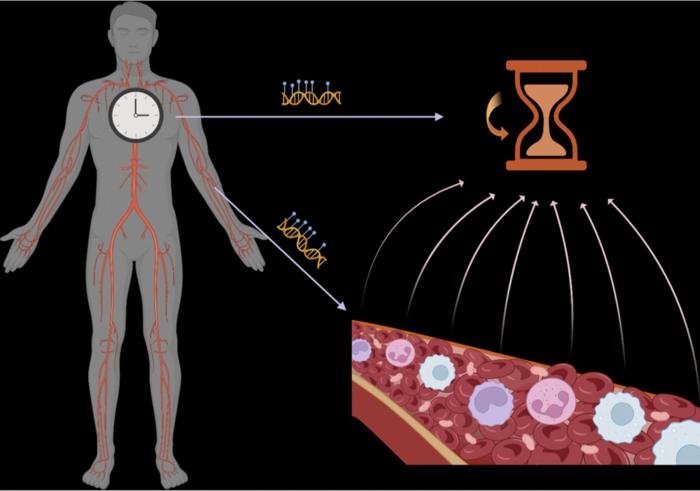
“Our study revealed that the composition of immune cells significantly affects the variation in EAA across six common blood epigenetic clocks.”
“Our study revealed that the composition of immune cells significantly affects the variation in EAA across six common blood epigenetic clocks.”
BUFFALO, NY- August 14, 2024 – A new editorial was published in Aging (listed by MEDLINE/PubMed as “Aging (Albany NY)” and “Aging-US” by Web of Science), Volume 16, Issue 14 on July 17, 2024, entitled, “Recalibrate concepts of epigenetic aging clocks in human health.”
As detailed in the opening of this editorial, DNA methylation-based epigenetic clocks are used as biomarkers of biological age in human health. Multiple epigenetic clocks have rapidly emerged in the past decade by modeling DNA methylation changes with age in large cohorts, primarily using peripheral blood samples. Despite efforts to understand the functional implications of features used to estimate biological age, the underlying mechanisms of these clocks remain poorly understood, leading to potential misinterpretations of their associations with health outcomes.
Researchers Ze Zhang, Brock C. Christensen, and Lucas A. Salas from the Divisions of Population Sciences and Medical Oncology, Dana-Farber Cancer Institute, Harvard Medical School, the Department of Epidemiology, Geisel School of Medicine, Dartmouth College, Dartmouth Cancer Center, Dartmouth-Hitchcock Medical Center, and the Department of Molecular and Systems Biology, Geisel School of Medicine, Dartmouth College explored the association of 12 immune cell types with epigenetic age acceleration (EAA) in both healthy and diseased populations.
Their work sheds light on the complex interplay between immune cell composition and epigenetic aging, utilizing high-resolution methylation cytometry in blood samples.
“In this editorial, we aim to address the key implications of our study on epigenetic aging clocks in human health from a broader perspective. While epigenetic clocks are widely hyped as aging biomarkers today, it’s essential to recalibrate some fundamental concepts in this field.”
Continue reading: DOI: https://doi.org/10.18632/aging.206027
Corresponding Author: Lucas A. Salas – [email protected]
Keywords: epigenetics, DNA methylation, epigenetic clock, epigenetic age acceleration, methylation cytometry
Click here to sign up for free Altmetric alerts about this article.
About Aging:
The journal Aging aims to promote 1) treatment of age-related diseases by slowing down aging, 2) validation of anti-aging drugs by treating age-related diseases, and 3) prevention of cancer by inhibiting aging. (Cancer and COVID-19 are age-related diseases.)
Aging is indexed by PubMed/Medline (abbreviated as “Aging (Albany NY)”), PubMed Central, Web of Science: Science Citation Index Expanded (abbreviated as “Aging‐US” and listed in the Cell Biology and Geriatrics & Gerontology categories), Scopus (abbreviated as “Aging” and listed in the Cell Biology and Aging categories), Biological Abstracts, BIOSIS Previews, EMBASE, META (Chan Zuckerberg Initiative) (2018-2022), and Dimensions (Digital Science).
Please visit our website at www.Aging-US.com and connect with us:
- X
- YouTube
- Spotify, and available wherever you listen to podcasts
Click here to subscribe to Aging publication updates.
For media inquiries, please contact [email protected].
Aging (Aging-US) Journal Office
6666 E. Quaker St., Suite 1
Orchard Park, NY 14127
Phone: 1-800-922-0957, option 1
Journal
Aging-US
DOI
10.18632/aging.206027
Method of Research
Commentary/editorial
Subject of Research
Not applicable
Article Title
Recalibrate concepts of epigenetic aging clocks in human health
Article Publication Date
17-Jul-2024
COI Statement
The authors have no conflicts of interest to declare.