• HOME
  • NEWS
  • EXPLORE
    • CAREER
      • Companies
      • Jobs
    • EVENTS
    • iGEM
      • News
      • Team
    • PHOTOS
    • VIDEO
    • WIKI
  • BLOG
  • COMMUNITY
    • FACEBOOK
    • INSTAGRAM
    • TWITTER
Tuesday, May 19, 2026
BIOENGINEER.ORG
No Result
View All Result
  • Login
  • HOME
  • NEWS
  • EXPLORE
    • CAREER
      • Companies
      • Jobs
        • Lecturer
        • PhD Studentship
        • Postdoc
        • Research Assistant
    • EVENTS
    • iGEM
      • News
      • Team
    • PHOTOS
    • VIDEO
    • WIKI
  • BLOG
  • COMMUNITY
    • FACEBOOK
    • INSTAGRAM
    • TWITTER
  • HOME
  • NEWS
  • EXPLORE
    • CAREER
      • Companies
      • Jobs
        • Lecturer
        • PhD Studentship
        • Postdoc
        • Research Assistant
    • EVENTS
    • iGEM
      • News
      • Team
    • PHOTOS
    • VIDEO
    • WIKI
  • BLOG
  • COMMUNITY
    • FACEBOOK
    • INSTAGRAM
    • TWITTER
No Result
View All Result
Bioengineer.org
No Result
View All Result
Home NEWS Science News Biology

Rats trail behind shrews, monkeys, and humans in visual problem solving

Bioengineer by Bioengineer
July 12, 2018
in Biology
Reading Time: 2 mins read
1
Share on FacebookShare on TwitterShare on LinkedinShare on RedditShare on Telegram
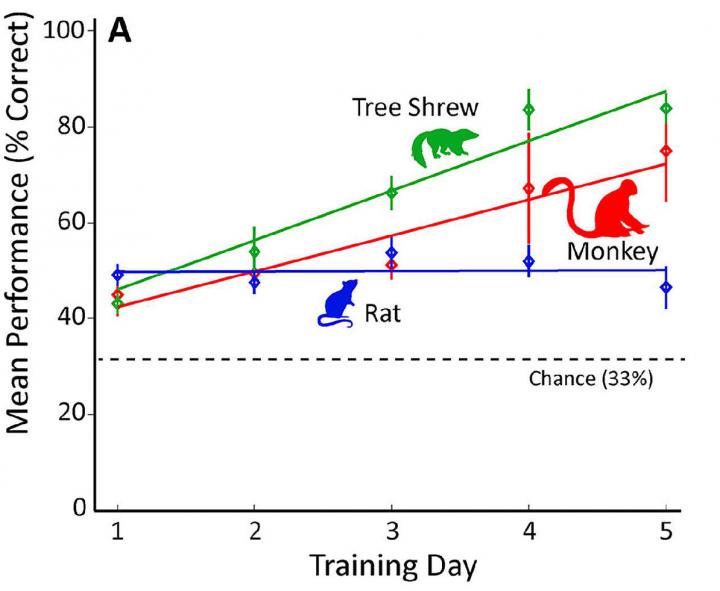
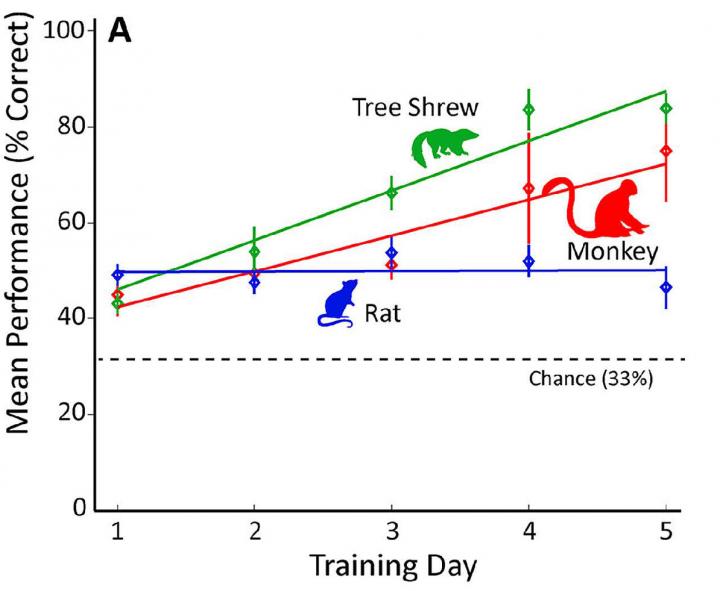
IMAGE

Credit: Mustafar et al., eNeuro (2018)

Rats take a fundamentally different approach toward solving a simple visual discrimination task than tree shrews, monkeys, and humans, according to a comparative study of the four mammal species published in eNeuro. The work could have important implications for the translation of research in animal models to humans.

Scientists have developed powerful technologies that allow for precise manipulation of the rodent nervous system, which is similar to that of humans, making them crucial laboratory animals in neuroscience. Although it is thought that learning in mice and rats can overcome initial species differences on a task, few studies have directly tested this idea.

Gregor Rainer and colleagues addressed this gap in knowledge by comparing the ability of two species more closely related to humans — macaques (Macaca fascicularis) and tree shrews (Tupaia belangeri) — to discriminate a flickering light from two distracting stimuli. While the macaques and tree shrews used similar visual learning strategies and their performance improved over time, rats (Rattus norvegicus) were instead focused on where they had previously received a food reward and their performance did not improve. These findings suggest that rats use their brains differently than the other species in the context of this particular task.

###

Article: Divergent solutions to visual problem solving across mammalian species
DOI: https://doi.org/10.1523/ENEURO.0167-18.2018
Corresponding author: Gregor Rainer (University of Fribourg, Switzerland), [email protected]

About eNeuro

eNeuro, the Society for Neuroscience's open-access journal launched in 2014, publishes rigorous neuroscience research with double-blind peer review that masks the identity of both the authors and reviewers, minimizing the potential for implicit biases. eNeuro is distinguished by a broader scope and balanced perspective achieved by publishing negative results, failure to replicate or replication studies. New research, computational neuroscience, theories and methods are also published.

About The Society for Neuroscience

The Society for Neuroscience is the world's largest organization of scientists and physicians devoted to understanding the brain and nervous system. The nonprofit organization, founded in 1969, now has nearly 37,000 members in more than 90 countries and over 130 chapters worldwide.

Media Contact

David Barnstone
[email protected]
202-962-4000
@SfNJournals

http://www.sfn.org

Related Journal Article

http://dx.doi.org/10.1523/ENEURO.0167-18.2018

Share14Tweet8Share2ShareShareShare2

Related Posts

New Insights into How Smoking Causes Lung Stiffness — Biology

New Insights into How Smoking Causes Lung Stiffness

May 19, 2026
Breakthrough Cancer Treatment Effective Across All Organ Types — Biology

Breakthrough Cancer Treatment Effective Across All Organ Types

May 18, 2026

Butyrate Alleviates Temporomandibular Joint Pain via Epigenetic Mechanisms

May 18, 2026

How Hibernation Impacts Visual Processing in Squirrels’ Brains

May 18, 2026
Please login to join discussion

POPULAR NEWS

  • Research Indicates Potential Connection Between Prenatal Medication Exposure and Elevated Autism Risk

    845 shares
    Share 338 Tweet 211
  • New Study Reveals Plants Can Detect the Sound of Rain

    731 shares
    Share 292 Tweet 182
  • Salmonella Haem Blocks Macrophages, Boosts Infection

    62 shares
    Share 25 Tweet 16
  • Breastmilk Balances E. coli and Beneficial Bacteria in Infant Gut Microbiomes

    58 shares
    Share 23 Tweet 15

About

We bring you the latest biotechnology news from best research centers and universities around the world. Check our website.

Follow us

Recent News

Neonatal Heart Rate Predicts Neurodevelopment in TGA Kids

Uncovering COPD Subtypes via Variational Autoencoders

PROTECT Study: Real-World Perioperative Stress & Risk

Subscribe to Blog via Email

Enter your email address to subscribe to this blog and receive notifications of new posts by email.

Join 82 other subscribers
  • Contact Us

Bioengineer.org © Copyright 2023 All Rights Reserved.

Welcome Back!

Login to your account below

Forgotten Password?

Retrieve your password

Please enter your username or email address to reset your password.

Log In
No Result
View All Result
  • Homepages
    • Home Page 1
    • Home Page 2
  • News
  • National
  • Business
  • Health
  • Lifestyle
  • Science

Bioengineer.org © Copyright 2023 All Rights Reserved.