

• HOME
  • NEWS
  • EXPLORE
    • CAREER
      • Companies
      • Jobs
    • EVENTS
    • iGEM
      • News
      • Team
    • PHOTOS
    • VIDEO
    • WIKI
  • BLOG
  • COMMUNITY
    • FACEBOOK
    • INSTAGRAM
    • TWITTER
Wednesday, September 9, 2026
BIOENGINEER.ORG
No Result
View All Result
  • Login
  • HOME
  • NEWS
  • EXPLORE
    • CAREER
      • Companies
      • Jobs
        • Lecturer
        • PhD Studentship
        • Postdoc
        • Research Assistant
    • EVENTS
    • iGEM
      • News
      • Team
    • PHOTOS
    • VIDEO
    • WIKI
  • BLOG
  • COMMUNITY
    • FACEBOOK
    • INSTAGRAM
    • TWITTER
  • HOME
  • NEWS
  • EXPLORE
    • CAREER
      • Companies
      • Jobs
        • Lecturer
        • PhD Studentship
        • Postdoc
        • Research Assistant
    • EVENTS
    • iGEM
      • News
      • Team
    • PHOTOS
    • VIDEO
    • WIKI
  • BLOG
  • COMMUNITY
    • FACEBOOK
    • INSTAGRAM
    • TWITTER
No Result
View All Result
Bioengineer.org
No Result
View All Result
Home NEWS Science News Biology

New Cell Imaging Technique Illuminates Previously Hidden Cellular Blind Spots

Bioengineer by Bioengineer
July 15, 2026
in Biology
Reading Time: 2 mins read
0
New Cell Imaging Technique Illuminates Previously Hidden Cellular Blind Spots
Share on FacebookShare on TwitterShare on LinkedinShare on RedditShare on Telegram

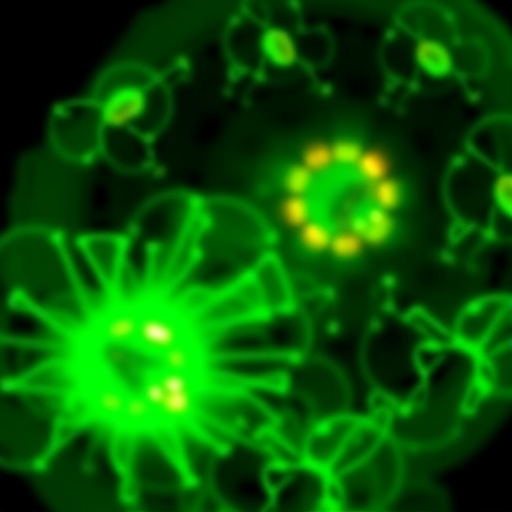
Cells behave like crowded cities, yet many crucial molecular conversations have been impossible to watch directly in real time. Traditional microscopy often averages enzyme activity across a whole cell, hiding where reactions actually occur—down to tiny nanodomains where signaling is decided.

A team at the University of Illinois Chicago has now introduced an imaging strategy designed to reveal previously obscured enzyme activity across the entire live cell. The work, published in the Proceedings of the National Academy of Sciences, enables scientists to map where specific biochemical events happen with higher clarity and spatial resolution.

The core challenge lies in biosensors that report negatively: instead of glowing when an enzyme is active, they “go dark” when activity changes. Those dim signals can blend into background regions during imaging, creating false ambiguity—areas with real high activity can appear similar to areas with little or none.

The researchers developed a method called Fluctuation Increase Negated by Intra-Chain (FINICI). FINICI converts the inverted readout of negative biosensors into a positive, interpretable optical signal. By effectively flipping the sensor logic, the approach allows existing negative biosensors to be used without years of redesign.

Using FINICI, the team imaged three targets: Src kinase, Syk kinase, and cGMP. For Src kinase, they observed burst-like activity concentrated in small regions of the cell membrane, including cholesterol-rich lipid rafts. Some active nanodomains appeared only briefly, while others persisted—kinetics that would be blurred out by whole-cell measurements.

For cGMP, the imaging revealed that the molecule forms small clusters that rapidly become overwhelmed as the signal spreads outward through the cell.

In immune cells, Syk kinase showed the opposite of a simplistic “near the receptor” picture: activity was most prominent near internal scaffolding rather than at the sites where upstream receptors are triggered. This spatial mismatch suggests that signaling outcomes depend strongly on subcellular positioning.

Overall, the study supports the idea that enzyme activity is location-dependent: being active is not enough if the enzyme is not in the right compartment. The implications extend to drug development, where therapeutic success often hinges on where drug targets and their signaling partners meet inside cells.

Subject of Research: Live cell enzyme activity imaging using inverse (negative) biosensors
Article Title: Directly adopting inverse biosensors to image live cell enzyme activities in nanodomains
News Publication Date:
Web References: https://www.pnas.org/doi/10.1073/pnas.2531118123
References:
Image Credits: Credit: Gary Mo.

Keywords: Biosensors, imaging, live cells, enzyme activity, nanodomains, FINICI, signal transduction, kinase signaling, cGMP

Tags: advanced fluorescence microscopybiosensor signal inversioncell imagingenzyme activity mappingFINICI imaging techniquehigh-resolution cellular imagingkinase activity visualizationlive cell microscopynanodomain signaling detectionnegative biosensorsreal-time cellular processessubcellular signaling


Share12Tweet7Share2ShareShareShare1

Related Posts

Genetic diversity of Ehrlichia canis revealed in naturally infected Brazilian dogs

Genetic diversity of Ehrlichia canis revealed in naturally infected Brazilian dogs

September 9, 2026
Salt-tolerant jeotgal bacteria evaluated as safe, functional fermentation starters

Salt-tolerant jeotgal bacteria evaluated as safe, functional fermentation starters

September 9, 2026

Gut microbes and ABC transporters linked to herbal remedy for diarrhea

September 9, 2026

Commiphora gileadensis resin metabolites show enzyme inhibition in computational study

September 9, 2026

POPULAR NEWS

  • Caffeine Chewing Gum Quickly Boosts Physical Performance, Meta-Analysis Finds

    29 shares
    Share 12 Tweet 7
  • Researchers validate low-cost filter device for sampling microplastics in wells

    29 shares
    Share 12 Tweet 7
  • Genetic diversity of Ehrlichia canis revealed in naturally infected Brazilian dogs

    29 shares
    Share 12 Tweet 7
  • Disulfidptosis: new insights into cancer cell death and therapeutic targets

    29 shares
    Share 12 Tweet 7

About

We bring you the latest biotechnology news from best research centers and universities around the world. Check our website.

Follow us

Recent News

Caffeine Chewing Gum Quickly Boosts Physical Performance, Meta-Analysis Finds

Researchers validate low-cost filter device for sampling microplastics in wells

Genetic diversity of Ehrlichia canis revealed in naturally infected Brazilian dogs

Subscribe to Blog via Email

Enter your email address to subscribe to this blog and receive notifications of new posts by email.

Join 85 other subscribers
  • Contact Us

Bioengineer.org © Copyright 2023 All Rights Reserved.

Welcome Back!

Login to your account below

Forgotten Password?

Retrieve your password

Please enter your username or email address to reset your password.

Log In
No Result
View All Result
  • Homepages
    • Home Page 1
    • Home Page 2
  • News
  • National
  • Business
  • Health
  • Lifestyle
  • Science

Bioengineer.org © Copyright 2023 All Rights Reserved.