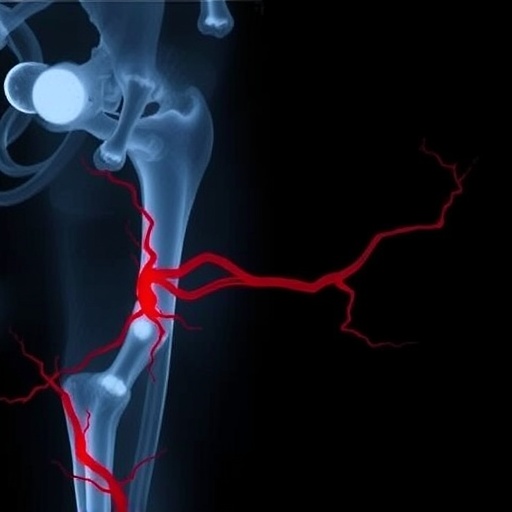
In a remarkable and unsettling clinical event, researchers have reported an extraordinary case involving superficial femoral artery thrombosis following the use of proximal femoral nail antirotation (PFNA) fixation in an elderly patient suffering from an intertrochanteric fracture compounded by sarcopenia and chronic obstructive pulmonary disease (COPD). This singular case, published in BMC Geriatrics in 2026, draws crucial attention to the intricacies of vascular complications associated with orthopedic interventions in vulnerable patient populations.
The patient in question, presenting with an intertrochanteric fracture—a common but serious injury in geriatric patients—underwent PFNA fixation, a widely used surgical method designed to promote early mobilization and reduce morbidity. The surgical technique involves the insertion of a specially designed intramedullary nail that stabilizes the fracture enabling weight-bearing. Although the procedure is generally deemed safe and effective, this case exposes a rare yet severe vascular complication that challenges current understanding.
Vascular complications post-orthopedic surgery are rare but have significant clinical consequences. Superficial femoral artery thrombosis, as described in this case, represents an unusual and dangerous occlusion of one of the major arteries supplying the lower limb. This condition can precipitate ischemia, potentially leading to limb-threatening consequences if not promptly recognized and treated. The convergence of the patient’s sarcopenia and COPD likely compounded their vulnerability to such vascular events.
Sarcopenia, characterized by a degenerative loss of skeletal muscle mass and strength, is prevalent in elderly individuals and worsens surgical outcomes by impairing mobility and reducing physiological reserves. COPD, a chronic inflammatory lung disease causing obstructed airflow, further complicates the patient’s systemic condition by promoting hypoxia and systemic inflammation. Together, these comorbidities may exacerbate vascular dysfunction, contributing to thrombosis formation at the narrow confines of the superficial femoral artery in the postoperative period.
The thrombotic event in this case is particularly compelling because it underscores the interplay between mechanical factors induced by orthopedic hardware and pre-existing systemic conditions. PFNA, by virtue of its intramedullary placement, exerts mechanical stress not only on bone but surrounding soft tissue and vascular structures. The direct pressure or microtrauma on the arterial wall can serve as a nidus for thrombogenesis, especially in patients with compromised vascular integrity.
Diagnostic challenges arise in such complex cases where clinical signs of ischemia—pain, pallor, pulselessness—may be masked by post-surgical pain or swelling. The authors detailed the use of advanced imaging modalities, including Doppler ultrasonography and computed tomography angiography, to confirm the presence of arterial obstruction. Timely diagnosis is critical, as delay may lead to irreversible tissue ischemia or necessitate major surgical intervention.
Treatment strategies for superficial femoral artery thrombosis in this context require a delicate balance between restoring blood flow and managing surgical-site integrity. Conventional thrombolytic therapy or surgical thrombectomy may be complicated by poor healing in sarcopenic and COPD-affected patients. Multidisciplinary management involving vascular surgeons, orthopedic specialists, and rehabilitation experts is essential for optimizing outcomes and minimizing complications.
This case report further highlights the need for preoperative risk stratification in elderly patients with sarcopenia and COPD undergoing orthopedic procedures. Prophylactic measures, such as vigilant perioperative anticoagulation protocols and careful intraoperative handling to avoid vascular injury, should be emphasized. Additionally, postoperative monitoring tailored to detect early vascular compromise could potentially prevent catastrophic events like thrombosis.
Beyond individual management, the broader implications of this report call for innovation in surgical device design. Minimizing pressure on vascular structures through biomechanical refinement of intramedullary nails or the development of alternative fixation techniques may reduce the incidence of such adverse events. Furthermore, enhancing surgical training to increase awareness of vascular anatomy amid complex fractures is paramount.
From a pathophysiological standpoint, this case opens avenues for research into how sarcopenia-induced muscle atrophy and systemic inflammation in COPD might synergistically contribute to endothelial dysfunction and hypercoagulability. Understanding these mechanisms can pave the way for targeted therapies that address thrombosis risk beyond the traditional anticoagulation paradigm.
The clinical narrative also emphasizes patient-centered care, highlighting the importance of comprehensive rehabilitation strategies addressing muscle wasting, respiratory function, and mobility restoration post-surgery. Integrative approaches incorporating nutritional optimization, physical therapy, and respiratory interventions may mitigate the risk factors contributing to vascular complications.
In the evolving landscape of geriatric orthopedic care, this rare yet significant report positions vascular complications as an essential consideration in treatment planning. It challenges clinicians to refine surgical techniques and perioperative protocols while advocating for robust multidisciplinary collaboration.
Overall, the case illustrates a critical intersection between fragile vascular health and orthopedic intervention, underscoring the complexity of managing elderly patients with multifactorial comorbidities. It serves as a clarion call for heightened vigilance, research innovation, and tailored clinical care to prevent and manage vascular complications in similar clinical scenarios.
As the population ages, the prevalence of intertrochanteric fractures alongside conditions like sarcopenia and COPD will predictably rise. This case’s insights provide a foundation for future guidelines, emphasizing individualized risk assessment and proactive complication prevention strategies. Integrating these lessons into clinical practice may significantly improve postoperative outcomes and patient survival.
In conclusion, this extraordinary case of superficial femoral artery thrombosis following PFNA fixation in a sarcopenic, COPD-afflicted elderly patient highlights the delicate balance between surgical intervention and systemic vulnerability. It calls on the medical community to deepen understanding, innovate solutions, and refine patient care pathways to confront such rare but perilous complications effectively.
Subject of Research: Vascular complications following orthopedic fixation in geriatric patients with sarcopenia and chronic obstructive pulmonary disease.
Article Title: Superficial femoral artery thrombosis after PFNA in an intertrochanteric fracture patient with sarcopenia and COPD: a rare case report.
Article References:
Yin, Z., Gong, G., Peng, P. et al. Superficial femoral artery thrombosis after PFNA in an intertrochanteric fracture patient with sarcopenia and copd: a rare case report. BMC Geriatr (2026). https://doi.org/10.1186/s12877-026-07811-1
Image Credits: AI Generated
Tags: COPD impact on orthopedic outcomeselderly patient fracture fixationgeriatric orthopedic surgery risksintertrochanteric fracture managementintramedullary nail thrombosis caselimb ischemia after orthopedic fixationPFNA vascular injuryproximal femoral nail antirotation complicationsrare vascular complications post-surgerysarcopenia and fracture healingsuperficial femoral artery thrombosisvascular occlusion in orthopedic procedures