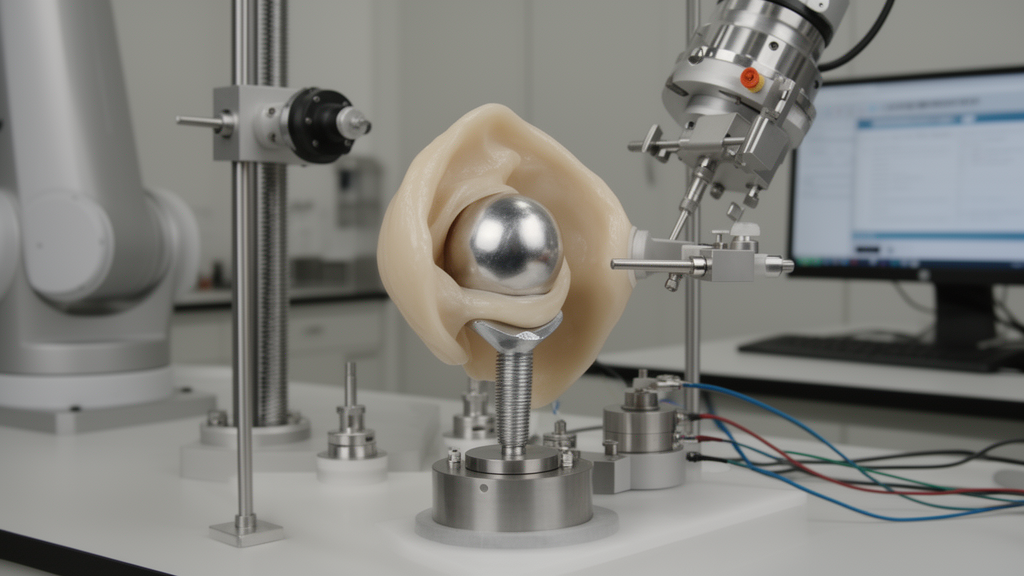
The hip capsule, a fibrous sleeve enclosing the joint, provides a passive restraining function that helps keep the hip stable after total hip arthroplasty. Restoring this function with implants has remained difficult because capsular biomechanics are complex and surgeons have lacked efficient quantitative tools for adjusting implant geometry and positioning. A study published in Annals of Biomedical Engineering on 26 October 2026 addressed this gap by developing a rapidly calibratable numerical parametric hip capsule model designed to characterize passive capsular mechanics and to quantitatively evaluate implant geometric and positioning parameters.
Methodologically, the team constructed a nonlinear spring-based model by dividing the capsule into 12 sectors described by 25 parameters, and calibrated it using experimentally measured torque–rotation data from cadaveric hips. Model accuracy was validated through comparison with finite element simulations and with experimental measurements across multiple motions. The calibrated framework was then applied to nine hip specimens to assess how femoral head size, neck length increment, and femoral stem anteversion influence capsular restraint after arthroplasty.
The reported computational performance was central to the study’s aim of practicality. Calibration took 0.74 hours per specimen, with each iteration requiring less than 1 second, and the model demonstrated strong agreement with finite element simulations, achieving an overall torque root-mean-square error of 0.21 ± 0.02 Nm. Relative to the experimental measurements, rotational root-mean-square errors ranged from 5.2° to 9.4° across the tested motions. These error values, reported by the authors as validation metrics for a numerical model, indicate close correspondence between the spring-based representation, the finite element reference simulations, and the cadaveric torque–rotation data.
The parametric analyses yielded findings relevant to implant planning. Femoral head size alone was insufficient to restore capsular restraint, whereas coordinated adjustment of neck length and stem anteversion significantly improved stability and reduced rotational hypermobility in the modeled hips. In other words, the model’s estimates suggest that no single implant dimension can reproduce the capsule’s passive restraining function, and that combined tuning of neck length and stem anteversion is associated with improved capsular restraint in this cadaveric modeling framework.
The authors conclude that the framework provides a computationally efficient and accurate hip capsule modeling tool that enables rapid calibration and quantitative evaluation of capsular mechanics, supporting personalized total hip arthroplasty planning and postoperative stability assessment. The evidence base for these conclusions is a numerical modeling study calibrated and validated against cadaveric hip experiments, so the reported performance and parametric findings apply to the modeled specimens rather than demonstrating clinical outcomes in patients. The study also involved a limited sample of nine hip specimens, and the abstract does not report intraoperative or postoperative clinical results. Within those boundaries, the work offers a quantitative approach to a long-standing challenge in joint replacement: efficiently characterizing the capsule’s passive restraint and using that characterization to guide implant parameter adjustment before surgery.
Subject of Research: Computational biomechanical modeling of hip capsular restraint in total hip arthroplasty
Article Title: A Rapidly Calibratable Parametric Hip Capsule Model for Evaluating Capsular Restraint in Total Hip Arthroplasty
Article References: Feng, T., Yew, A., Chou, S. M., Zhang, X., Zhang, Y., & Jin, Z. (2026). A Rapidly Calibratable Parametric Hip Capsule Model for Evaluating Capsular Restraint in Total Hip Arthroplasty. Annals of Biomedical Engineering. https://doi.org/10.1007/s10439-026-04416-y
Image Credits: AI Generated
DOI: 10.1007/s10439-026-04416-y
Keywords: hip capsule, total hip arthroplasty, biomechanics, spring-based model, finite element validation, cadaveric hips, torque-rotation, femoral head size, neck length, stem anteversion, joint stability, computational modeling
News Source: Ophelia Keating. (October 26, 2026). Rapidly Calibratable Hip Capsule Model Quantifies Capsular Restraint After Hip Replacement. Scienmag.