• HOME
  • NEWS
  • EXPLORE
    • CAREER
      • Companies
      • Jobs
    • EVENTS
    • iGEM
      • News
      • Team
    • PHOTOS
    • VIDEO
    • WIKI
  • BLOG
  • COMMUNITY
    • FACEBOOK
    • INSTAGRAM
    • TWITTER
Sunday, July 12, 2026
BIOENGINEER.ORG
No Result
View All Result
  • Login
  • HOME
  • NEWS
  • EXPLORE
    • CAREER
      • Companies
      • Jobs
        • Lecturer
        • PhD Studentship
        • Postdoc
        • Research Assistant
    • EVENTS
    • iGEM
      • News
      • Team
    • PHOTOS
    • VIDEO
    • WIKI
  • BLOG
  • COMMUNITY
    • FACEBOOK
    • INSTAGRAM
    • TWITTER
  • HOME
  • NEWS
  • EXPLORE
    • CAREER
      • Companies
      • Jobs
        • Lecturer
        • PhD Studentship
        • Postdoc
        • Research Assistant
    • EVENTS
    • iGEM
      • News
      • Team
    • PHOTOS
    • VIDEO
    • WIKI
  • BLOG
  • COMMUNITY
    • FACEBOOK
    • INSTAGRAM
    • TWITTER
No Result
View All Result
Bioengineer.org
No Result
View All Result
Home NEWS Science News

Rapid lateral flow immunoassay developed for fluorescence detection of SARS-CoV-2 RNA

Bioengineer by Bioengineer
December 10, 2020
in Science News
Reading Time: 2 mins read
0
IMAGE
Share on FacebookShare on TwitterShare on LinkedinShare on RedditShare on Telegram

IMAGE

Credit: SIBET

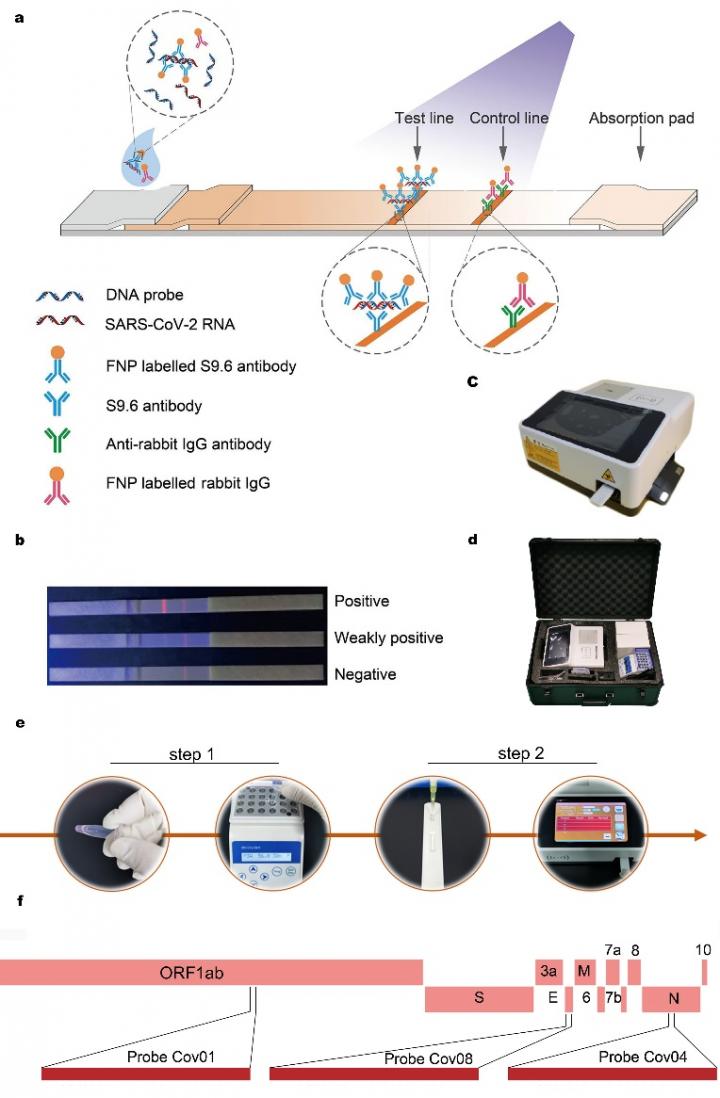
The COVID-19 pandemic has highlighted the need for rapid and accurate nucleic acid detection at the point of care. To meet this need, scientists from the Suzhou Institute of Biomedical Engineering and Technology have developed a novel amplification-free rapid SARS-CoV-2 nucleic acid detection platform based on hybrid capture fluorescence immunoassay (HC-FIA).

The use of the monoclonal antibody S9.6 is the distinctive feature of this process, which recognizes DNA-RNA double-stranded hybrids and enables the conversion of nucleic acid testing into immunofluorescence on a simple lateral flow dipstick.

The whole test procedure involves two steps, namely hybridization and immunofluorescence analysis, and it can be finished in less than an hour.

The process uses optimized DNA probes to target the conserved open reading frame 1ab, envelope protein and the nucleocapsid regions of the SARS-CoV-2 genome derived from clinical throat swab samples. It can achieve a limit of detection of 500 copies/mL, comparable to commercial kits based on real-time quantitative polymerase chain reaction (qPCR). In addition, no significant cross-reaction has been found between the SARS-CoV-2 probes and 55 common pathogens.

The performance of the HC-FIA detection reagent is free of interference by hemoglobin, mucin and various possible drugs that might exist in clinical samples. This assay and test kit can also be adapted for the detection of other viral RNA.

The HC-FIA process described here was supported by a multi-hospital randomized double-blind trial involving 734 samples. The current research not only represents proof-of-concept, but also has resulted in development of a commercial test kit for the diagnosis of SARS-CoV-2. The test kit was recently approved by the National Medical Products Administration and received European Conformity certification.

The test kit requires little in terms of equipment and professional personnel to confirm infection. It can function as a “suitcase laboratory” and thus be used as an on-site detection method for outpatient departments, emergency departments, customs and grassroots disease control.

“We are confident that the HC-FIA test is capable of serving as a sure safeguard in containing the epidemic through reducing community spread and imported cases, especially in developing countries,” said WANG Daming, lead researcher of the study.

###

This work entitled “Rapid lateral flow immunoassay for the fluorescence detection of SARS-CoV-2 RNA” was published in Nature Biomedical Engineering on December 3rd, 2020.

Media Contact
XIAO Xintong
[email protected]

Original Source

http://english.cas.cn/newsroom/research_news/life/202012/t20201210_256457.shtml

Related Journal Article

http://dx.doi.org/10.1038/s41551-020-00655-z

Tags: BiologyBiotechnologyDiagnostics
Share13Tweet8Share2ShareShareShare2

Related Posts

Living Alone and Poverty Heighten Risks for Older Nigerians in Cities

July 12, 2026

YEARS Algorithm Enhances Pulmonary Embolism Diagnosis in Cancer Patients

July 12, 2026

Diverse Symptom Burdens and Care Needs in Older Ischemic Stroke Patients

July 12, 2026

KAIST Creates AI to Detect Early Cerebrovascular Disease Signs at Home

July 12, 2026
Please login to join discussion

POPULAR NEWS

  • Detection of EDCs in Breast Milk and Infant Urine Up to Six Months Highlights Early Exposure Risks

    77 shares
    Share 31 Tweet 19
  • New Drug Candidate Developed at McMaster Shows Potential for Treating Brain Cancer

    58 shares
    Share 23 Tweet 15
  • KTU Researchers Explore Ultrasound’s Role in Enhancing Blood Flow Beyond Diagnostics

    53 shares
    Share 21 Tweet 13
  • 高齢者の骨粗鬆症治療の持続性比較

    51 shares
    Share 20 Tweet 13

About

BIOENGINEER.ORG

We bring you the latest biotechnology news from best research centers and universities around the world. Check our website.

Follow us

Recent News

Living Alone and Poverty Heighten Risks for Older Nigerians in Cities

YEARS Algorithm Enhances Pulmonary Embolism Diagnosis in Cancer Patients

Diverse Symptom Burdens and Care Needs in Older Ischemic Stroke Patients

Subscribe to Blog via Email

Enter your email address to subscribe to this blog and receive notifications of new posts by email.

Join 85 other subscribers
  • Contact Us

Bioengineer.org © Copyright 2023 All Rights Reserved.

Welcome Back!

Login to your account below

Forgotten Password?

Retrieve your password

Please enter your username or email address to reset your password.

Log In
No Result
View All Result
  • Homepages
    • Home Page 1
    • Home Page 2
  • News
  • National
  • Business
  • Health
  • Lifestyle
  • Science

Bioengineer.org © Copyright 2023 All Rights Reserved.