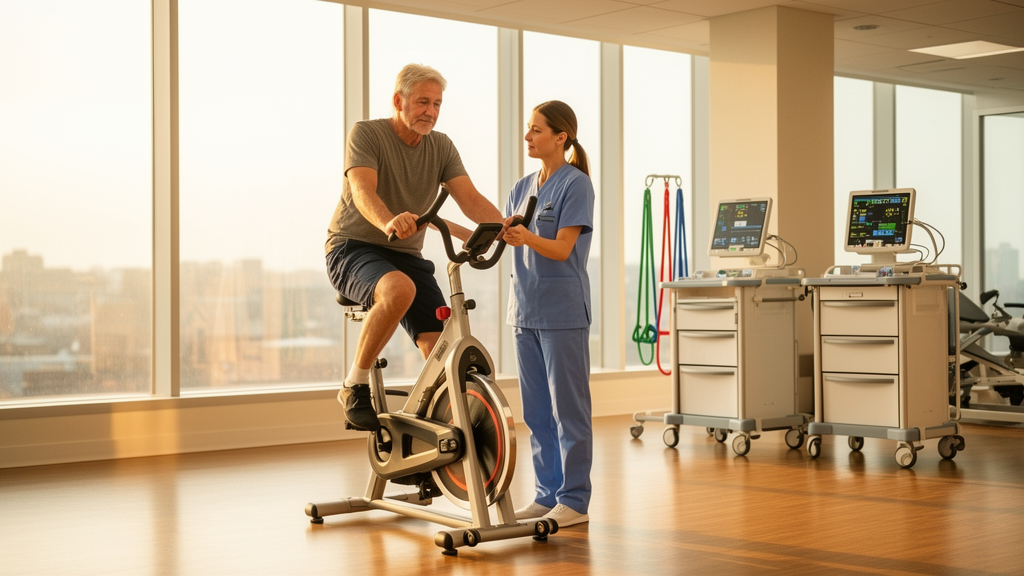
Researchers have outlined a randomized controlled trial protocol to compare high-intensity interval training and low-intensity continuous exercise in patients undergoing curative surgery for upper gastrointestinal cancer. The planned study, titled EXCITING-UGI, addresses substantial postoperative functional decline in patients treated for esophageal and gastric malignancies. In this surgical population, cardiorespiratory fitness decreases markedly following tumor resection, serving as a surrogate marker of prognosis because reduced fitness correlates with poor clinical outcomes.
Although exercise has been shown to enhance cardiorespiratory fitness in patients diagnosed with cancer, the optimal exercise intensity during the early postoperative phase remains unresolved. The protocol suggests that high-intensity interval training, or HIIT, may yield greater physiological improvements, whereas low-intensity continuous training, or LICT, may provide a more feasible alternative for patients with compromised physical function. The primary objective of the trial is to directly compare how these two distinct exercise intensities affect postoperative recovery.
According to the published protocol, the investigation is designed as a single-center, three-arm randomized controlled trial. Participants recovering from curative upper gastrointestinal surgery will be randomly allocated to a HIIT group, a LICT group, or a control group. Participants assigned to the intervention arms will undertake an eight-week supervised exercise regimen that combines aerobic and resistance training conducted across three sessions each week.
Aerobic exercise intensity within the intervention programs will be individualized based on baseline peak oxygen uptake, designated as VO₂peak. Participants assigned to the HIIT arm will train at 80% to 95% of their VO₂peak, while those in the LICT arm will exercise at 37% to 45% of VO₂peak. In addition to the structured exercise interventions, participants across all trial groups will receive standard nutritional counseling.
The primary outcome measure specified for the trial is cardiorespiratory fitness, determined by changes in VO₂peak through cardiopulmonary exercise testing. The trial design also incorporates secondary outcomes spanning physical function, body composition, activity and behavior, patient-reported outcomes, biological and mechanistic outcomes, and overall safety and clinical outcomes. Participant evaluations are scheduled at baseline, four weeks post-intervention, and eight weeks post-intervention.
Registered under clinical trial identifier NCT07561840, the publication describes planned trial methodologies rather than completed efficacy results. By assessing both functional performance and underlying biological mechanisms, the investigators intend to generate evidence to guide intensity-specific exercise recommendations for postoperative cancer care.
The secondary biological and mechanistic outcomes aim to clarify the internal physiological pathways associated with post-surgical exercise.
Led by investigators including Takuya Fukushima, Makoto Yamasaki, and Jiro Nakano, the protocol published in BMC Cancer aims to establish a methodological foundation for evidence-based exercise prescription following curative upper gastrointestinal cancer surgery.
Subject of Research: Postoperative exercise training protocol in upper gastrointestinal cancer
Article Title: Exercise and Cardiorespiratory fitness Improvement through supervised TraINinG in patients undergoing surgery for Upper GastroIntestinal cancer (EXCITING-UGI): study protocol for a randomized controlled trial
Article References: Fukushima, T., Yamasaki, M., Yamamoto, N., Ochi, E., Sato, S., Yamada, Y., Murai, N., Koda, H., Toshiyama, S., Harino, T., Hashimoto, Y., Kotsuka, M., Sato, T., Yasukochi, Y., Inoue, K., Higasa, K., Kimura, Y., & Nakano, J. (2026). Exercise and Cardiorespiratory fitness Improvement through supervised TraINinG in patients undergoing surgery for Upper GastroIntestinal cancer (EXCITING-UGI): study protocol for a randomized controlled trial. BMC Cancer. https://doi.org/10.1186/s12885-026-16859-6
Image Credits: AI Generated
DOI: 10.1186/s12885-026-16859-6
Keywords: upper gastrointestinal cancer, exercise training, cardiorespiratory fitness, high-intensity interval training, low-intensity continuous training, study protocol, randomized controlled trial, postoperative recovery, Exercise, Cardiorespiratory, fitness, Improvement
News Source: Nathaniel Bowman. (November 12, 2026). Randomized Trial Protocol Tests Exercise Intensity After Upper Gastrointestinal Cancer Surgery. Scienmag.