A small pilot study from a single Mexican center reports that stereotactic radiosurgery delivered with a linear accelerator reduced seizure frequency substantially in patients with drug-resistant mesial temporal lobe epilepsy, yet none of the seven treated patients achieved complete seizure freedom, and several experienced delayed neurological and psychiatric complications. The findings, published in the Chinese Neurosurgical Journal, offer a cautiously encouraging but sobering picture of a minimally invasive alternative for patients who cannot or will not undergo open temporal lobe surgery.
The prospective, exploratory case series was conducted at the Hospital de Especialidades, Centro Médico Nacional de Occidente in Guadalajara, Jalisco, a tertiary referral center, between March 1, 2017 and March 1, 2020. The researchers enrolled adults aged 18 to 65 with confirmed drug-resistant unilateral mesial temporal lobe epilepsy, a condition in which recurrent, unprovoked seizures arise from the inner structures of the temporal lobe, most commonly the hippocampus. Drug resistance was defined strictly: failure to achieve seizure control despite appropriate treatment with at least two antiepileptic drugs. Every participant had to document at least two disabling seizures per month through twelve months of prospective seizure diaries, supported by three serial electroencephalograms and magnetic resonance imaging consistent with the diagnosis.
The clinical context is considerable. Epilepsy affects more than 50 million people worldwide, with a reported global prevalence of 7.6 per 1,000 inhabitants, and in Mexico estimates range from 3.9 to 41 cases per 1,000. Among focal epilepsies, temporal lobe epilepsy is the most common form in adults, accounting for roughly 60% of cases. Hippocampal sclerosis, marked by the loss of neurons in specific hippocampal regions, is one of the most frequent pathological findings, and a high proportion of patients with this combination develop drug-resistant epilepsy. The standard surgical answer, anterior temporal lobectomy, produces seizure freedom in 60 to 80% of such patients, but it carries risks of cognitive dysfunction, visual field defects such as quadrantanopia, memory impairment, language disturbances when the dominant hemisphere is involved, hemorrhage, and infection. Many patients are not suitable candidates because of bilateral disease, dominant-hemisphere involvement, comorbidities, or simple reluctance to undergo a craniotomy.
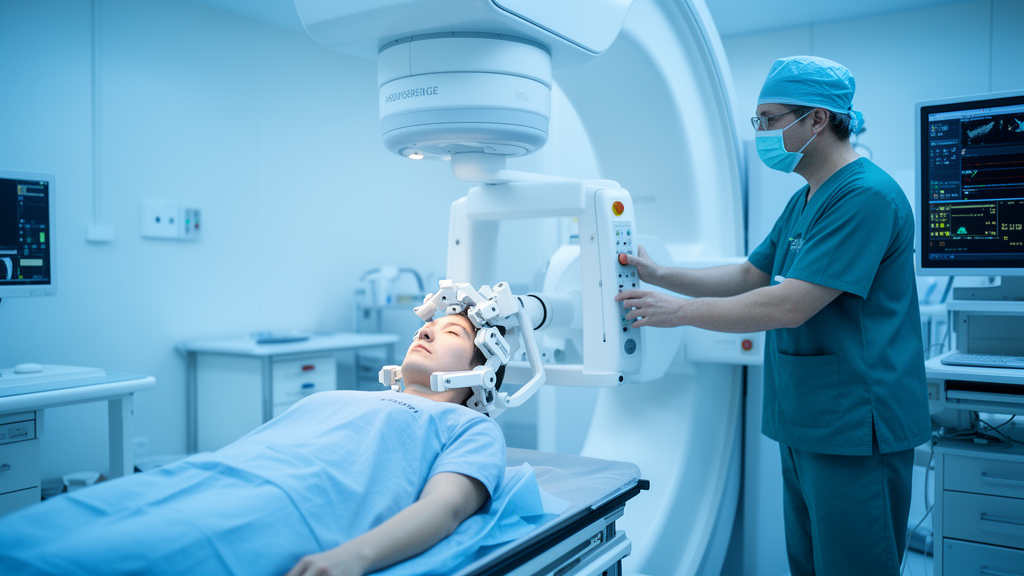
Against that backdrop, the Guadalajara team turned to linear accelerator-based radiosurgery, using a BrainLab Novalis system with 6-megavolt photons and a micro-multileaf collimator. Notably, they deliberately restricted the target to the hippocampal head and anterior body, excluding the broader amygdalo-entorhinal complex that many prior radiosurgical protocols have included. A prescribed margin dose of 22 Gy was normalized to the 50% isodose line at the isocenter, with at least 90% target coverage and a dose gradient below 10%. The plan geometry used eight modulated dynamic arcs with tailored couch rotations, and dose constraints adhered to international standards: no more than 8 Gy to the optic apparatus and cochlea, and less than 10 Gy to less than 1 milliliter of brainstem. Treatment was outpatient; a single prophylactic 12-mg dose of dexamethasone was given, and patients went home the same day.
The primary outcome was complete freedom from disabling seizures, corresponding to Engel Class I and ILAE Class 1, at 24 months after treatment. By that yardstick, the trial fell short: no patient achieved seizure freedom. But the secondary picture was more encouraging. Median seizure frequency fell from 12 seizures per month at baseline to 3.5 per month at 24 months, a median reduction of 75.6% with an interquartile range of 50% to 88.3%. Longitudinal analysis using the Friedman test showed a statistically significant reduction in seizure frequency over time, with a chi-squared statistic of 14.62 and a p-value of 0.006. Post hoc Wilcoxon signed-rank comparisons confirmed that the differences were significant between baseline and every follow-up period, while no significant differences emerged among the postoperative time points themselves, suggesting a stable treatment effect once it had been established.
Kaplan–Meier analysis, treating the maintenance of at least a 50% reduction in seizure frequency as the event of interest, showed that 85.7% of patients remained responders at six months, and 71.4% at 18 months, with the curve stable through the full 24-month follow-up. The median time to loss of response was not reached. Four patients had auras before treatment, and in those the median aura reduction at 24 months was 60%, a trend that did not reach statistical significance. Strikingly, the three patients who had been aura-free before treatment developed de novo auras during follow-up, a phenomenon the authors link to earlier radiosurgical reports in which auras transiently worsen while disabling seizures decline, possibly reflecting evolving neuromodulatory effects and radiation-induced changes within epileptogenic networks.
The safety findings temper the enthusiasm. Three patients, 42.8% of the cohort, developed visual field deficits, specifically bilateral hemianopsia, during the 24-month follow-up. Two patients, 28.6%, experienced psychotic episodes requiring specialized psychiatric intervention and ongoing monitoring. One patient with pre-existing cognitive impairment showed a clinically significant decline in recent memory. Headaches occurred in two patients but resolved after a course of corticosteroids, without signs of papilledema. The authors note that these delayed effects mean radiosurgery does not simply avoid collateral damage; rather, the visual pathways and perilesional limbic networks appear highly vulnerable to delayed radiation effects, underscoring the need for stricter dosimetric constraints. Medication regimens stayed constant in four of the seven patients, while three required changes, including the addition of benzodiazepines, memantine, primidone, or clonazepam to manage the psychiatric and cognitive adverse events and persistent seizure activity.
How do these results compare with the wider literature? The randomized ROSE trial showed that anterior temporal lobectomy achieves seizure-free rates of 70 to 78%, while stereotactic radiosurgery at 24 Gy to the 50% isodose line targeting mesial structures achieved seizure freedom in 52 to 60% of patients at 24 to 36 months, albeit with less cognitive impairment. A recent systematic review of minimally invasive techniques concluded that open resection remains superior for seizure control, at 60 to 80%, compared with 40 to 60% for laser interstitial thermal therapy and radiofrequency ablation, and 50 to 60% for radiosurgery, but that this efficacy comes at the cost of a higher risk of permanent adverse effects. The authors also point to the characteristic latency of radiosurgical benefit, usually between 9 and 24 months, which is thought to depend on progressive structural changes such as subnecrotic ischemic injury and alterations in the N-acetylaspartate-to-creatine ratio seen on magnetic resonance spectroscopy. In their cohort, seizure frequency declined gradually in step with progressive neuroimaging changes, which they interpret as consistent with a delayed neuromodulation mechanism.
The study’s limitations are substantial and the authors are candid about them. With only seven patients, no control group undergoing open surgery, and a follow-up capped at 24 months, the durability of the effect cannot be fully assessed. Formal neuropsychological testing and automated visual field perimetry were not routinely performed, so the degree of cognitive and visual decline rests on gross clinical reporting rather than standardized measurement. Positron emission tomography, single-photon emission computed tomography, and invasive stereo-electroencephalography were not available during the study period and were not incorporated into patient selection, potentially limiting the precision of epileptogenic zone localization. The cohort was also clinically heterogeneous, and the authors explicitly caution that the findings should be interpreted in that light.
What the study does establish is proof of principle with a specific technical signature: a radiosurgical target confined to the hippocampal head and anterior body, sparing extra-hippocampal limbic structures, can still produce a clinically meaningful reduction in seizure frequency in carefully selected patients who are not candidates for resection or who lack access to alternative ablative technologies. The authors call for controlled clinical trials directly comparing linear accelerator radiosurgery, Gamma Knife radiosurgery, and laser interstitial thermal therapy, along with the incorporation of structural and functional neuroimaging biomarkers to improve response prediction and enable individualized dosimetric planning. Until such trials exist, the message for patients and clinicians is measured: radiosurgery reduced seizures meaningfully in most of these seven patients, but it freed no one from seizures entirely, and its delayed visual and psychiatric complications arrived at rates that any honest conversation about this option would need to confront directly.
Subject of Research: LINAC-based stereotactic radiosurgery of the hippocampus for drug-resistant mesial temporal lobe epilepsy
Article Title: LINAC-based stereotactic radiosurgery targeting the hippocampus in mesial temporal lobe epilepsy: a single-center case series
Article References: García-García, V. A., Ramírez-Sánchez, M. V., García-Romero, R. C., Jasso-García, I., Garcia-Martinez, D., Tavares-Ortega, A., Gonzalez-Gonzalez, A. M., Estrada-Hernández, R. C., Sánchez-Miranda, M. F., Castillo-Cardiel, G., Cervantes-Guevara, G., Cervantes-Pérez, E., Ramírez-Ochoa, S., González-Ojeda, A., & Fuentes-Orozco, C. (2026). LINAC-based stereotactic radiosurgery targeting the hippocampus in mesial temporal lobe epilepsy: a single-center case series. Chinese Neurosurgical Journal, 12(1), Article 27. https://doi.org/10.1186/s41016-026-00446-6
Image Credits: AI Generated
DOI: 10.1186/s41016-026-00446-6
Keywords: mesial temporal lobe epilepsy, stereotactic radiosurgery, LINAC, hippocampus, drug-resistant epilepsy, seizure frequency, visual field deficits, adverse events, pilot case series, epilepsy surgery, neuromodulation, hippocampal sclerosis
News Source: Kendall Mcintyre. (October 28, 2026). Radiosurgery Eased Seizures in Drug-Resistant Epilepsy, but No Patient Became Seizure-Free. Scienmag.