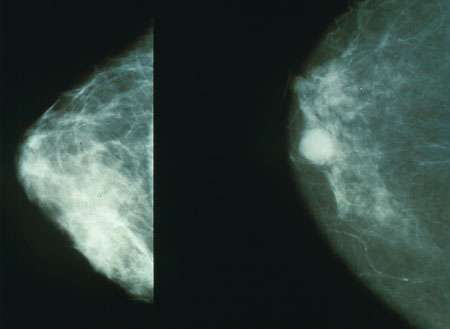
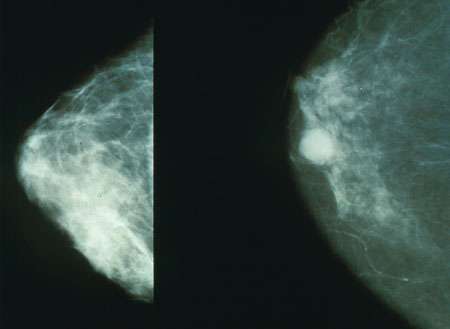
A new study by investigators at Brigham and Women’s Hospital in collaboration with researchers at the University of York and Leeds in the UK and MD Andersen Cancer Center in Texas puts to the test anecdotes about experienced radiologists’ ability to sense when a mammogram is abnormal. In a paper published August 29 in the Proceedings of the National Academy of Sciences, visual attention researchers showed radiologists mammograms for half a second and found that they could identify abnormal mammograms at better than chance levels. They further tested this ability through a series of experiments to explore what signal may alert radiologists to the presence of a possible abnormality, in the hopes of using these insights to improve breast cancer screening and early detection.
“Radiologists can have ‘hunches’ after a first look at a mammogram. We found that these hunches are based on something real in the images. It’s really striking that in the blink of an eye, an expert can pick up on something about that mammogram that indicates abnormality,” said Jeremy Wolfe, PhD, senior author of the study and director of the Visual Attention Laboratory at BWH. “Not only that, but they can detect something abnormal in the other breast, the breast that does not contain a lesion.”
In the clinic, radiologists carefully evaluate mammograms and may use computer automated systems to help screen the images. Although they would never assess an image in half a second in the clinic, the ability of experts to extract the “gist” of an image quickly suggests that there may be a detectable signs of breast cancer that radiologists are rapidly picking up.
In previous work, Wolfe and his colleagues found that radiologists could distinguish abnormal mammograms after a half-second glimpse but that non-experts could not. In the current study, the researchers tested whether breast tissue symmetry, breast density, image size, resolution or other characteristics were contributing factors to the success rate of the radiologists. They found that performance did not depend on breast symmetry or breast density but finer details of the texture of the breast tissue did help radiologists make the correct diagnosis more frequently.
Interestingly, the team found that radiologists could do better than chance in discriminating breast cancer cases from normal tissue, even when the images of abnormal breast tissue did not directly capture a cancerous lesion or when those images were taken from the contralateral breast (the breast on the other side of the body) of a woman with breast cancer.
“These results suggest that there may be something in the nominally normal breast that looks abnormal and is detectable,” said Wolfe. “Together, these results suggest that radiologists may be picking up on some sort of early, global signal of abnormality that is unknown to us at this point.”
Defining the signal that experienced radiologists are detecting could help researchers refine and improve Computer-Aided Detection (CAD) systems that can aid in medical screening and could be incorporated into training for medical experts to improve detection. The team is also interested in exploring whether other medical image experts such as dermatologists and pathologists can use analogous signals.
###
This research was supported in part by a grant from the John S. Dunn, Sr., Distinguished Chair in Diagnostic Radiology of U. T. MD Anderson Cancer Center and by the National Institutes of Health.
Brigham and Women’s Hospital (BWH) is a 793-bed nonprofit teaching affiliate of Harvard Medical School and a founding member of Partners HealthCare. BWH has more than 4.2 million annual patient visits and nearly 46,000 inpatient stays, is the largest birthing center in Massachusetts and employs nearly 16,000 people. The Brigham’s medical preeminence dates back to 1832, and today that rich history in clinical care is coupled with its national leadership in patient care, quality improvement and patient safety initiatives, and its dedication to research, innovation, community engagement and educating and training the next generation of health care professionals. Through investigation and discovery conducted at its Brigham Research Institute (BRI), BWH is an international leader in basic, clinical and translational research on human diseases, more than 3,000 researchers, including physician-investigators and renowned biomedical scientists and faculty supported by nearly $666 million in funding. For the last 25 years, BWH ranked second in research funding from the National Institutes of Health (NIH) among independent hospitals. BWH is also home to major landmark epidemiologic population studies, including the Nurses’ and Physicians’ Health Studies and the Women’s Health Initiative as well as the TIMI Study Group, one of the premier cardiovascular clinical trials groups. For more information, resources and to follow us on social media, please visit BWH’s online newsroom.
Media Contact
Haley Bridger
[email protected]
617-525-6383
@BrighamWomens
http://www.brighamandwomens.org
The post Radiologists detect breast cancer in ‘blink of an eye’ appeared first on Scienmag.