Earth-size planets can have varying amounts of radioactive elements, which generate internal heat that drives a planet’s geological activity and magnetism
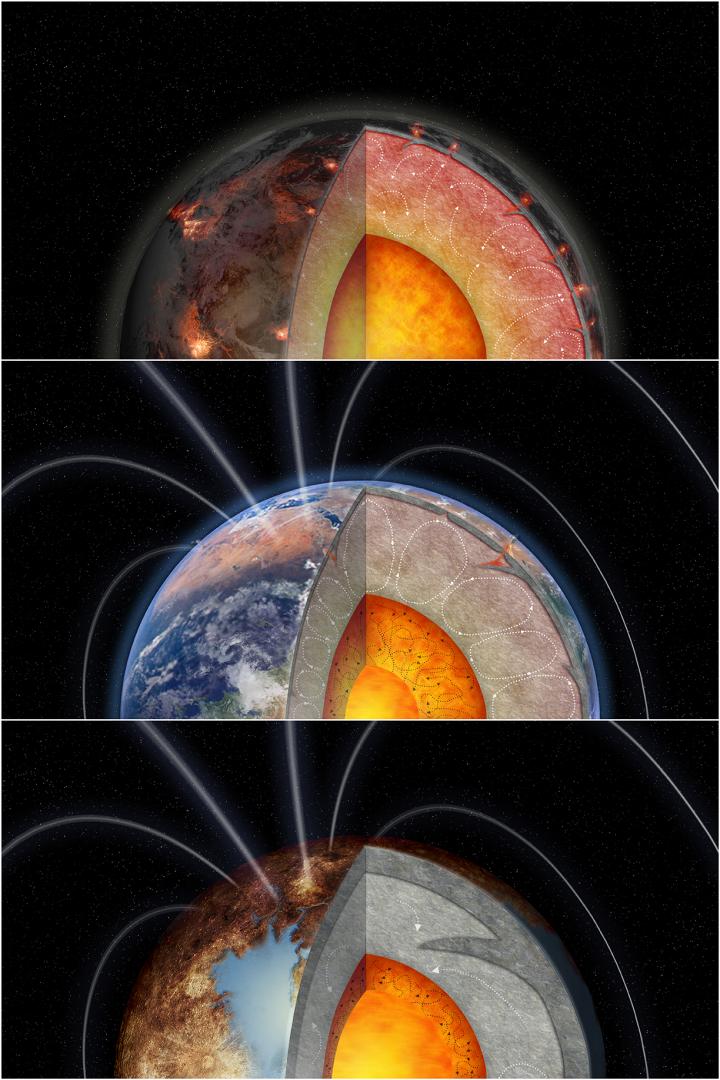
Credit: Illustrations by Melissa Weiss
The amount of long-lived radioactive elements incorporated into a rocky planet as it forms may be a crucial factor in determining its future habitability, according to a new study by an interdisciplinary team of scientists at UC Santa Cruz.
That’s because internal heating from the radioactive decay of the heavy elements thorium and uranium drives plate tectonics and may be necessary for the planet to generate a magnetic field. Earth’s magnetic field protects the planet from solar winds and cosmic rays.
Convection in Earth’s molten metallic core creates an internal dynamo (the “geodynamo”) that generates the planet’s magnetic field. Earth’s supply of radioactive elements provides more than enough internal heating to generate a persistent geodynamo, according to Francis Nimmo, professor of Earth and planetary sciences at UC Santa Cruz and first author of a paper on the new findings, published November 10 in Astrophysical Journal Letters.
“What we realized was that different planets accumulate different amounts of these radioactive elements that ultimately power geological activity and the magnetic field,” Nimmo explained. “So we took a model of the Earth and dialed the amount of internal radiogenic heat production up and down to see what happens.”
What they found is that if the radiogenic heating is more than the Earth’s, the planet can’t permanently sustain a dynamo, as Earth has done. That happens because most of the thorium and uranium end up in the mantle, and too much heat in the mantle acts as an insulator, preventing the molten core from losing heat fast enough to generate the convective motions that produce the magnetic field.
With more radiogenic internal heating, the planet also has much more volcanic activity, which could produce frequent mass extinction events. On the other hand, too little radioactive heat results in no volcanism and a geologically “dead” planet.
“Just by changing this one variable, you sweep through these different scenarios, from geologically dead to Earth-like to extremely volcanic without a dynamo,” Nimmo said, adding that these findings warrant more detailed studies.
“Now that we see the important implications of varying the amount of radiogenic heating, the simplified model that we used should be checked by more detailed calculations,” he said.
A planetary dynamo has been tied to habitability in several ways, according to Natalie Batalha, a professor of astronomy and astrophysics whose Astrobiology Initiative at UC Santa Cruz sparked the interdisciplinary collaboration that led to this paper.
“It has long been speculated that internal heating drives plate tectonics, which creates carbon cycling and geological activity like volcanism, which produces an atmosphere,” Batalha explained. “And the ability to retain an atmosphere is related to the magnetic field, which is also driven by internal heating.”
Coauthor Joel Primack, a professor emeritus of physics, explained that stellar winds, which are fast-moving flows of material ejected from stars, can steadily erode a planet’s atmosphere if it has no magnetic field.
“The lack of a magnetic field is apparently part of the reason, along with its lower gravity, why Mars has a very thin atmosphere,” he said. “It used to have a thicker atmosphere, and for a while it had surface water. Without the protection of a magnetic field, much more radiation gets through and the surface of the planet also becomes less habitable.”
Primack noted that the heavy elements crucial to radiogenic heating are created during mergers of neutron stars, which are extremely rare events. The creation of these so-called r-process elements during neutron-star mergers has been a focus of research by coauthor Enrico Ramirez-Ruiz, professor of astronomy and astrophysics.
“We would expect considerable variability in the amounts of these elements incorporated into stars and planets, because it depends on how close the matter that formed them was to where these rare events occurred in the galaxy,” Primack said.
Astronomers can use spectroscopy to measure the abundance of different elements in stars, and the compositions of planets are expected to be similar to those of the stars they orbit. The rare earth element europium, which is readily observed in stellar spectra, is created by the same process that makes the two longest-lived radioactive elements, thorium and uranium, so europium can be used as a tracer to study the variability of those elements in our galaxy’s stars and planets.
Astronomers have obtained europium measurements for many stars in our galactic neighborhood. Nimmo was able use those measurements to establish a natural range of inputs to his models of radiogenic heating. The sun’s composition is in the middle of that range. According to Primack, many stars have half as much europium compared to magnesium as the sun, and many stars have up to two times more than the sun.
The importance and variability of radiogenic heating opens up many new questions for astrobiologists, Batalha said.
“It’s a complex story, because both extremes have implications for habitability. You need enough radiogenic heating to sustain plate tectonics but not so much that you shut down the magnetic dynamo,” she said. “Ultimately, we’re looking for the most likely abodes of life. The abundance of uranium and thorium appear to be key factors, possibly even another dimension for defining a Goldilocks planet.”
Using europium measurements of their stars to identify planetary systems with different amounts of radiogenic elements, astronomers can start looking for differences between the planets in those systems, Nimmo said, especially once the James Webb Space Telescope is deployed. “The James Webb Space Telescope will be a powerful tool for the characterization of exoplanet atmospheres,” he said.
###
In addition to Nimmo, Primack, and Ramirez-Ruiz, the coauthors of the paper include Sandra Faber, professor emerita of astronomy and astrophysics, and postdoctoral scholar Mohammadtaher Safarzadeh.
Media Contact
Tim Stephens
[email protected]
Related Journal Article
http://dx.