• HOME
  • NEWS
  • EXPLORE
    • CAREER
      • Companies
      • Jobs
    • EVENTS
    • iGEM
      • News
      • Team
    • PHOTOS
    • VIDEO
    • WIKI
  • BLOG
  • COMMUNITY
    • FACEBOOK
    • INSTAGRAM
    • TWITTER
Friday, May 1, 2026
BIOENGINEER.ORG
No Result
View All Result
  • Login
  • HOME
  • NEWS
  • EXPLORE
    • CAREER
      • Companies
      • Jobs
        • Lecturer
        • PhD Studentship
        • Postdoc
        • Research Assistant
    • EVENTS
    • iGEM
      • News
      • Team
    • PHOTOS
    • VIDEO
    • WIKI
  • BLOG
  • COMMUNITY
    • FACEBOOK
    • INSTAGRAM
    • TWITTER
  • HOME
  • NEWS
  • EXPLORE
    • CAREER
      • Companies
      • Jobs
        • Lecturer
        • PhD Studentship
        • Postdoc
        • Research Assistant
    • EVENTS
    • iGEM
      • News
      • Team
    • PHOTOS
    • VIDEO
    • WIKI
  • BLOG
  • COMMUNITY
    • FACEBOOK
    • INSTAGRAM
    • TWITTER
No Result
View All Result
Bioengineer.org
No Result
View All Result
Home NEWS Science News Chemistry

Radio signal reveals supernova origin

Bioengineer by Bioengineer
May 17, 2023
in Chemistry
Reading Time: 3 mins read
0
Supernova explosion
Share on FacebookShare on TwitterShare on LinkedinShare on RedditShare on Telegram

In the latest issue of the journal Nature, astronomers from Stockholm University reveal the origin of a thermonuclear supernova explosion. Strong emission lines of helium and the first detection of such a supernova in radio waves show that the exploding white dwarf star had a helium-rich companion.
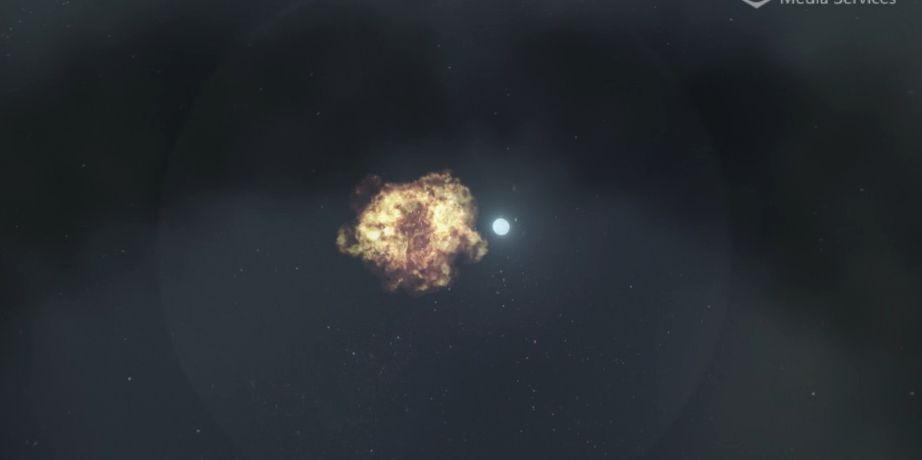
Supernova explosion

Credit: Adam Makarenko/W. M. Keck Observatory

In the latest issue of the journal Nature, astronomers from Stockholm University reveal the origin of a thermonuclear supernova explosion. Strong emission lines of helium and the first detection of such a supernova in radio waves show that the exploding white dwarf star had a helium-rich companion.

Supernovae of Type Ia are important for astronomers since they are used to measure the expansion of the Universe. However, the origin of these explosions has remained an open question. While it is established that the explosion is that of a compact white dwarf star somehow accreting too much matter from a companion star, the exact process and the nature of the progenitor is not known. The new discovery of supernova SN 2020eyj established that the companion star was a helium star that had lost much of its material just prior to the explosion of the white dwarf.

“Once we saw the signatures of strong interaction with the material from the companion we tried to also detect it in radio emission”, explains Erik Kool, post-doc at the Department of Astronomy at Stockholm university and lead author of the paper. “The detection in radio is the first one of a Type Ia supernova – something astronomers have tried to do for decades.”

Supernova 2020eyj was discovered by the Zwicky Transient Facility camera on Palomar mountain, where the Oskar Klein Centre at Stockholm University are members.

“The Nordic Optical telescope on La Palma was fundamental for following up this supernova”, says Professor Jesper Sollerman at the Department of Astronomy and co-author of the paper.
“As were spectra from the large Keck telescope on Hawai’i that immediately revealed the very unusual helium-dominated material around the exploded star.”

“This is clearly a very unusual Type Ia supernova, but still related to the ones we use to measure the expansion of the universe”, adds Joel Johansson from the Department of Physics.

“While normal Type Ia supernovae appear to always explode with the same brightness, this supernova tells us that there are many different pathways to a white dwarf star explosion”, he adds.

Link to the article in Nature: https://www.nature.com/articles/s41586-023-05916-w 

The paper A radio-detected Type Ia supernova with helium-rich circumstellar material is published in Nature and is led by Erik Kool from the Department of Astronomy at Stockholm University and describes the first radio detection of a Type Ia supernova. Co-authors from Stockholm University are Joel Johansson, Jesper Sollerman, Steve Schulze, Peter Lundqvist, Sheng Yang, and Conor Omand. This work involved researchers from institutes across the world, including Caltech, Weizmann Institute, IAA-CSIC, NAOJ, Macquarie University, and Trinity College Dublin.


Journal

Nature

DOI

10.1038/s41586-023-05916-w

Method of Research

Observational study

Subject of Research

Not applicable

Article Title

A radio-detected Type la supernova with helium-rich circumstellar material

Article Publication Date

17-May-2023

Share12Tweet8Share2ShareShareShare2

Related Posts

Key Additives Help Perovskite Solar Cells Bypass Yellow Phase and Enhance Longevity — Chemistry

Key Additives Help Perovskite Solar Cells Bypass Yellow Phase and Enhance Longevity

April 30, 2026
DAMPE Satellite Unveils New Insights into the Origins of Cosmic Rays — Chemistry

DAMPE Satellite Unveils New Insights into the Origins of Cosmic Rays

April 30, 2026

Unveiling the Hidden Framework of a Popular Class of Materials

April 30, 2026

Quantum Communication Breakthrough Shatters Longstanding Barrier

April 30, 2026

POPULAR NEWS

  • Research Indicates Potential Connection Between Prenatal Medication Exposure and Elevated Autism Risk

    830 shares
    Share 332 Tweet 208
  • New Study Reveals Plants Can Detect the Sound of Rain

    711 shares
    Share 284 Tweet 178
  • Scientists Investigate Possible Connection Between COVID-19 and Increased Lung Cancer Risk

    67 shares
    Share 27 Tweet 17
  • Salmonella Haem Blocks Macrophages, Boosts Infection

    60 shares
    Share 24 Tweet 15

About

We bring you the latest biotechnology news from best research centers and universities around the world. Check our website.

Follow us

Recent News

Small Trial Finds GLP-1 Lowers Heavy Drinking Days in Individuals with Alcohol Use Disorder and Obesity

Study Reveals CDC Missed Four of Seven Key Measles Elimination Indicators

Widening Disparities in Cervical Cancer Rates Between High- and Low-Income Nations

Subscribe to Blog via Email

Enter your email address to subscribe to this blog and receive notifications of new posts by email.

Join 82 other subscribers
  • Contact Us

Bioengineer.org © Copyright 2023 All Rights Reserved.

Welcome Back!

Login to your account below

Forgotten Password?

Retrieve your password

Please enter your username or email address to reset your password.

Log In
No Result
View All Result
  • Homepages
    • Home Page 1
    • Home Page 2
  • News
  • National
  • Business
  • Health
  • Lifestyle
  • Science

Bioengineer.org © Copyright 2023 All Rights Reserved.