


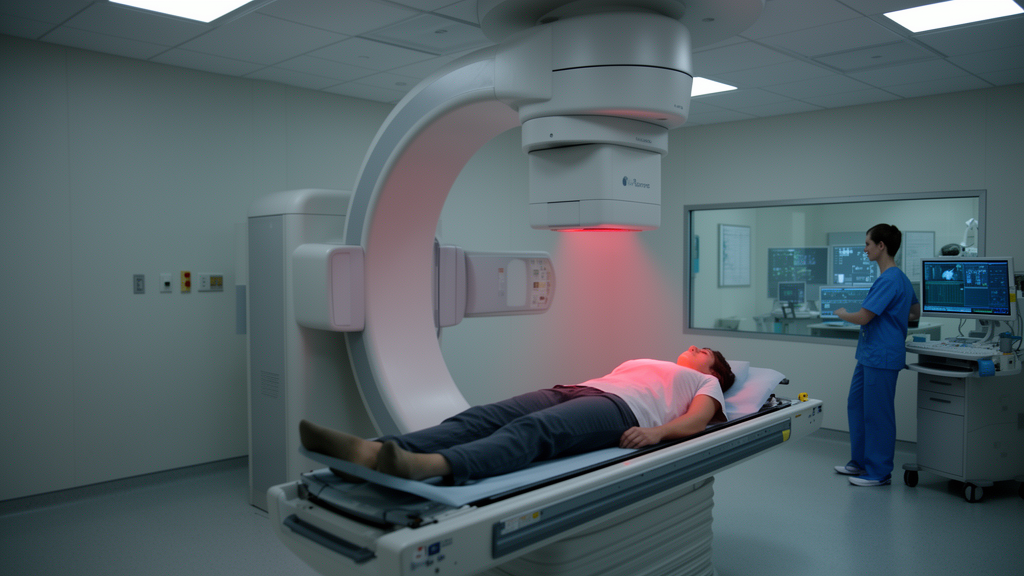
A single-patient brief report published in Cellular Oncology describes how a combination of helical tomotherapy, the targeted drug pazopanib, and the chemotherapy agent temozolomide was used to treat a 36-year-old man whose high-grade malignant peripheral nerve sheath tumor had spread to multiple sites. The case, reported by Wei Guan, Yueteng Yang and Ning Wu, documents a partial response that was first recorded at six months and still maintained at twelve months, before the disease eventually progressed after that assessment window.
The authors note that when this tumor metastasizes to paraspinal or perivascular locations, it becomes especially difficult to manage: the surrounding anatomy limits what surgery and radiation can safely achieve, systemic treatment options are limited, and the toxicities of available drugs can overlap in problematic ways. It was against this backdrop that the treating team assembled a multimodal regimen for their patient.
The man had developed metastases at the C2–3 and L4–5 levels of the spine and in the right axilla, in addition to his original mediastinal tumor. Helical tomotherapy was applied to these metastatic sites and also to a measurable residual mediastinal lesion within the postoperative tumor bed.
On the systemic side, pazopanib was started at 800 milligrams per day, and temozolomide was given at 150 milligrams per square meter of body surface per day on days 1 through 5 of each 28-day cycle. Treatment response was evaluated using RECIST v1.1, and toxicity was graded according to CTCAE v5.0.
According to the report, a partial response was first documented at the six-month evaluation and remained at twelve months, with no new lesions and no unequivocal progression of non-target disease during that period. The authors emphasize that after the twelve-month assessment, a PET/CT scan performed in May 2026 revealed multiple new metastases, confirming disease progression, although local control was maintained in several of the irradiated lesions. This distinction matters: the regimen produced a meaningful period of disease control, but it did not stop the cancer permanently.
The treatment also carried substantial toxicity. The pazopanib dose was first reduced from 800 to 600 milligrams per day because of anorexia, and then to 400 milligrams per day after a grade 4 drop in the patient’s white blood cell count, with the count falling to a nadir of 0.88 × 10⁹ per liter. A grade 3 lung infection required hospitalization, intravenous antimicrobials, and supplemental oxygen. Both systemic agents were ultimately discontinued on March 26, 2025.
One of the most striking observations in the case was cosmetic rather than oncological: the patient’s hair lost its pigment during pazopanib exposure, and the depigmentation partially reversed after the drug was stopped. In their conclusion, they state that reversible hair depigmentation is best regarded as an exposure-associated, hypothesis-generating observation rather than a validated pharmacodynamic biomarker. In other words, it is an intriguing signal that deserves further study, not an established marker of drug activity.
The authors also draw a careful boundary around what the case can and cannot show. They conclude that helical tomotherapy was technically feasible within multimodal treatment for anatomically complex metastatic MPNST, but they explicitly note that the individual contributions of the different treatment components cannot be distinguished. Because this is a single-patient report without a control group, it cannot establish whether the radiation, the pazopanib, the temozolomide, or their combination produced the observed response. The report is published as a peer-reviewed accepted article shared ahead of the final version of record, and it includes a brief review of the related literature. Its main value lies in documenting a feasible treatment approach for a tumor type with few options, and in flagging a reversible side effect that may prompt further investigation into pazopanib’s effects on pigmentation.
Subject of Research: A case report of helical tomotherapy combined with pazopanib and temozolomide for metastatic malignant peripheral nerve sheath tumor, including reversible hair depigmentation.
Article Title: Helical tomotherapy and pazopanib-based multimodal therapy for metastatic malignant peripheral nerve sheath tumor with reversible hair depigmentation: a brief report and brief literature review
Article References: Guan, W., Yang, Y., & Wu, N. (2026). Helical tomotherapy and pazopanib-based multimodal therapy for metastatic malignant peripheral nerve sheath tumor with reversible hair depigmentation: a brief report and brief literature review. Cellular Oncology. https://doi.org/10.1007/s13402-026-01315-1
Image Credits: AI Generated
DOI: 10.1007/s13402-026-01315-1
Keywords: malignant peripheral nerve sheath tumor, MPNST, helical tomotherapy, pazopanib, temozolomide, metastatic cancer, hair depigmentation, RECIST, case report, radiotherapy, drug toxicity, Cellular Oncology
News Source: Nathaniel Bowman. (October 28, 2026). Radiation plus pazopanib regimen shows partial response in metastatic nerve sheath tumor case. Scienmag.



