• HOME
  • NEWS
  • EXPLORE
    • CAREER
      • Companies
      • Jobs
    • EVENTS
    • iGEM
      • News
      • Team
    • PHOTOS
    • VIDEO
    • WIKI
  • BLOG
  • COMMUNITY
    • FACEBOOK
    • INSTAGRAM
    • TWITTER
Tuesday, October 20, 2026
BIOENGINEER.ORG
No Result
View All Result
  • Login
  • HOME
  • NEWS
  • EXPLORE
    • CAREER
      • Companies
      • Jobs
        • Lecturer
        • PhD Studentship
        • Postdoc
        • Research Assistant
    • EVENTS
    • iGEM
      • News
      • Team
    • PHOTOS
    • VIDEO
    • WIKI
  • BLOG
  • COMMUNITY
    • FACEBOOK
    • INSTAGRAM
    • TWITTER
No Result
View All Result
Bioengineer.org
No Result
View All Result
Home NEWS Science News Health

Quasi-experimental study links scalable end-of-life care simulation with short-term competence gains in nursing students

by
October 20, 2026
in Health
Reading Time: 2 mins read
0
Quasi-experimental study links scalable end-of-life care simulation with short-term competence gains in nursing students

Scalable Simulation Program Boosts Nursing Students' End-of-Life Care Skills

Share on FacebookShare on TwitterShare on LinkedinShare on RedditShare on Telegram

A single-group pretest–posttest study reported that an 80-minute, scalable end-of-life care simulation was associated with improved objective clinical competence, knowledge and self-reported confidence among third-year undergraduate nursing students in Japan. The findings, summarized in the study abstract, were observed in a small volunteer cohort at one national university and do not establish that the program caused the changes. The researchers called for larger controlled studies to confirm the results.

Twenty-seven of approximately 80 eligible third-year students enrolled voluntarily, and 25 completed all evaluations. The intervention was adapted from a previously evaluated small-group scenario for delivery to approximately 25–30 students in one session. Students participated through direct care roles, structured observation, small-group discussion and sequential debriefing. Objective structured clinical examination assessments were conducted before the program and two weeks later. Knowledge and confidence were measured at baseline, immediately after the program and at the two-week follow-up.

The primary outcome was OSCE-assessed clinical competence. Mean scores for physical assessment skills increased from 3.08 ± 1.50 at baseline to 5.96 ± 1.17 two weeks after the program, a mean difference of 2.88 (95% CI 1.95–3.81; p < 0.001) with a reported Cohen’s dz of 1.285. Scores for psychological care skills increased from 3.40 ± 2.80 to 7.80 ± 3.92, a mean difference of 4.40 (95% CI 2.57–6.23; p < 0.001), with Cohen’s dz of 0.990.

Knowledge scores rose from 7.00 ± 2.29 at baseline to 8.16 ± 1.57 immediately after the simulation and 8.20 ± 1.47 two weeks later; the Friedman test result was p = 0.001, with Kendall’s W = 0.262. Confidence in physical and psychological care also changed over time, although the abstract did not provide the corresponding numerical results. The study’s uncontrolled one-group design, single-university setting, small volunteer sample and short follow-up restrict causal interpretation. Two enrolled students did not complete all evaluations, and larger controlled studies are required to determine whether the observed improvements are reproducible and attributable to the program.

Subject of Research: Short-term outcomes of a scalable end-of-life care simulation for third-year nursing students in Japan

Article Title: A scalable simulation program for end-of-life care education in undergraduate nursing students: changes in OSCE-assessed clinical competence, knowledge, and confidence—a quasi-experimental one-group pretest-posttest study

Article References: Tamaki, T., Inumaru, A., Yokoi, Y., Fujii, M., Ohno, Y., & Tsujikawa, M. (2026). A scalable simulation program for end-of-life care education in undergraduate nursing students: changes in OSCE-assessed clinical competence, knowledge, and confidence—a quasi-experimental one-group pretest-posttest study. BMC Nursing. https://doi.org/10.1186/s12912-026-05358-5

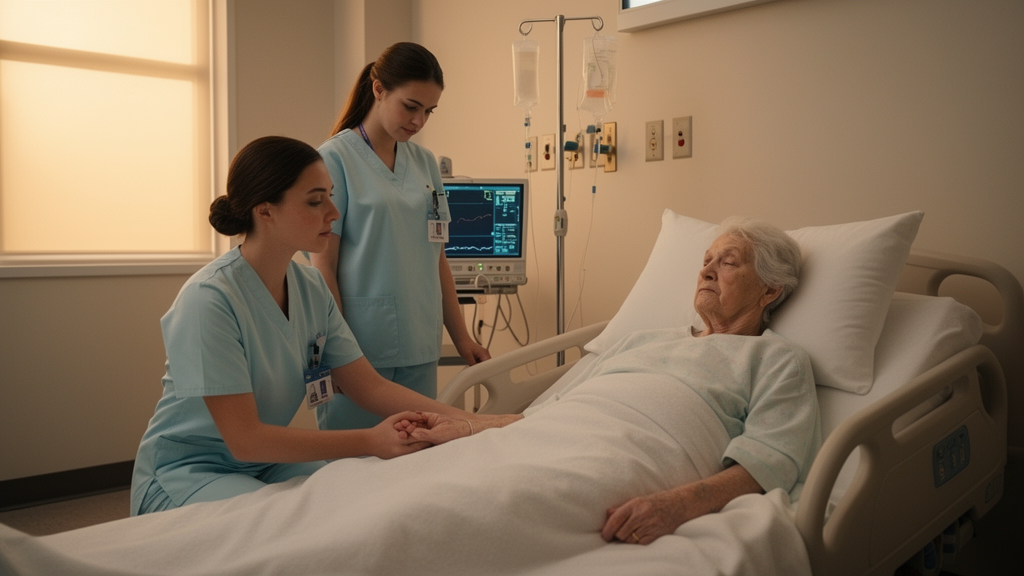
Image Credits: AI Generated

DOI: 10.1186/s12912-026-05358-5

Keywords: nursing education, end-of-life care, simulation, clinical competence, OSCE, knowledge, self-reported confidence, quasi-experimental study, scalable, program, end-of-life, care

News Source: Ophelia Keating. (October 20, 2026). Quasi-experimental study links scalable end-of-life care simulation with short-term competence gains in nursing students. Scienmag.


Tags: CareClinical Competenceend-of-lifeend-of-life careknowledgeNursing educationOSCEprogramQuasi-Experimental StudyScalableself-reported confidencesimulation
Share12Tweet7Share2ShareShareShare1

Related Posts

Jordanian community pharmacist survey identifies dispensing practices and knowledge gaps in weight-management medicines

Jordanian community pharmacist survey identifies dispensing practices and knowledge gaps in weight-management medicines

October 20, 2026
Qualitative study identifies factors shaping medication management during emergency department-to-home transitions

Qualitative study identifies factors shaping medication management during emergency department-to-home transitions

October 20, 2026

Scoping review links multifaceted pharmacist interventions with better antidepressant adherence

October 20, 2026

Cross-sectional CFS study links fatigue to six symptom clusters

October 20, 2026

POPULAR NEWS

  • Long-term camera trap monitoring of mammalian diversity and activity rhythms of threatened species in Xianxialing Nature Reserve, Zhejiang Province, China

    Long-term camera trap monitoring of mammalian diversity and activity rhythms of threatened species in Xianxialing Nature Reserve, Zhejiang Province, China

    29 shares
    Share 12 Tweet 7
  • Morphological and molecular study describes sulphidic cave shrimp from southwestern Iran

    29 shares
    Share 12 Tweet 7
  • Fungal exudates alter gene expression, hormones and fatty acids in Gymnadenia conopsea orchid seeds

    29 shares
    Share 12 Tweet 7
  • Jordanian community pharmacist survey identifies dispensing practices and knowledge gaps in weight-management medicines

    29 shares
    Share 12 Tweet 7

About

We bring you the latest biotechnology news from best research centers and universities around the world. Check our website.

Follow us

Recent News

Long-term camera trap monitoring of mammalian diversity and activity rhythms of threatened species in Xianxialing Nature Reserve, Zhejiang Province, China

Morphological and molecular study describes sulphidic cave shrimp from southwestern Iran

Fungal exudates alter gene expression, hormones and fatty acids in Gymnadenia conopsea orchid seeds

Subscribe to Blog via Email

Enter your email address to subscribe to this blog and receive notifications of new posts by email.

Join 85 other subscribers
  • Contact Us

Bioengineer.org © Copyright 2023 All Rights Reserved.

Welcome Back!

Login to your account below

Forgotten Password?

Retrieve your password

Please enter your username or email address to reset your password.

Log In
No Result
View All Result
  • Homepages
    • Home Page 1
    • Home Page 2
  • News
  • National
  • Business
  • Health
  • Lifestyle
  • Science

Bioengineer.org © Copyright 2023 All Rights Reserved.