• HOME
  • NEWS
  • EXPLORE
    • CAREER
      • Companies
      • Jobs
    • EVENTS
    • iGEM
      • News
      • Team
    • PHOTOS
    • VIDEO
    • WIKI
  • BLOG
  • COMMUNITY
    • FACEBOOK
    • INSTAGRAM
    • TWITTER
Saturday, February 7, 2026
BIOENGINEER.ORG
No Result
View All Result
  • Login
  • HOME
  • NEWS
  • EXPLORE
    • CAREER
      • Companies
      • Jobs
        • Lecturer
        • PhD Studentship
        • Postdoc
        • Research Assistant
    • EVENTS
    • iGEM
      • News
      • Team
    • PHOTOS
    • VIDEO
    • WIKI
  • BLOG
  • COMMUNITY
    • FACEBOOK
    • INSTAGRAM
    • TWITTER
  • HOME
  • NEWS
  • EXPLORE
    • CAREER
      • Companies
      • Jobs
        • Lecturer
        • PhD Studentship
        • Postdoc
        • Research Assistant
    • EVENTS
    • iGEM
      • News
      • Team
    • PHOTOS
    • VIDEO
    • WIKI
  • BLOG
  • COMMUNITY
    • FACEBOOK
    • INSTAGRAM
    • TWITTER
No Result
View All Result
Bioengineer.org
No Result
View All Result
Home NEWS Science News

Quantum RAM: Modelling the big questions with the very small

Bioengineer by Bioengineer
February 3, 2017
in Science News
Reading Time: 2 mins read
0
Share on FacebookShare on TwitterShare on LinkedinShare on RedditShare on Telegram
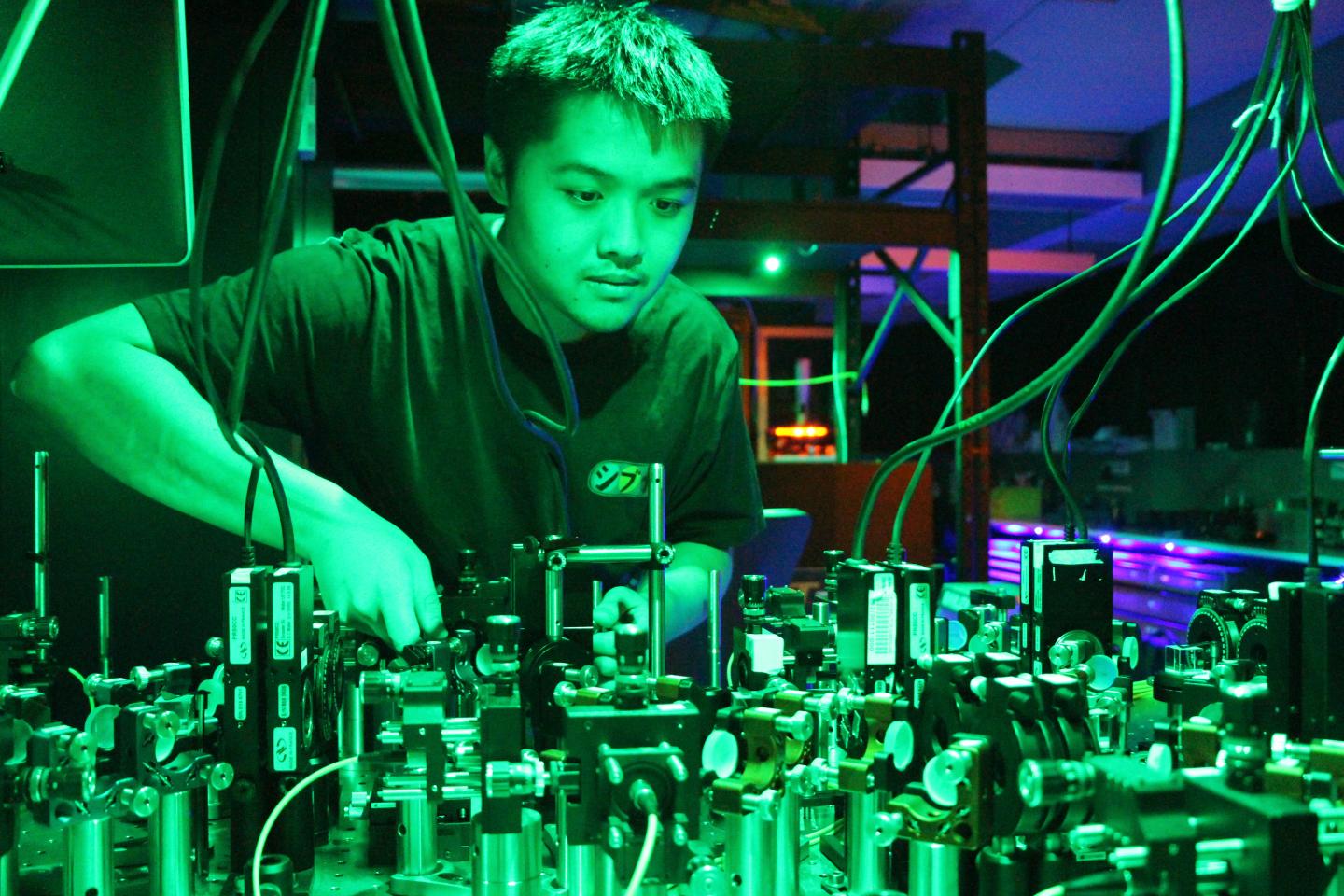
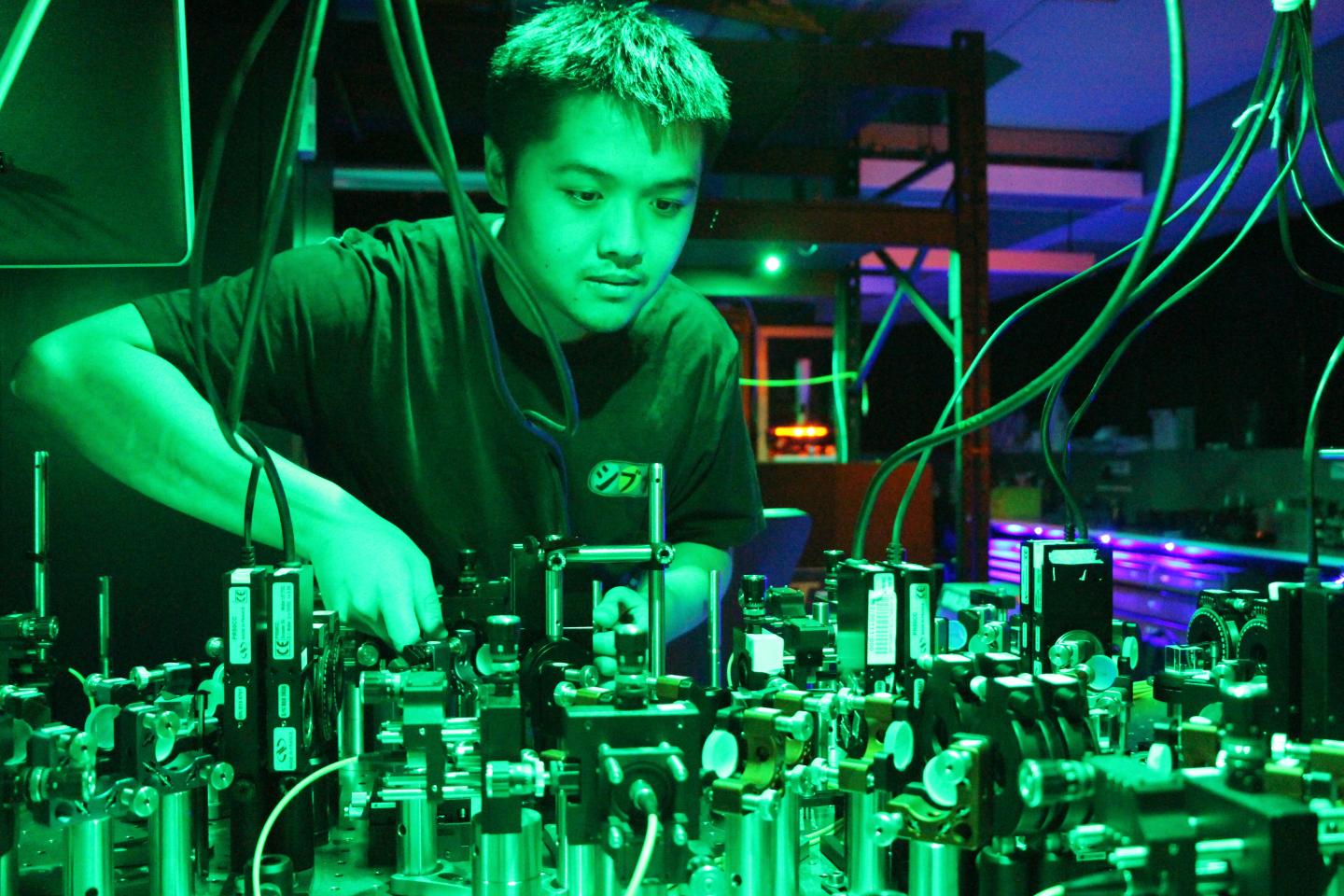
IMAGE

Credit: Griffith University

Griffith's Professor Geoff Pryde, who led the project, says that such processes could be simulated using a "quantum hard drive", much smaller than the memory required for conventional simulations.

"Stephen Hawking once stated that the 21st century is the 'century of complexity', as many of today's most pressing problems, such as understanding climate change or designing transportation system, involve huge networks of interacting components," he says.

"Their simulation is thus immensely challenging, requiring storage of unprecedented amounts of data. What our experiments demonstrate is a solution may come from quantum theory, by encoding this data into a quantum system, such as the quantum states of light."

Einstein once said that "God does not play dice with the universe," voicing his disdain with the idea that quantum particles contain intrinsic randomness.

"But theoretical studies showed that this intrinsic randomness is just the right ingredient needed to reduce the memory cost for modelling partially random statistics," says Dr Mile Gu, a member of the team who developed the initial theory.

In contrast with the usual binary storage system – the zeroes and ones of bits – quantum bits can be simultaneously 0 and 1, a phenomenon known as quantum superposition.

The researchers, in their paper published in Science Advances, say this freedom allows quantum computers to store many different states of the system being simulated in different superpositions, using less memory overall than in a classical computer.

The team constructed a proof-of-principle quantum simulator using a photon – a single particle of light – interacting with another photon.

They measured the memory requirements of this simulator, and compared it with the fundamental memory requirements of a classical simulator, when used to simulate specified partly random processes.

The data showed that the quantum system could complete the task with much less information stored than the classical computer- a factor of 20 improvements at the best point.

"Although the system was very small – even the ordinary simulation required only a single bit of memory – it proved that quantum advantages can be achieved," Pryde says.

"Theoretically, large improvements can also be realized for much more complex simulations, and one of the goals of this research program is to advance the demonstrations to more complex problems."

###

Media Contact

Stephanie Bedo
[email protected]
61-408-727-734
@Griffith_Uni

http://www.griffith.edu.au

############

Story Source: Materials provided by Scienmag

Share12Tweet8Share2ShareShareShare2

Related Posts

Digital Health Perspectives from Baltic Sea Experts

February 7, 2026
Florida Cane Toad: Complex Spread and Selective Evolution

Florida Cane Toad: Complex Spread and Selective Evolution

February 7, 2026

Exploring Decision-Making in Dementia Caregivers’ Mobility

February 7, 2026

Succinate Receptor 1 Limits Blood Cell Formation, Leukemia

February 7, 2026
Please login to join discussion

POPULAR NEWS

  • Robotic Ureteral Reconstruction: A Novel Approach

    Robotic Ureteral Reconstruction: A Novel Approach

    82 shares
    Share 33 Tweet 21
  • Digital Privacy: Health Data Control in Incarceration

    63 shares
    Share 25 Tweet 16
  • Study Reveals Lipid Accumulation in ME/CFS Cells

    57 shares
    Share 23 Tweet 14
  • Breakthrough in RNA Research Accelerates Medical Innovations Timeline

    53 shares
    Share 21 Tweet 13

About

We bring you the latest biotechnology news from best research centers and universities around the world. Check our website.

Follow us

Recent News

Digital Health Perspectives from Baltic Sea Experts

Florida Cane Toad: Complex Spread and Selective Evolution

Exploring Decision-Making in Dementia Caregivers’ Mobility

Subscribe to Blog via Email

Enter your email address to subscribe to this blog and receive notifications of new posts by email.

Join 73 other subscribers
  • Contact Us

Bioengineer.org © Copyright 2023 All Rights Reserved.

Welcome Back!

Login to your account below

Forgotten Password?

Retrieve your password

Please enter your username or email address to reset your password.

Log In
No Result
View All Result
  • Homepages
    • Home Page 1
    • Home Page 2
  • News
  • National
  • Business
  • Health
  • Lifestyle
  • Science

Bioengineer.org © Copyright 2023 All Rights Reserved.