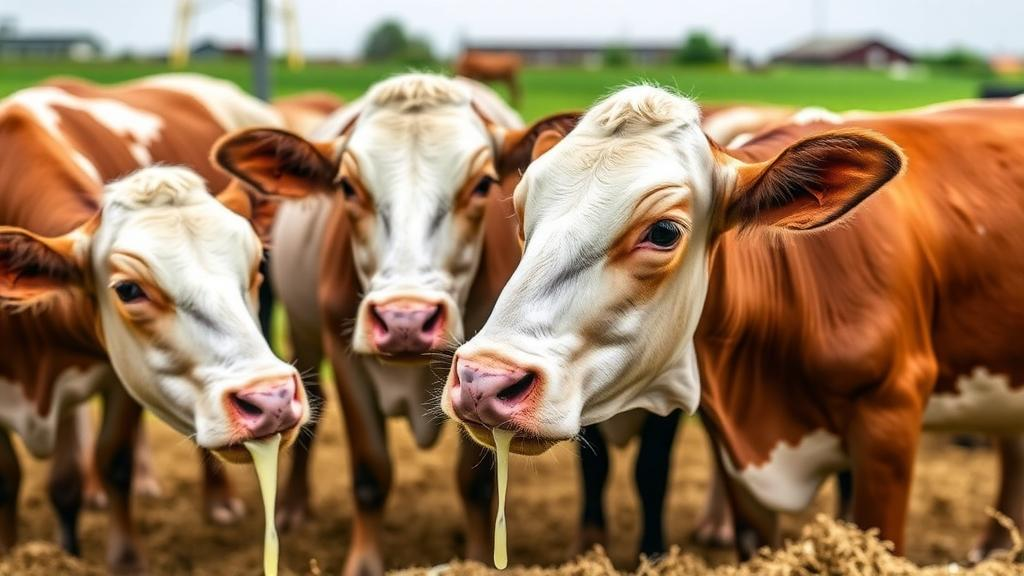
Every glass of milk carries an invisible climate cost. A single lactating dairy cow releases roughly 128 kilograms of methane each year, more than double the output of a feedlot beef animal, according to the Intergovernmental Panel on Climate Change. Because methane traps heat twenty-eight times more effectively than carbon dioxide over a century, scientists and policymakers have pinned considerable hope on feed additives that suppress the gas at its source: the rumen. Yet nearly all the supporting evidence comes from tightly controlled research barns, where diets, dosages, and environments are held constant. What happens when these additives are poured into the feed bunk of a working commercial dairy, with its shifting forage quality, variable herd structure, and seasonal heat stress, has remained largely unknown. A new four-year field study from Jeju, South Korea, now offers one of the most detailed real-world answers to date, and its findings are both reassuring and subtly complicated.
The research, published in Food Science of Animal Resources, followed 400 lactating Holstein cows across three commercial dairy farms in Jeju City over 47 months, from January 2021 to November 2024. During this period the farms progressively replaced their conventional concentrate feeds with commercially manufactured methane-mitigating concentrates, allowing the researchers to compare milk records before and after the transition under genuine production conditions. Two products were involved: one containing a yeast-based additive, garlic-derived diallyl disulfide, and condensed tannins, and another built around a commercial essential-oil blend marketed as Agolin. The full composition of the additives is proprietary, a common feature of the emerging methane-mitigation market that itself complicates independent scientific evaluation. All cows received a total mixed ration formulated to Korean feeding standards, delivered twice daily, with free access to water and minerals.
The headline result is straightforward: milk volume survived the transition intact. Across all statistical models, including multifactorial general linear models and linear mixed-effects models that treated individual cows as random effects, methane-mitigating feeding showed no significant effect on daily milk yield. For dairy farmers weighing whether to adopt climate-friendly rations, this is the single most commercially consequential finding, because any drop in milk output would translate directly into lost revenue and would likely doom adoption regardless of environmental benefits. The result also aligns with earlier experimental work showing that additives such as 3-nitrooxypropanol, which can cut enteric methane by 24 to 40 percent, and the red seaweed Asparagopsis, which has suppressed methane by more than 80 percent in controlled trials, generally leave production untouched.
Beneath the calm surface of total yield, however, the milk itself changed. Cows receiving the methane-mitigating concentrate showed significantly lower concentrations of milk protein, solid non-fat, and milk urea nitrogen, along with a modest but statistically consistent increase in somatic cell count, an indicator of udder health and immune activity. Milk urea nitrogen is a window into nitrogen metabolism: when rumen microbes capture dietary nitrogen inefficiently, excess ammonia is converted to urea and appears in blood and milk. Lower MUN in the methane-mitigating group therefore hints that the additives altered rumen fermentation in ways that shifted how the animals handled nitrogen, a plausible consequence of additives that redirect hydrogen away from methanogenic archaea and thereby reshape the entire microbial economy of the rumen.
The somatic cell count finding deserves careful handling. The increase was moderate and does not indicate clinical mastitis, and the authors explicitly caution against causal interpretation. Still, the signal appeared across all three farms, reaching statistical significance everywhere, which lends it weight. One mechanistic explanation involves the gut-immune axis: dietary components that alter rumen fermentation can shift ruminal pH and microbial turnover, promoting the release of lipopolysaccharides, molecular fragments of bacterial membranes that act as inflammatory triggers and can elevate somatic cell counts even in the absence of infection. Previous trials with 3-nitrooxypropanol and Asparagopsis have reported similarly inconsistent somatic cell outcomes, suggesting this may be a recurring, if subtle, trade-off in methane-mitigation feeding.
Perhaps the most striking feature of the study is how context-dependent the responses proved to be. Milk fat fell significantly on Farm A but not on the other two. Milk protein dropped on Farm C alone. Solid non-fat declined on Farms B and C but not on A. Interactions between feed type and farm, parity, and month were significant for nearly every compositional trait, meaning the effect of the same additive family depended on where the cow lived, how many lactations she had completed, and what time of year it was. Farm-level differences in forage quality, hygiene protocols, microclimate, and baseline nutrition likely explain much of this heterogeneity, and the authors argue that any policy or implementation framework must account for it.
Parity emerged as a particularly powerful moderator. Milk yield climbed steadily from the first through the fifth lactation before plateauing and declining, while protein, solid non-fat, and MUN drifted downward with age, consistent with the cumulative metabolic stress and reduced hepatic and mammary efficiency of older cows. Against this backdrop, the methane-mitigating feed produced parity-specific effects: milk yield rose significantly in sixth-parity cows but fell in third and fourth parity animals, solid non-fat declined consistently across parities three through six, and somatic cell counts rose in several mid-life parities. MUN was lower across all parities, though significance faded after the second. These patterns suggest that younger, more metabolically resilient cows absorb dietary perturbation more easily, while older animals, already operating closer to their physiological limits, respond more visibly.
Seasonality added another layer of complexity. Milk protein and solid non-fat dipped during the hot summer months of June through August, a classic heat-stress signature reflecting reduced feed intake and impaired rumen function. Yet the methane-mitigating group’s solid non-fat decline progressed gradually from summer into winter rather than showing a sharp heat-driven drop, and MUN differences persisted across most months with only scattered exceptions. The monthly patterns therefore do not map neatly onto thermal stress alone, implying that individual cow variability, forage quality, and intake dynamics modulate how the feed expresses itself through the calendar. Notably, somatic cell counts remained stable across months, suggesting mammary health in these herds was governed more by parity structure and farm hygiene than by climate.
To distill these tangled effects, the team ran stepwise regression guided by the Schwarz Bayesian Criterion, testing whether methane-mitigating feeding independently explained variation in each trait once farm, parity, and month were considered. The answer was nuanced. Feed group was not retained for milk yield, fat, or protein, indicating those traits are governed by structural factors. But it was retained with strong statistical support for solid non-fat, MUN, and log-transformed somatic cell count, and its inclusion improved model fit, most notably for MUN. The overall explanatory power of the models was modest, with adjusted R-squared values between roughly 0.07 and 0.20, which the authors attribute to the enormous unmeasured variability inherent in field data, from genetics and individual intake to rumen microbial communities.
The study carries an important caveat that tempers its climate message: no methane was actually measured. The feeds were formulated with mitigation in mind, but the research assessed downstream consequences on milk, not upstream effects on emissions. The authors are explicit that the results should not be read as proof of methane reduction. What the study does establish is feasibility and safety at scale: commercially available methane-mitigating concentrates can be deployed across real farms for years without sacrificing milk volume, while producing detectable, context-sensitive shifts in nitrogen-related milk traits and a modest rise in somatic cell counts. The next generation of research, the authors argue, must pair direct methane measurement with rumen fermentation analysis, inflammatory marker monitoring, and cow-level physiological profiling. Until then, the Jeju experiment stands as a rare and valuable bridge between the optimistic world of controlled methane trials and the messy, variable reality of the commercial dairy farm, where the climate solution ultimately has to work.
Subject of Research: Field evaluation of methane-mitigating concentrate feed effects on milk production, composition, and udder health in commercial Holstein dairy cows
Article Title: Impact of methane-mitigating concentrate feed on milk production, composition, and udder health in Holstein cows
Article References: Lee, S., Ko, K., Kim, G., Park, J.-E., & Ryu, Y. (2026). Impact of methane-mitigating concentrate feed on milk production, composition, and udder health in Holstein cows. Food Science of Animal Resources, 46(1), Article 49. https://doi.org/10.1007/s44463-025-00033-w
Image Credits: AI Generated
DOI: 10.1007/s44463-025-00033-w
Keywords: methane mitigation, dairy cows, Holstein, milk composition, milk urea nitrogen, somatic cell count, enteric fermentation, feed additives, greenhouse gas emissions, udder health, commercial dairy farms, sustainable dairy production
News Source: William Thompson. (October 5, 2026). Methane-Cutting Cattle Feed Keeps Milk Flowing but Shifts Milk Chemistry on Real Farms. Scienmag.