• HOME
  • NEWS
  • EXPLORE
    • CAREER
      • Companies
      • Jobs
    • EVENTS
    • iGEM
      • News
      • Team
    • PHOTOS
    • VIDEO
    • WIKI
  • BLOG
  • COMMUNITY
    • FACEBOOK
    • INSTAGRAM
    • TWITTER
Friday, March 13, 2026
BIOENGINEER.ORG
No Result
View All Result
  • Login
  • HOME
  • NEWS
  • EXPLORE
    • CAREER
      • Companies
      • Jobs
        • Lecturer
        • PhD Studentship
        • Postdoc
        • Research Assistant
    • EVENTS
    • iGEM
      • News
      • Team
    • PHOTOS
    • VIDEO
    • WIKI
  • BLOG
  • COMMUNITY
    • FACEBOOK
    • INSTAGRAM
    • TWITTER
  • HOME
  • NEWS
  • EXPLORE
    • CAREER
      • Companies
      • Jobs
        • Lecturer
        • PhD Studentship
        • Postdoc
        • Research Assistant
    • EVENTS
    • iGEM
      • News
      • Team
    • PHOTOS
    • VIDEO
    • WIKI
  • BLOG
  • COMMUNITY
    • FACEBOOK
    • INSTAGRAM
    • TWITTER
No Result
View All Result
Bioengineer.org
No Result
View All Result
Home NEWS Science News Chemistry

Quantum physics helps destroy cancer cells

Bioengineer by Bioengineer
July 14, 2021
in Chemistry
Reading Time: 3 mins read
0
IMAGE
Share on FacebookShare on TwitterShare on LinkedinShare on RedditShare on Telegram

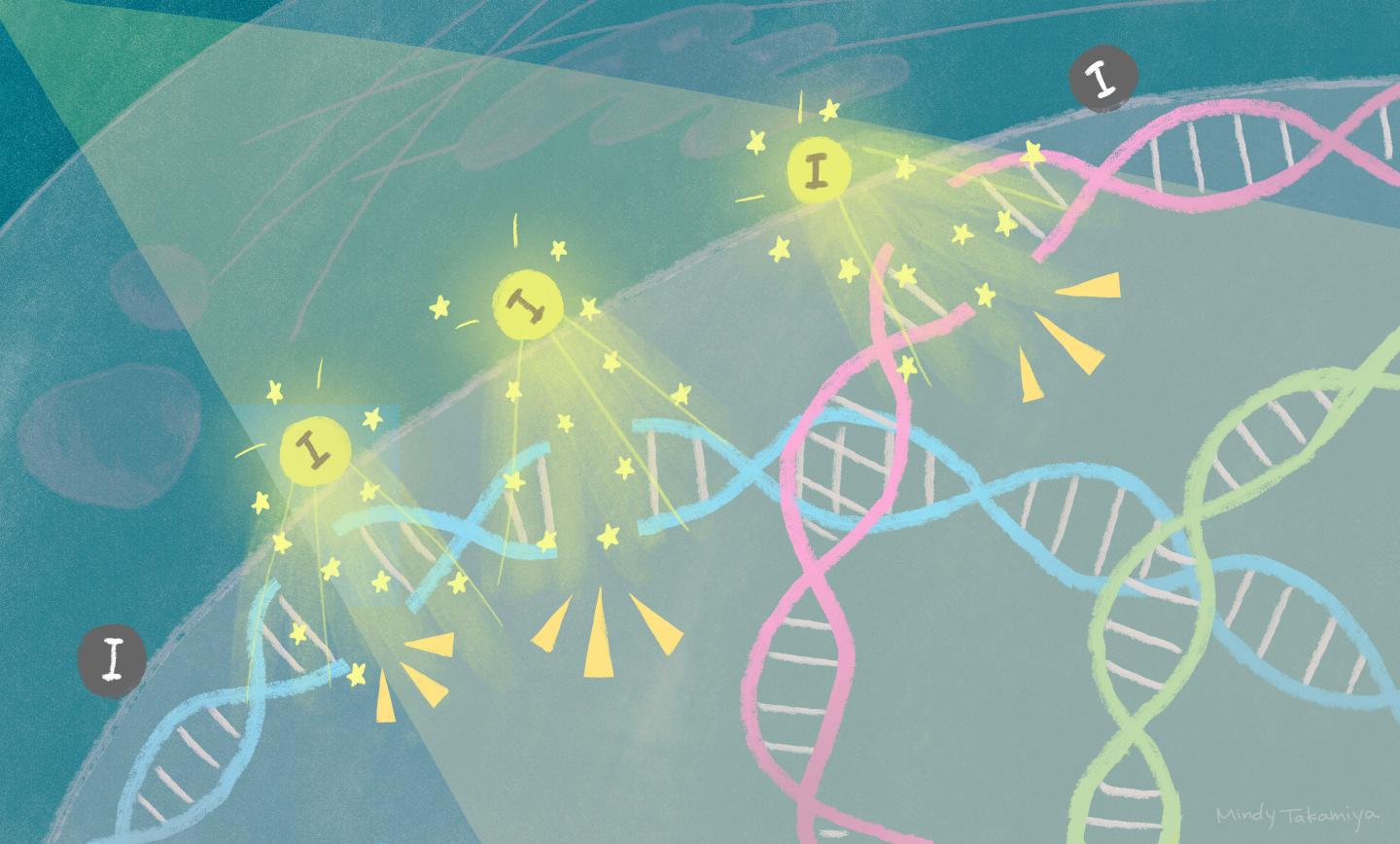
Researchers have found a way to enhance radiation therapy using novel iodine nanoparticles
IMAGE

Credit: Mindy Takamiya/Kyoto University iCeMS

Cancer cell death is triggered within three days when X-rays are shone onto tumor tissue containing iodine-carrying nanoparticles. The iodine releases electrons that break the tumor’s DNA, leading to cell death. The findings, by scientists at Kyoto University’s Institute for Integrated Cell-Material Sciences (iCeMS) and colleagues in Japan and the US, were published in the journal Scientific Reports.

“Exposing a metal to light leads to the release of electrons, a phenomenon called the photoelectric effect. An explanation of this phenomenon by Albert Einstein in 1905 heralded the birth of quantum physics,” says iCeMS molecular biologist Fuyuhiko Tamanoi, who led the study. “Our research provides evidence that suggests it is possible to reproduce this effect inside cancer cells.”

A long-standing problem with cancer radiation therapy is that it is not effective at the center of tumors where oxygen levels are low due to the lack of blood vessels penetrating deeply into the tissue. X-ray irradiation needs oxygen to generate DNA-damaging reactive oxygen when the rays hit molecules inside the cell.

Tamanoi, together with Kotaro Matsumoto and colleagues have been trying to overcome this issue by finding more direct ways to damage cancer DNA. In earlier work, they showed that gadolinium-loaded nanoparticles could kill cancer cells when irradiated with 50.25 kiloelectron volts of synchrotron-generated X-rays.

In the current study, they designed porous, iodine-carrying organosilica nanoparticles. Iodine is cheaper than gadolinium and releases electrons at lower energy levels.

The researchers dispersed their nanoparticles through tumor spheroids, 3D tissue containing multiple cancer cells. Irradiating the spheroids for 30 minutes with 33.2 keV of X-rays led to their complete destruction within three days. By systematically changing energy levels, they were able to demonstrate that the optimum effect of tumor destruction occurs with 33.2 keV X-ray.

Further analyses showed that the nanoparticles were taken up by the tumor cells, localizing just outside their nuclei. Shining just the right amount of X-ray energy onto the tissue prompted iodine to release electrons, which then caused double-strand breaks in the nuclear DNA, triggering cell death.

“Our study represents an important example of employing a quantum physics phenomenon inside a cancer cell,” says Matsumoto. “It appears that a cloud of low-energy electrons is generated close to DNA, causing double strand breaks that are difficult to repair, eventually leading to programmed cell death.”

The team next wants to understand how electrons are released from iodine atoms when they are exposed to X-rays. They are also working on placing iodine on DNA rather than near it to increase efficacy, and to test the nanoparticles on mouse models of cancer.

Key contributors to this work are Yuya Higashi (iCeMS), Hiroyuki Saitoh (QST) and Toshiki Tajima (UC Irvine, Dept. of Physics & Astronomy) in addition to Tamanoi and Matsumoto.

###

DOI: 10.1038/s41598-021-93429-9

About Kyoto University’s Institute for Integrated Cell-Material Sciences (iCeMS):

At iCeMS, our mission is to explore the secrets of life by creating compounds to control cells, and further down the road to create life-inspired materials.
https://www.icems.kyoto-u.ac.jp/

For more information, contact:

I. Mindy Takamiya/Christopher Monahan
[email protected]

Media Contact
I. Mindy Takamiya/Christopher Monahan
[email protected]

Related Journal Article

http://dx.doi.org/10.1038/s41598-021-93429-9

Tags: BiochemistryBiologyBiomedical/Environmental/Chemical EngineeringBiotechnologycancerCell BiologyGene TherapyGenetics
Share13Tweet8Share2ShareShareShare2

Related Posts

blank

Innovative Tools and Techniques Propel Gallium Oxide as the Future of Power Semiconductors

March 13, 2026
Breakthrough Study Uncovers How Semiconductor Electrodes Enable Green Hydrogen Production

Breakthrough Study Uncovers How Semiconductor Electrodes Enable Green Hydrogen Production

March 13, 2026

Mechanochemical Modification of Biochar Yields Durable Water-Repellent Coatings and Efficient Oil Adsorbents

March 12, 2026

Rice Bioengineer Secures $2.2 Million Grant to Develop Long-Acting Cell Factory Implants Targeting HIV and Malaria Prevention and Treatment

March 12, 2026
Please login to join discussion

POPULAR NEWS

  • Imagine a Social Media Feed That Challenges Your Views Instead of Reinforcing Them

    Imagine a Social Media Feed That Challenges Your Views Instead of Reinforcing Them

    994 shares
    Share 394 Tweet 246
  • Revolutionary AI Model Enhances Precision in Detecting Food Contamination

    94 shares
    Share 38 Tweet 24
  • Epigenetic Changes Play a Crucial Role in Accelerating the Spread of Pancreatic Cancer

    60 shares
    Share 24 Tweet 15
  • Water: The Ultimate Weakness of Bed Bugs

    55 shares
    Share 22 Tweet 14

About

We bring you the latest biotechnology news from best research centers and universities around the world. Check our website.

Follow us

Recent News

Dual Targeting Strategy Enhances Immunotherapy Effectiveness in Glioblastoma

Flexible Magnetic Soft Sheet Robot Paves the Way for Precise, Real-Time Targeted Drug Delivery

UBE2V1 Drives Hepatocellular Carcinoma Progression Through a Positive Feedback Loop with HIF-1α

Subscribe to Blog via Email

Enter your email address to subscribe to this blog and receive notifications of new posts by email.

Join 78 other subscribers
  • Contact Us

Bioengineer.org © Copyright 2023 All Rights Reserved.

Welcome Back!

Login to your account below

Forgotten Password?

Retrieve your password

Please enter your username or email address to reset your password.

Log In
No Result
View All Result
  • Homepages
    • Home Page 1
    • Home Page 2
  • News
  • National
  • Business
  • Health
  • Lifestyle
  • Science

Bioengineer.org © Copyright 2023 All Rights Reserved.